Anthropic's Global Workspace Research Shows Why SME AI Agents Need Shared Context
Anthropic's workspace research is a prompt for SMEs to design shared context, approvals, and audit trails around AI agents.
# Quick answer Hajikreena's view is that SMEs should treat this as a workflow design problem. If Claude or any other model benefits from an internal workspace for information, a business AI system needs an external work
Quick answer
Hajikreena's view is that SMEs should treat this as a workflow design problem. If Claude or any other model benefits from an internal workspace for information, a business AI system needs an external workspace for tasks, handoffs, approvals, evidence, and accountability.
This is not a claim that the research proves a new business product is ready today. It is a named viewpoint on a fresh Anthropic research signal, cross-checked with headline-level coverage from VentureBeat and The Indian Express, plus an adjacent r/Anthropic discussion where users described better results when they gave models intent, input and output contracts, constraints, preconditions, and verifiable exit criteria.
What this means for SMEs
Most SMEs do not fail with AI because the model is too weak. They fail because the business context lives in five places at once: CRM notes, inbox threads, spreadsheets, ticket comments, SOP documents, and a manager's memory. An agent that cannot see the current customer state, the approval rule, the exception path, and the desired output will either ask for help too often or act with too much confidence.
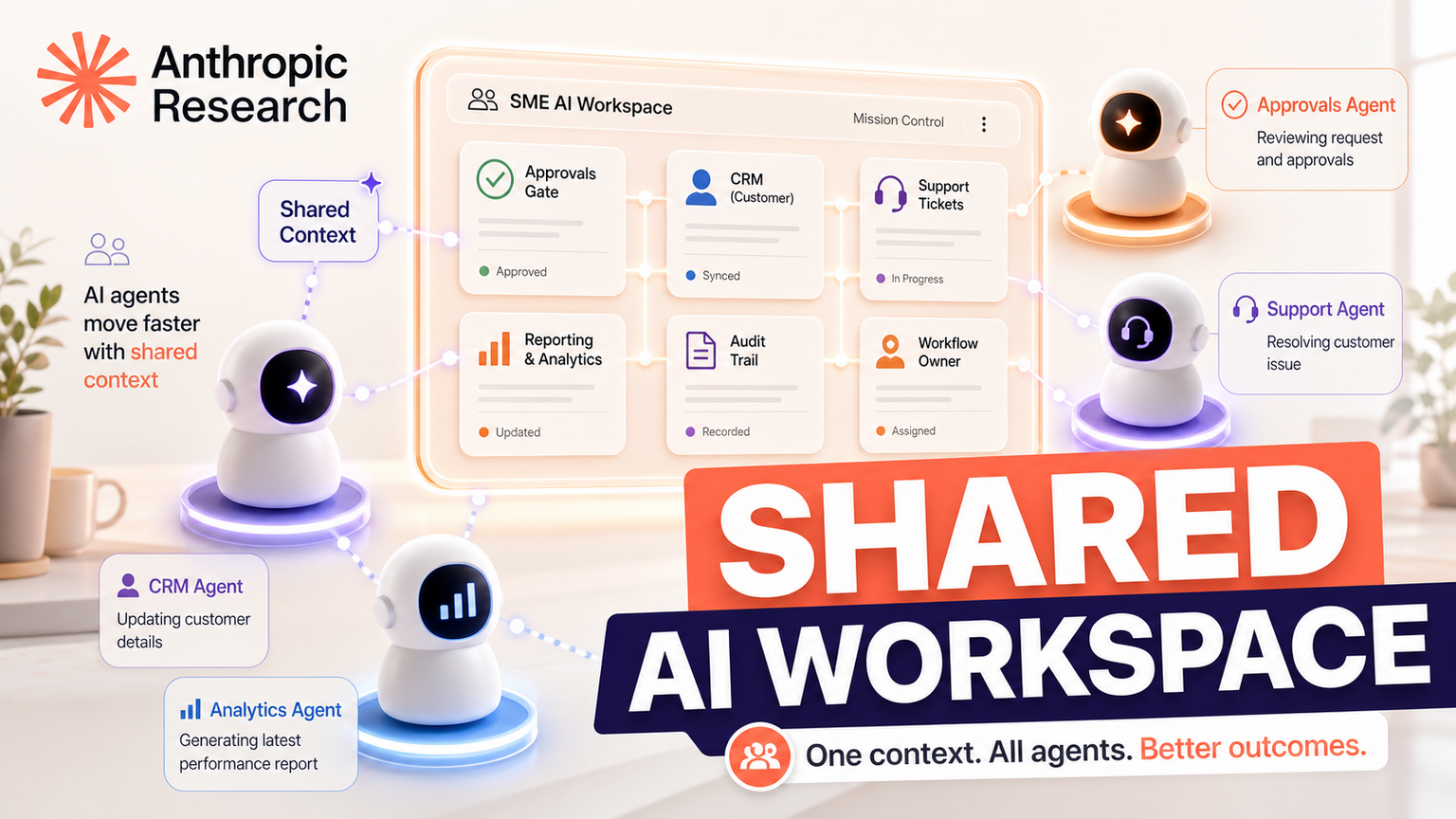
The Anthropic workspace discussion is useful because it gives business leaders a simple question to ask: where is our shared workspace for AI work?
For a support team, that workspace may be the place where an agent sees the customer record, drafts a response, checks refund rules, asks a human for approval, and writes the final outcome back to the helpdesk. For a sales team, it may be the place where lead enrichment, CRM updates, follow-up drafting, and manager review happen in one traceable flow. For finance or operations, it may be the place where documents are classified, exceptions are routed, and reports are reviewed before they reach clients.
UK, US, and European SMEs should care because AI governance is becoming less about one tool choice and more about proof that work was controlled, reviewed, and improved.
Competitor lens
Global SaaS competitors such as Zapier, n8n, Make, Relevance AI, Lindy, Gumloop, Bardeen, and Stack AI make it easier to build task automations and agents. US and European consulting firms such as LeewayHertz, Markovate, Addepto, STX Next, Netguru, and 10Clouds often explain agentic AI, RAG, production AI, and industry use cases. UK firms such as Faculty AI, Deeper Insights, Waracle, and Brainpool AI add enterprise and public-sector AI depth.
That content is useful, but many SMEs still need the layer between a tool and a measurable business outcome. Tools automate tasks. GOFTUS automates the workflow around the task.
The practical difference is ownership. GOFTUS designs the intake, context, approvals, integrations, monitoring, error handling, and monthly improvement loop. A shared AI workspace is not just a dashboard. It is the operating system for how a customer email becomes a resolved ticket, how a lead becomes a followed-up opportunity, or how a document becomes a checked decision.
Summery for SMEs
| Question | Practical answer | GOFTUS workflow move |
| --- | --- | --- |
| What is the signal? | Anthropic's research headline describes a global workspace in language models. | Use it as a metaphor for shared business context around agents. |
| Why does it matter? | Isolated prompts miss customer state, policies, and handoff rules. | Connect CRM, helpdesk, documents, approvals, and reporting. |
| What should SMEs avoid? | Buying another agent tool without deciding who reviews exceptions. | Build approval gates, audit trails, and escalation paths first. |
| What is the outcome? | Faster AI-assisted work with less rework and fewer blind spots. | Monitor agent outputs monthly and improve the workflow. |
FAQ
Does Anthropic's research mean SMEs need Claude specifically?
No. The business lesson is broader than one model. Claude may be one strong option, but SMEs should focus on the workflow architecture around whichever model they use. The shared context, approval trail, and integration design matter more than a single vendor decision.
Can a workflow builder create a shared AI workspace by itself?
A workflow builder can automate steps, but someone still has to define the business rule, exception path, review owner, data source, and measurement loop. That is where implementation discipline matters. SaaS tools are useful, but SMEs need workflow design, integration, human review, monitoring, and monthly improvement.
What should an SME automate first?
Start with one repetitive workflow where context is scattered and the cost of mistakes is visible. Good candidates include support triage, CRM follow-up, quote preparation, document processing, weekly reporting, and internal knowledge requests. Build the shared workspace first, then add more agent actions safely.
GOFTUS helps SMEs turn AI agents into controlled workflow systems. If your team wants AI to handle follow-ups, support triage, documents, reporting, or internal knowledge work without losing human control, book a practical workflow automation review with GOFTUS.
Sources and source notes
Reddit access was partial, with several other subreddit feeds returning 429 rate limits.
X signal: xurl was unavailable in this cron environment, so X was not used.