Anthropic's FCA Sandbox Role Shows Why SMEs Need AI Test Workflows
Anthropic's FCA sandbox role shows why SMEs need AI test workflows with approvals, audit trails, data limits, and measured rollout plans now.
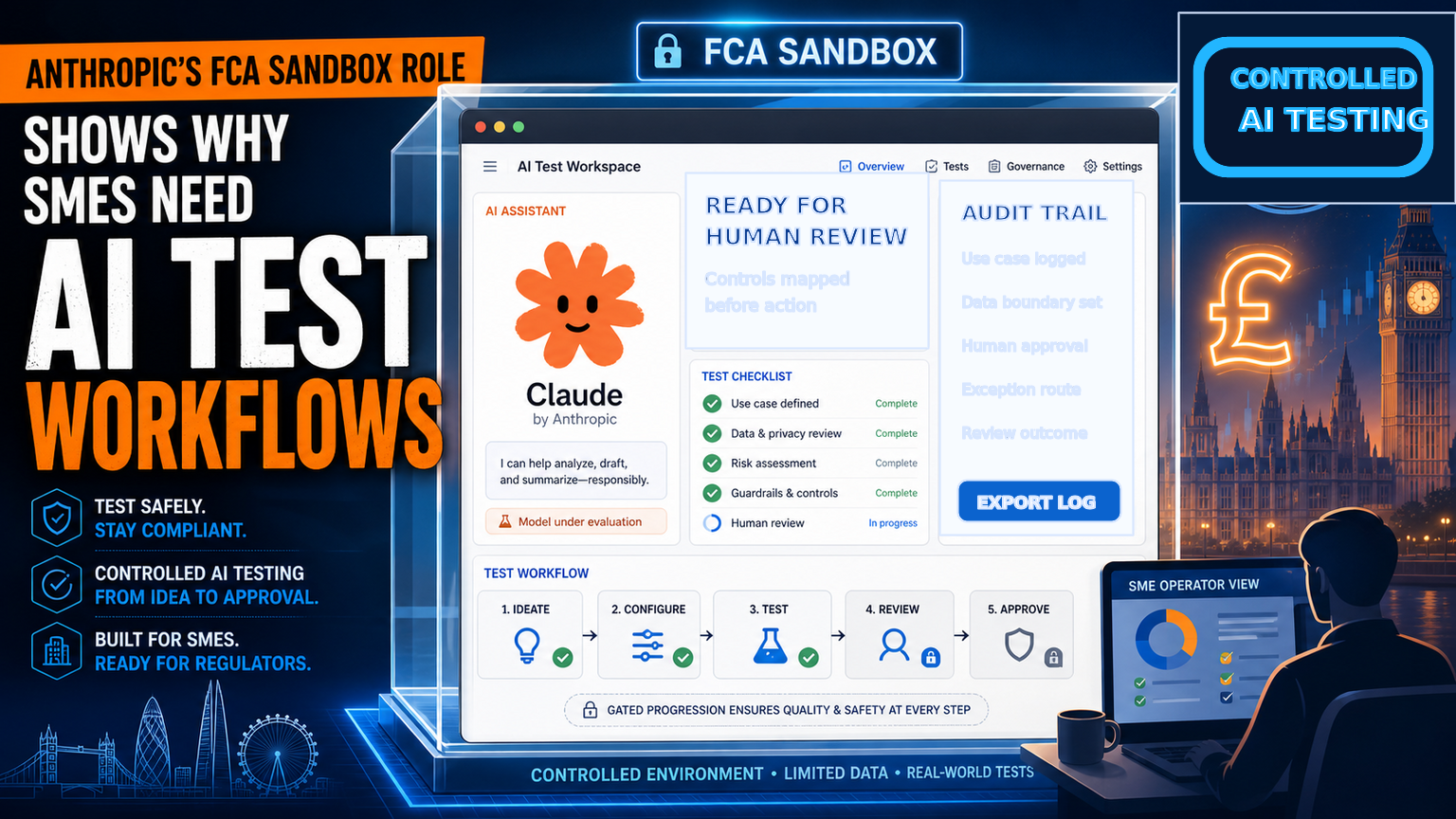
# Anthropic's FCA Sandbox Role Shows Why SMEs Need AI Test Workflows ## Quick answer Anthropic is being reported as a support partner for the UK Financial Conduct Authority's Supercharged Sandbox, where firms can test
Anthropic's FCA Sandbox Role Shows Why SMEs Need AI Test Workflows
Quick answer
Anthropic is being reported as a support partner for the UK Financial Conduct Authority's Supercharged Sandbox, where firms can test AI use cases in a controlled environment. For SMEs, the useful lesson is not that every company needs a regulator-grade sandbox tomorrow. It is that AI rollouts need a test workflow before they touch customers, money, regulated documents, private data, or operational decisions.
The business value comes from a repeatable path: define the use case, limit the data, test with real examples, review edge cases, log decisions, approve the rollout, and keep improving it after launch. That is the difference between experimenting with AI and operating AI safely. GOFTUS builds this kind of practical AI automation around existing tools, CRM systems, support inboxes, documents, reporting, and browser-based work. If you want that operating layer, start with /services or an AI agent diagnostic at /agents.
What this means for SMEs
The Google News feed on 25 July listed Global Government Finance coverage saying Anthropic will support AI testing in the UK financial regulator's Supercharged Sandbox. Other Google News results from Open Banking Expo, Retail Banker International, Finextra, and FF News described the same broad story: Anthropic is connected to the FCA's second sandbox group, with firms exploring AI use cases under supervision. I treated those as headline-level cross-checks rather than scraped full-article verification.
For owners and operators in the UK, US, and EU, the signal is bigger than financial services. AI is moving from chat windows into business processes. It drafts responses, checks documents, updates CRM records, runs reports, uses browser portals, and can soon trigger actions that previously sat with staff. That makes testing a workflow problem, not only a model problem.
A small company does not need a laboratory full of researchers. It needs a simple AI test workflow that answers practical questions. What data can the AI see? What is it allowed to change? Which outputs need human approval? What happens when confidence is low? Where is the audit trail? Who reviews failures every month? Without those answers, a helpful assistant can become a faster way to spread confusion.
Thirumurugan's view
The important move is to stop treating AI adoption as a one-off tool choice. Many SMEs still ask whether they should use ChatGPT, Claude, Copilot, Gemini, n8n, Zapier, Bardeen, Relevance AI, Lindy, Gumloop, Make, or a custom agent. That is the wrong first question. The better question is: what workflow are we prepared to test, approve, monitor, and improve?
For example, a sales team might want AI to classify inbound leads, draft follow-ups, and update a CRM. The test workflow should include sample lead records, tone rules, banned claims, approval points, handoff fields, and a small reporting loop that shows what the AI handled and what staff corrected. A support team might use AI to answer repeated questions, route complex issues, and feed unanswered questions back into /services#faq-automation. A finance or operations team might test document extraction with clear rules for low-confidence fields and manager sign-off.
The companies that benefit from AI first will not be the ones with the longest prompt library. They will be the ones with the clearest operating controls.
What SMEs should do next
Start with one workflow that has enough repetition to matter but enough risk to justify controls. Good candidates include support triage, CRM follow-up, invoice or document checks, sales reporting, onboarding checklists, internal knowledge assistants, and portal updates where a browser with ai controls is needed.
Then write a test brief before connecting tools. Define the goal in one sentence. List the systems involved. Mark the data that should never leave the workflow. Decide what the AI can draft, what it can recommend, and what it can actually change. Add a human review step for customer-facing messages, payments, legal wording, regulated decisions, account updates, and anything that could damage trust.
Next, run real examples through the system. Keep the sample small at first. Capture wrong answers, missing context, messy handoffs, and staff corrections. Turn those findings into better prompts, stronger data boundaries, clearer approval rules, and better reporting. The aim is not a perfect demo. The aim is a workflow that can survive normal business messiness.
GOFTUS usually turns this into a practical operating map: trigger, input, AI step, tool action, approval, exception route, audit log, and monthly review. That map can then be built with n8n, Make, CRM automation, document processing, browser automation, custom agents, or a mix of SaaS and code.
Competitor lens
Faculty AI, Deeper Insights, Waracle, Brainpool AI, LeewayHertz, Markovate, SoluLab, BairesDev, Addepto, STX Next, Netguru, and 10Clouds can all be useful partners for AI delivery, data science, software engineering, or consulting. Tools such as Zapier, n8n, Relevance AI, Lindy, Gumloop, Bardeen, Make, and Stack AI can also automate individual steps quickly.
The missing layer for many SMEs is workflow ownership. Tools automate tasks. GOFTUS automates the workflow around the task. That means we focus on the route from business problem to safe operation: permissions, data boundaries, approval gates, CRM or support handoff, reporting, exception handling, and improvement cycles. A sandbox mindset is not only for banks. It is how a small business avoids turning AI pilots into unmanaged operational risk.
Summery for SMEs
The Anthropic and FCA sandbox signal points to a practical lesson: AI needs a test workflow before it becomes business workflow. SMEs should choose one valuable process, define what AI can see and do, add approvals, log outcomes, and review failures. GOFTUS can help design that operating layer across /services, AI agents at /agents, FAQ automation, document automation, reporting, CRM follow-up, and browser-based work.
FAQ
Is this confirmed direct FCA guidance for my business? No. This post treats it as a business signal about AI testing discipline, not as legal or regulatory advice.
Do SMEs need a formal AI sandbox?
Not always. Most need a smaller test workflow with sample cases, clear data limits, human approvals, logs, and a monthly review cadence.
Where should a company begin?
Pick one repeated workflow with visible business value: support triage, CRM follow-up, document processing, reporting, FAQ automation, or controlled browser automation.
Source notes
Direct article bodies were not scraped in this unattended run, so these are cited as headline-level cross-checks.