Anthropic's Dual-Use AI Off Switch: The SME Workflow Security Lesson
Anthropic's dual-use AI research shows why SMEs need security workflows, approvals, and audit trails around powerful AI tools.
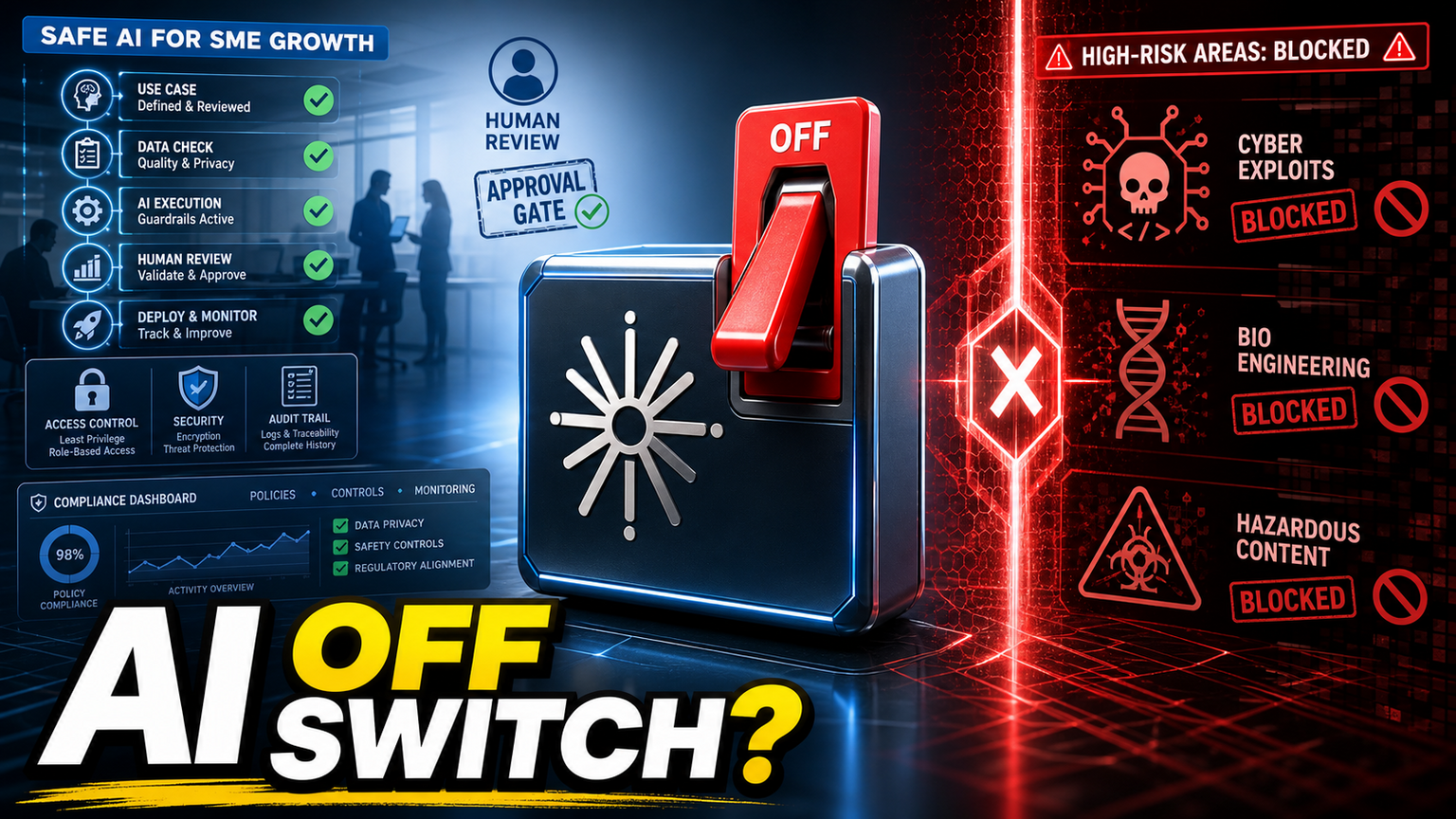
# Quick answer Anthropic published research on an "off switch" approach for dual-use knowledge in AI models. The company describes dual-use knowledge as information that can help legitimate work, such as cybersecurity o
Quick answer
Anthropic published research on an "off switch" approach for dual-use knowledge in AI models. The company describes dual-use knowledge as information that can help legitimate work, such as cybersecurity or virology, but can also support harmful misuse. Its research with AE Studio explores Gradient-Routed Auxiliary Modules, or GRAM, as a way to make certain knowledge removable or controllable without retraining a separate model for every safety setting.
Hajikreena's view: this is not just a model-safety story. It is a workflow-security story. SMEs using AI for cyber triage, document review, support, CRM follow-up, or internal knowledge work need the same principle at the business layer: separate powerful capability from everyday access, decide who can trigger risky actions, log what happened, and review exceptions before automation becomes trusted operations.
What this means for SMEs
Anthropic's research is early-stage model work, not a product switch that SMEs can turn on today. The practical lesson is still immediate. When AI tools become more capable, business owners need controls that decide when the AI can answer, when it should refuse, when a person must approve, and when a case should be escalated.
For a UK, US, or European SME, this matters in ordinary workflows:
a support agent that sees refund, contract, or health data
a CRM assistant that drafts sensitive follow-ups
a finance workflow that reads invoices and flags fraud
a cyber assistant that explains vulnerabilities and remediation steps
a document automation flow that handles legal or compliance evidence
The risk is not only that an AI says something wrong. The risk is that a high-trust workflow quietly gives the wrong person the wrong capability at the wrong time.
A practical SME control layer should include:
role-based access for sensitive prompts and data sources
human approval for high-risk recommendations
separate workflows for internal drafts and customer-facing actions
exception logs that show prompt, source, output, reviewer, and final decision
monitoring for unusual usage, repeated refusals, or risky categories
monthly improvement based on real incidents and overrides
That is how AI becomes safer without slowing every useful task.
Competitor lens
UK competitors such as Faculty AI, Deeper Insights, Waracle, and Brainpool AI often write about AI safety, public-sector AI, decision intelligence, and software quality. US firms such as LeewayHertz, Markovate, SoluLab, and BairesDev publish heavily around AI agents, OpenAI workflows, AI security, and industry use cases. European consultancies such as Addepto, STX Next, Netguru, and 10Clouds focus on production AI, RAG, sovereign cloud, cost, and vertical transformation. Global SaaS platforms including Zapier, n8n, Make, Bardeen, Gumloop, Lindy, Relevance AI, and Stack AI make it easier to connect tasks fast.
Those tools and firms can be useful. The missing layer for many SMEs is operational control after the first automation is built. Tools automate tasks. GOFTUS automates the workflow around the task.
If Anthropic is researching more surgical ways to control model knowledge, SMEs should apply the same idea to business process design. Do not give every AI helper the same data, authority, and action path. Design the workflow so sensitive steps require the right context, owner, approval, monitoring, and monthly improvement.
For Europe and the UK, this also supports auditability and data governance. For US SMEs, it reduces operational risk as AI agents move deeper into customer service, finance, security, and sales processes.
Summery for SMEs
| Area | SME takeaway | GOFTUS workflow response |
|---|---|---|
| Dual-use capability | Useful AI knowledge can also create risk | Separate everyday AI use from sensitive workflows |
| Access control | Not every user should trigger every AI action | Add roles, permissions, and approval gates |
| Cyber and compliance | AI can help review risk but also expose risky guidance | Log prompts, sources, recommendations, and reviewer decisions |
| Automation maturity | Safety is not a one-time setting | Monitor exceptions and improve the workflow each month |
FAQ
Is Anthropic's AI off switch available for SMEs to use now?
No. The Anthropic post describes research, not a plug-in control that SMEs can buy and switch on today. SMEs can still apply the same principle by adding workflow-level controls around AI tools.
Why does dual-use AI knowledge matter for normal businesses?
Many normal business workflows touch sensitive areas such as customer data, contracts, finance, cyber vulnerabilities, HR notes, or compliance evidence. If AI can access and act on that information, the business needs clear controls over who can use it and what happens next.
How can GOFTUS help SMEs use powerful AI safely?
GOFTUS helps SMEs map the workflow, connect the right systems, add human review, build exception logs, monitor risky cases, and improve the automation each month. If you want AI agents that save time without handing over uncontrolled authority, GOFTUS can design the workflow around the task.
Anthropic official research post, "An off switch for dual-use knowledge in AI models", published Jul 8, 2026. This is treated as an adjacent community signal about model trust and controls, not as direct confirmation of the Anthropic research. Other Reddit feeds returned 429 rate limits during this unattended run.
X/Twitter signal was not used because xurl is not installed in this cron environment.