Anthropic and Blackstone Show AI Implementation Is the Real SME Test
Anthropic and Blackstone's Ode signal shows why SMEs need implementation workflows, approvals, logs and handoffs before AI delivers useful business results.
# Anthropic and Blackstone Show AI Implementation Is the Real SME Test Meta description: Anthropic and Blackstone's Ode signal shows why SMEs need implementation workflows, approvals and handoffs before AI delivers resu
Anthropic and Blackstone Show AI Implementation Is the Real SME Test
Meta description: Anthropic and Blackstone's Ode signal shows why SMEs need implementation workflows, approvals and handoffs before AI delivers results.
Quick answer
Anthropic, Blackstone, Hellman & Friedman and Goldman Sachs have been tied to Ode, an enterprise AI implementation company focused on turning frontier models into working business systems. Reddit's r/Anthropic RSS also showed a community post sharing the TechCrunch story, while several other Reddit feeds were rate limited during this run.
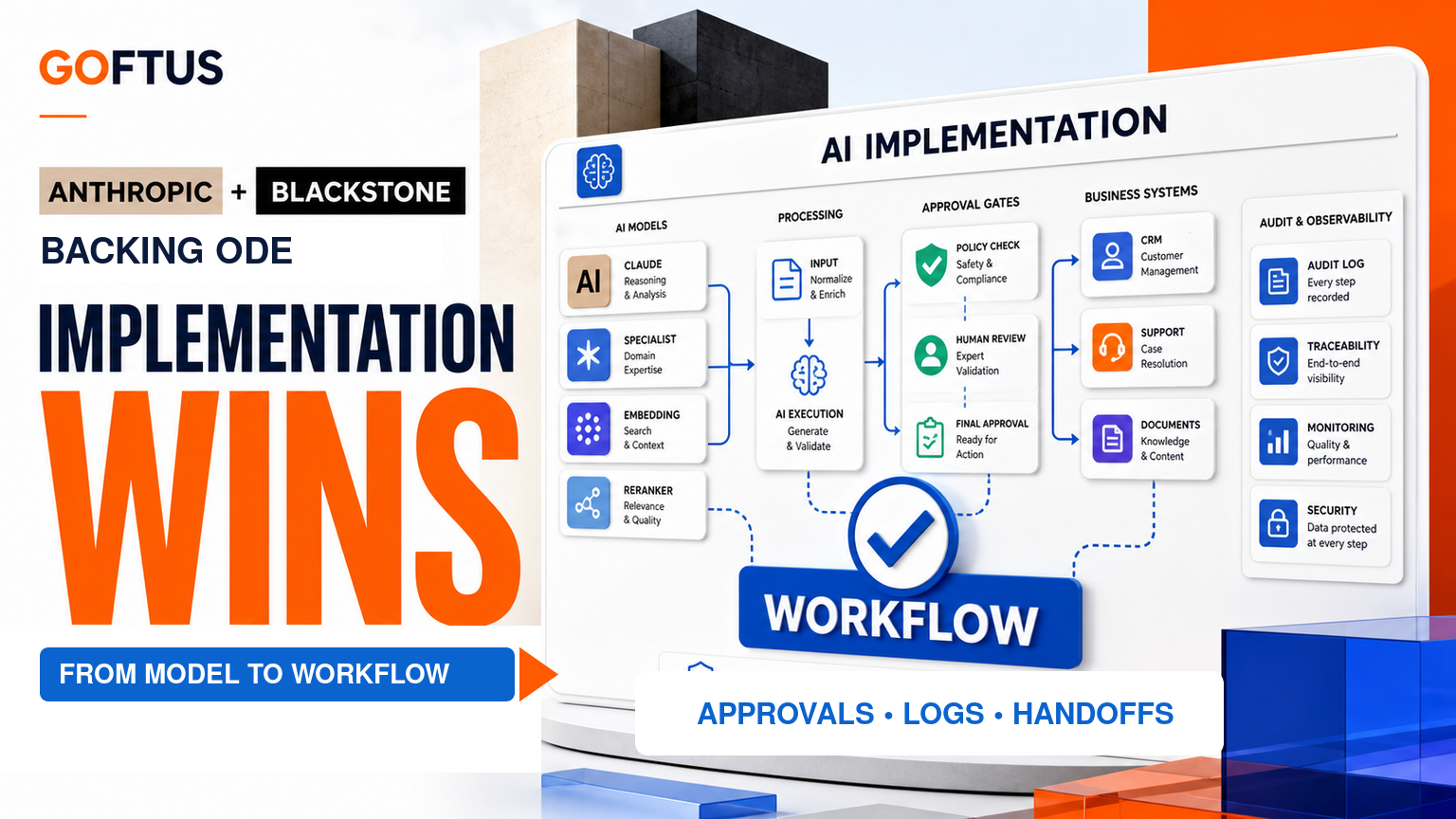
For UK, US and EU SMEs, the signal is simple: the next useful AI wave is not just model access. It is implementation. A better model does not automatically update a CRM, route a support issue, check an exception, prepare a document pack, or prove who approved what. Those results need workflow design.
GOFTUS helps SMEs make that move through practical AI automation services, AI agents, document workflows, CRM follow-up automation, support triage, and controlled browser or portal automation. The model is one part of the system. The workflow around the model is where the business value appears.
What this means for SMEs
The Ode story matters because it shifts attention from model announcements to delivery capability. Large enterprises can hire implementation partners, form internal AI offices, and spend months integrating AI into data estates, compliance checks and operational processes. SMEs do not usually have that luxury. They need a smaller version of the same discipline.
That means starting with one workflow that already costs time or loses revenue. A sales team may be slow to follow up because calls, forms and emails are scattered. A service team may answer the same questions every day but fail to capture unanswered questions. An operations manager may export reports manually because data lives across SaaS tools. A finance or admin team may still copy information from PDFs into spreadsheets and CRMs. In each case, the question is not which model is most impressive. The question is what the business wants to happen from trigger to outcome.
A practical implementation plan defines the inputs, the allowed systems, the human review points and the final handoff. If an AI agent drafts a reply, who approves it? If a browser-based agent fills a supplier portal, when must it stop before clicking submit? If a document workflow extracts data, where does the exception queue live? If a support chatbot cannot answer a question, how is that question measured and turned into better content?
This is why GOFTUS positions AI automation as workflow infrastructure, not a quick prompt library. The useful system connects repeated actions, decisions, records and review loops. It also leaves an audit trail so the business can improve the workflow every month.
Thirumurugan's view
Thirumurugan's view is that the Ode signal should comfort SMEs rather than intimidate them. If the biggest AI companies and investors are saying implementation matters, smaller businesses are right to be cautious about buying disconnected AI tools.
A model subscription can help staff write, search or analyse faster. But without workflow ownership, the output still lands in someone's inbox, spreadsheet or memory. That is why many AI pilots feel exciting for two weeks and then fade. The tool helped with a task, but nobody redesigned the surrounding process.
The better SME approach is narrower. Pick one painful workflow, write down the current steps, remove obvious friction, then add AI only where it reduces waiting, rework or missed handoffs. GOFTUS often starts with customer answers, CRM follow-up, reporting, documents or browser-based admin because these areas have visible triggers and measurable outcomes. Once the workflow is stable, the business can add more agentic steps with approvals and logs.
Competitor lens
The market is crowded for a reason. UK firms such as Faculty AI, Deeper Insights, Waracle and Brainpool AI can help with strategy, data science or bespoke builds. US providers such as LeewayHertz, Markovate, SoluLab and BairesDev often sell larger engineering programmes. European teams such as Addepto, STX Next, Netguru and 10Clouds can bring software delivery capability. SaaS tools such as Zapier, n8n, Relevance AI, Lindy, Gumloop, Bardeen, Make and Stack AI are useful for connecting tasks and prototypes.
GOFTUS does not need to dismiss any of them. The practical distinction is this: Tools automate tasks. GOFTUS automates the workflow around the task.
That means designing the trigger, approval, exception handling, handoff, measurement and improvement loop before chasing a bigger automation map. A Zapier or n8n flow may move data. An AI agent may draft an answer. A browser agent may operate a portal. But the SME still needs ownership rules, stop conditions, review queues, reporting and training. GOFTUS focuses on that operating layer.
What SMEs should do next
First, choose a workflow that already has a clear business owner. Do not start with a vague company-wide AI ambition. Start with a weekly pain: repeated customer questions, slow quote follow-up, manual document processing, inconsistent reporting, or staff using a browser portal because no API exists.
Second, write the workflow as a path. What starts it? What information is needed? Which systems must be touched? What can AI draft or extract? What requires human approval? What happens when confidence is low? What record proves the work was done?
Third, connect the workflow to one measurable outcome. That could be faster first response, fewer missed leads, cleaner CRM records, fewer manual report hours, shorter document turnaround, or fewer unanswered support questions. The metric does not have to be grand. It has to be visible.
Fourth, make the first version safe. Use allowed systems, limited permissions, approval gates, logs and clear stop rules. If the use case involves customer answers, start with FAQ automation so repeated questions become approved answers, leads and escalation signals. If the use case involves agents that act across apps or browsers, start with AI agents and define exactly what the agent may read, draft or click.
Finally, review the system monthly. Good implementation is not a one-time build. It is a rhythm of measuring exceptions, improving prompts or rules, adding integrations and retiring manual steps. That is the difference between an AI demo and an operational asset.
FAQ
Is this confirmed news or a market signal? It is a source-grounded market signal. Direct article access can vary, so GOFTUS is treating the run as headline-level news cross-check plus a Reddit social discussion signal.
Should SMEs wait for an Ode-style partner? No. SMEs can apply the same implementation logic at a smaller scale now: pick one workflow, define controls, connect systems, measure the outcome and improve the loop.
Where should a business start with GOFTUS? Start with a short workflow diagnostic through GOFTUS services or a consultation at contact. The aim is to find the first workflow where automation can produce a visible operational result.
Summery for SMEs
The Anthropic and Blackstone implementation signal shows that AI value is moving from model access to workflow delivery. SMEs should not judge AI by the most impressive demo. They should judge it by whether it answers repeated questions, updates records, routes exceptions, supports staff, and creates a traceable outcome. GOFTUS helps build that practical layer with automation services, AI agents, FAQ automation, document processing, CRM follow-up and reporting workflows.
Some Reddit feeds returned rate limits, so the Reddit signal is labelled as a limited social discussion signal rather than broad sentiment analysis.