AI Tool Cost Control for SMEs: Stop Runaway Usage Before It Hits the Budget
AI tool cost control helps SMEs cap runaway usage, approve expensive actions, audit spend, and keep automation budgets predictable.
# AI Tool Cost Control for SMEs: Stop Runaway Usage Before It Hits the Budget AI tool cost control is becoming an operating problem, not just a software subscription problem. The latest operator research feed flagged a
AI Tool Cost Control for SMEs: Stop Runaway Usage Before It Hits the Budget
AI tool cost control is becoming an operating problem, not just a software subscription problem. The latest operator research feed flagged a high-scoring r/Anthropic discussion where users complained about alleged phantom Claude Pro and Max usage, unexpected charges, weak support paths, and confusion around plan limits. It does not prove a platform-wide Anthropic billing issue. But it does show a real buyer concern: teams are adopting powerful AI tools faster than they are building budget controls around them.
Anthropic's own public plan and usage-limit pages explain that access depends on plan type, demand, usage patterns, and model choice. For UK, US, and European SMEs, the lesson is simple. If AI is now part of coding, support, research, sales, reporting, and operations, someone has to own the spend workflow before the next invoice, limit reset, or blocked project causes panic.
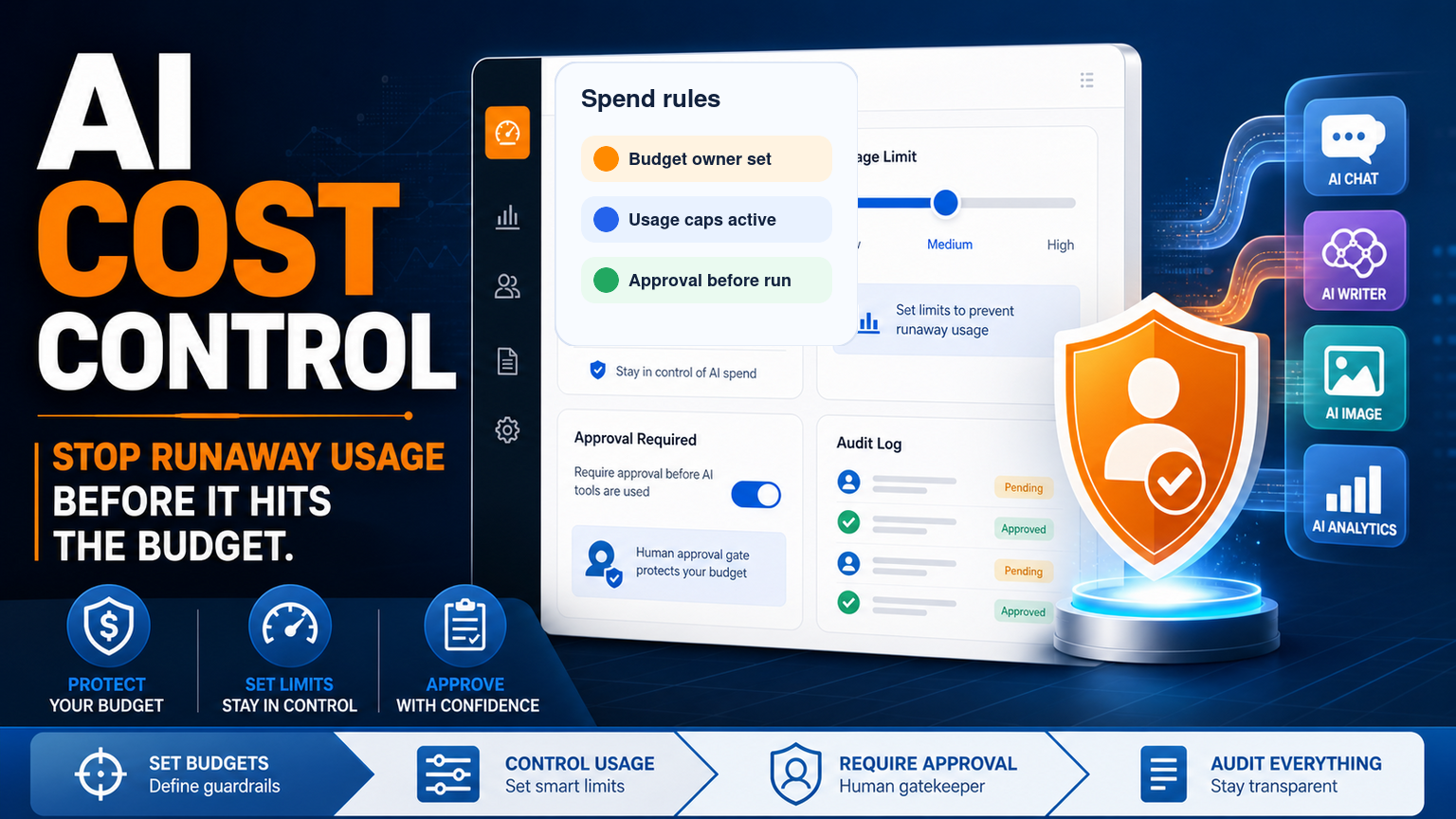
SMEs should treat AI tools like any other operational system with budget owners, usage rules, approval points, fallback routes, and audit logs. A strong AI tool cost control workflow defines who can use paid models, which tasks deserve premium capacity, when a human must approve expensive actions, how exceptions are logged, and when work shifts to another tool or manual queue. GOFTUS can build this as part of practical AI automation through /services, so cost control sits inside the workflow rather than in a spreadsheet no one checks.
What this means for SMEs
Most AI cost problems do not start with one dramatic mistake. They start with small, invisible habits. A developer leaves a coding agent running. A sales team uses high-cost prompts for routine research. A support workflow retries the same long context after every failure. A manager upgrades seats before measuring whether the work saved time. A founder pays for multiple tools because each team wants a different interface.
That pattern is understandable. AI tools are useful, and teams want speed. The risk is that usage becomes scattered across chats, browser agents, coding tools, CRM plugins, document processors, and automation platforms before the business has a shared view of cost, value, and permissions.
AI tool cost control should answer five practical questions. First, what work is valuable enough to use paid AI capacity? Second, which tasks should run on a cheaper model, reusable prompt, or normal automation? Third, who approves high-volume runs, agent loops, data enrichment, or browser-based actions? Fourth, where are logs stored so a manager can review what happened? Fifth, what is the fallback route when a vendor hits limits, changes pricing, or has an outage?
Hajikreena's view is that SMEs should not wait until finance complains about AI spend before creating rules. Cost control is easier when it is designed at the same time as the automation. If a workflow drafts customer replies, enriches leads, summarizes documents, or moves data between tools, the budget control should sit beside the approval control.
For example, a CRM research workflow can use a low-cost model for first-pass enrichment, then require approval before a premium model checks complex accounts. A support triage workflow can answer repeated questions through FAQ automation, then escalate unusual cases to a human instead of retrying an expensive agent loop. A browser automation workflow can pause before form submission, file download, or payment-related actions. These are not anti-AI rules. They make AI reliable enough for everyday operations.
This is where GOFTUS usually starts: map the real workflow, define the human decision points, connect the tools, then measure whether the automation saves time without creating new risk.
What SMEs should do next
Start with an AI spend register. It does not need to be complex. List the tools, teams, owners, monthly purpose, sensitive data touched, and the business outcome each tool supports. If a tool has no owner or no outcome, it needs review.
Next, separate AI use into lanes. Safe low-cost lanes can include summarising internal notes, drafting first versions, rewriting FAQs, and preparing reports. Approval lanes should include outbound customer messages, CRM updates, finance-adjacent work, system changes, browser submissions, and high-volume agent runs. Blocked lanes should include anything that exposes secrets, bypasses login controls, or acts without a recoverable log.
Then add operating controls. Use usage caps where vendors provide them. Add shared prompts and templates for repeated work. Route common questions into FAQ automation before escalating to expensive agents. Keep an audit log for agent actions, approvals, exceptions, and tool changes. Review the workflow monthly, not just the invoice.
If the team is already using n8n, Zapier, Make, Lindy, Relevance AI, Gumloop, Bardeen, or browser agents, do not rip them out. Put a workflow layer around them. GOFTUS can help define that layer through /services and connect it to agents, CRM, support, document processing, and reporting systems.
UK firms such as Faculty AI, Deeper Insights, Waracle, and Brainpool AI can help with AI strategy or implementation. US teams such as LeewayHertz, Markovate, SoluLab, and BairesDev can build custom systems. European firms such as Addepto, STX Next, Netguru, and 10Clouds can support delivery. SaaS tools such as Zapier, n8n, Relevance AI, Lindy, Gumloop, Bardeen, Make, and Stack AI can automate individual tasks quickly.
The gap is ownership of the workflow around the task. Tools automate tasks. GOFTUS automates the workflow around the task. For cost control, that means connecting budget rules, approvals, exception handling, logs, fallback routes, and monthly improvement into one operating pattern. The result is not just lower spend. It is predictable automation that owners can trust.
AI usage debates around Claude and other tools are a warning signal for SMEs. Do not treat AI spend as a loose collection of seats, prompts, and experiments. Treat it as a controlled workflow. Decide who owns usage, which actions require approval, how high-cost runs are capped, where logs are stored, and what happens when a vendor limit or bill surprises the team.
Is the Reddit complaint proof that Anthropic has a billing problem?
No. The useful signal is that operators are worried about unexpected AI usage, plan limits, and support visibility. SMEs should respond by building cost controls around their own AI workflows.
Should SMEs stop using paid AI tools because of usage risk?
No. Paid AI tools can still be valuable. The safer move is to match tool choice to business value, add approval gates for expensive runs, log usage, and review outcomes before expanding seats or agents.
Where should GOFTUS link this workflow?
Start with the GOFTUS AI automation and workflow services page at /services. A short diagnostic can identify which AI costs are useful, which are waste, and which workflows need approval or fallback controls.
Direct full article text was not assumed where only RSS headline/description access was available.
Official context: Anthropic public plan and usage-limit materials describe limits varying by plan, model, demand, and usage patterns.