AI Tool Cost Control for SMEs: Budget Gates Before Staff Switch Models and Agents
AI tool cost control helps SMEs set budget gates, usage logs, approvals, and fallback rules before staff switch models, agents, and browser workflows.
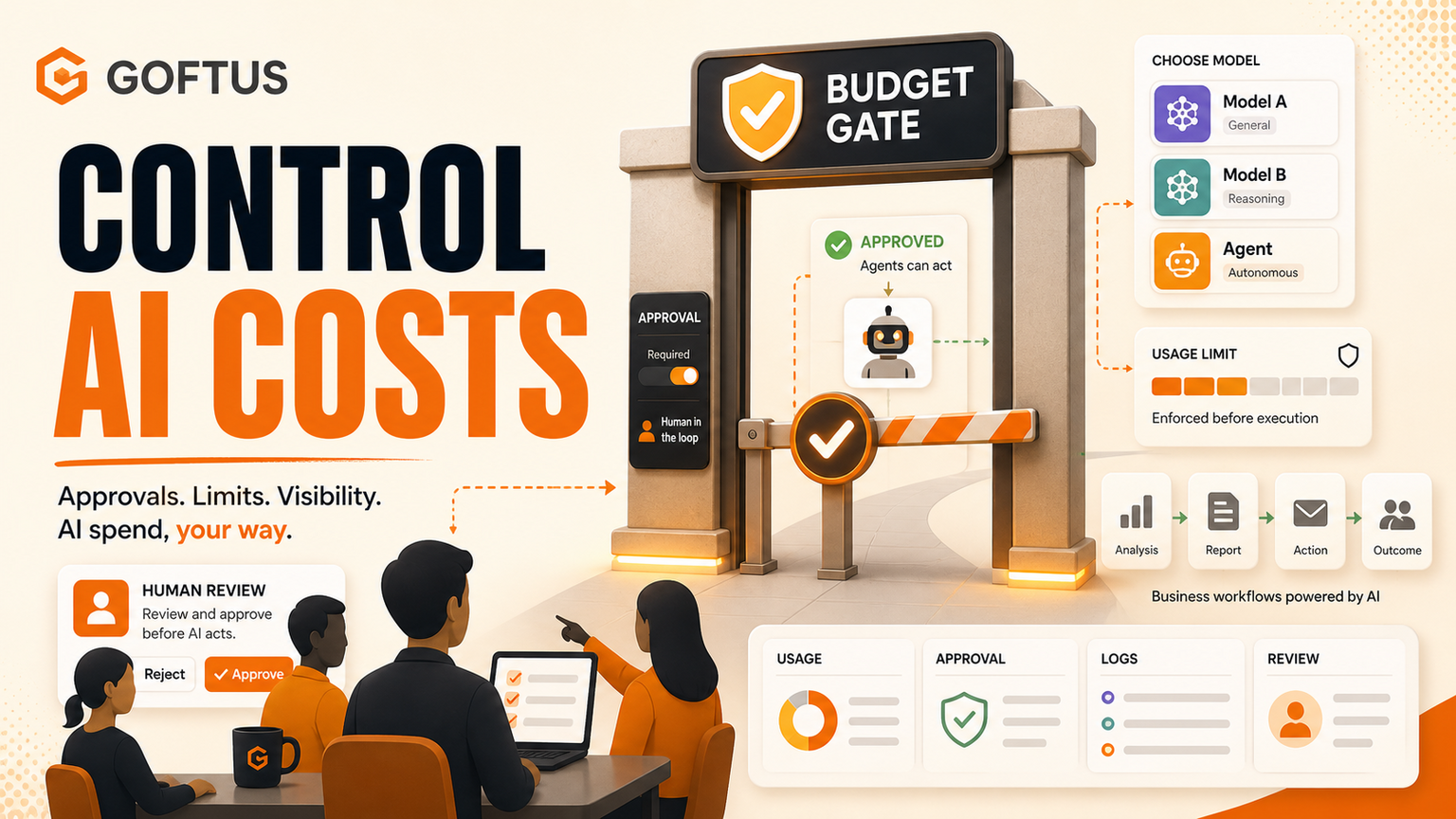
AI tool cost control is becoming a workflow problem, not just a finance problem. When staff can jump between Claude, ChatGPT, Gemini, coding agents, browser agents, n8n flows, Zapier, Make, and custom scripts, a business needs budget gates before action. That means clear owners, approved model lanes, usage logs, fallback rules, and human review for work that touches customers, CRM, support, finance, documents, or live websites. GOFTUS helps SMEs build those controls through practical AI automation services at /services, so teams can use better tools without turning every new model launch into surprise spend and unmanaged risk.
What this means for SMEs
The useful business signal is broader: staff now compare model quality, limits, speed, price, and reliability in real time. If one assistant feels weak, slow, capped, or expensive, people often try another. That behaviour is reasonable, but it creates hidden cost and control problems for SMEs.
A small team may start with one approved AI subscription, then add a coding tool, an image tool, a meeting assistant, a browser agent, a workflow builder, and a few API keys. None of those tools looks expensive alone. The issue appears when they sit outside a shared process. The same customer question can be answered twice. A report may be generated in one tool, rewritten in another, and copied into a CRM with no record of which source was trusted. A browser agent may be allowed to research, then later submit forms, download documents, or update portals without a new approval step.
That is why AI tool cost control should sit inside workflow design. The goal is not to block staff from using useful AI. The goal is to decide which work is safe, which tools are approved, who owns spend, what must be logged, and when a human signs off.
Hajikreena's view is simple: tool choice should follow workflow value. If a model helps a salesperson qualify leads faster, a support lead triage repeated tickets, or an operations manager prepare a weekly report, the business should capture that gain. But the workflow should also show where money is being spent and which outputs are allowed to move downstream.
A practical GOFTUS setup usually starts with four lanes.
Green lane tasks are low risk. They include drafting internal notes, summarising public information, cleaning text, or preparing first-pass ideas. These can use approved tools with light logging.
Amber lane tasks touch business records. They include CRM updates, customer support replies, invoice notes, policy drafts, website forms, and document processing. These need an owner, a review step, and a visible log before anything is sent or saved.
Red lane tasks change money, access, legal wording, customer commitments, production systems, or public posts. These should require explicit human approval and often a second check.
Fallback lane tasks handle outages, usage caps, or cost spikes. If the preferred model is unavailable or over budget, the team knows whether to queue the work, use a cheaper model, use a manual template, or escalate to a manager.
This is where GOFTUS differs from buying another automation tool. We map the actual work first, then connect AI agents, CRM automation, support triage, FAQ automation, reporting automation, browser controls, and document workflows around that map.
Tools such as Zapier, n8n, Relevance AI, Lindy, Gumloop, Bardeen, Make, and Stack AI can be very useful for connecting tasks. Consultants such as Faculty AI, Deeper Insights, Waracle, Brainpool AI, LeewayHertz, Markovate, SoluLab, BairesDev, Addepto, STX Next, Netguru, and 10Clouds can also help organisations build AI capability.
The gap for many SMEs is not whether a connector exists. The gap is who owns the workflow around the connector. Tools automate tasks. GOFTUS automates the workflow around the task.
That matters for AI cost control because spend rarely belongs to one button. It appears across prompts, retries, model switches, API calls, browser runs, failed automations, review time, and cleanup work. A simple monthly bill does not show whether the automation produced a customer outcome, saved staff time, or created extra checking work.
A GOFTUS workflow can include cost tags by process, approval gates before expensive runs, model fallback rules, browser action limits, logs for customer-facing output, and review dashboards for owners. The business sees which automations deserve more budget and which should be simplified, paused, or rebuilt.
What SMEs should do next
Start with one workflow, not the whole AI stack. Pick a process where staff already use AI or want to use it: sales follow-up, support triage, report preparation, document review, FAQ answers, data entry, or browser-based admin.
Write down the current path from request to result. Include the person who receives the request, the systems used, the decision made, the final output, and where mistakes would hurt. Then add the AI layer only where it improves the path.
For each AI step, define five controls:
1. Approved tool or model: which tools are allowed for this step.
2. Budget owner: who can approve more usage or a higher-cost model.
3. Human review: what must be checked before output moves on.
4. Action boundary: what the AI can prepare versus what it can submit, send, delete, buy, or update.
5. Log: what evidence is kept for later review.
This does not need to be heavy. A small business can start with a spreadsheet, a shared checklist, or a simple dashboard. As volume grows, GOFTUS can turn those rules into managed automations, AI agents, n8n flows, browser controls, and reporting dashboards.
AI tool cost control is not about saying no to new models. It is about giving staff safe lanes to use them. The best SMEs will not pick one tool forever. They will build workflows that make model switching, usage limits, approvals, and fallback routes visible.
If your team is already using several AI tools, start by controlling one important workflow. GOFTUS can help map the process, set approval gates, connect systems, and build the automation layer through /services. The result is practical: better output, fewer surprise bills, clearer ownership, and AI that supports the work instead of creating another unmanaged stack.
What is AI tool cost control?
AI tool cost control is the practice of managing AI spend at the workflow level. It covers which tools are approved, who owns usage, when humans review output, how model switches are logged, and which actions require approval. For SMEs, it is more useful than only checking invoices at month end because it connects spend to real business work.
How can SMEs start without slowing staff down?
Start with one workflow and three lanes: safe drafting, reviewed business updates, and restricted high-risk actions. Let staff use AI where it helps, but add review and logging before customer, finance, CRM, support, document, or browser actions. GOFTUS can help build this into practical automation through /services.
Direct article access varies by publisher, so this article uses those listings as context rather than claiming full independent scraping.
X signal: xurl was unavailable in this cron environment, so X was not used for this run.