AI Startup Automation Risk for SMEs: Validate Workflows Before Scaling Tools
AI startup automation risk falls when SMEs validate workflows, approvals, logs, and outcomes before scaling AI tools across the business.
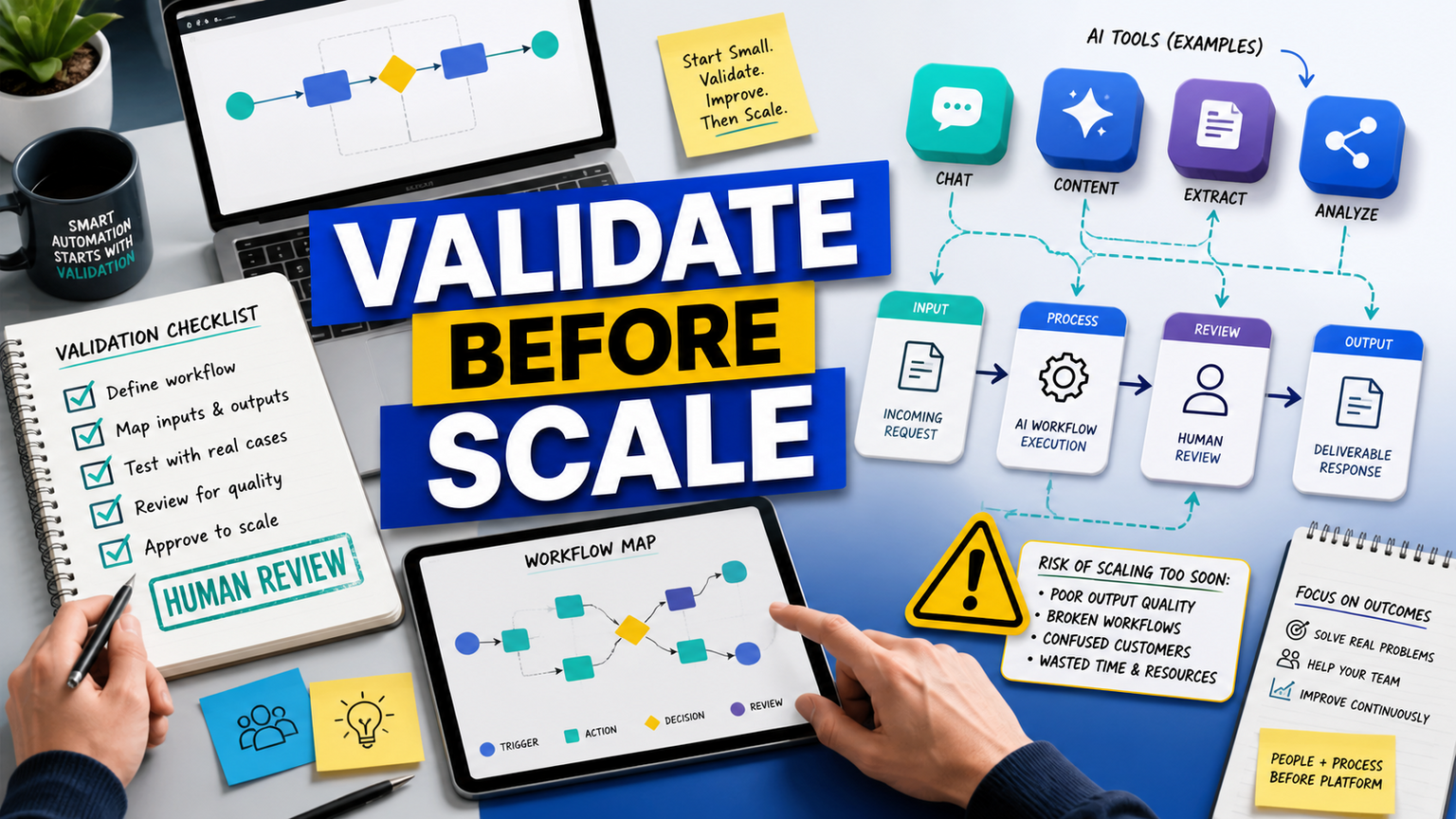
# AI Startup Automation Risk for SMEs: Validate Workflows Before Scaling Tools **Meta description:** AI startup automation risk falls when SMEs validate workflows, approvals, logs, and outcomes before scaling AI tools a
AI Startup Automation Risk for SMEs: Validate Workflows Before Scaling Tools
Meta description: AI startup automation risk falls when SMEs validate workflows, approvals, logs, and outcomes before scaling AI tools across the business.
Quick answer
AI startup automation risk is not just about choosing the wrong tool. It is about scaling an untested workflow before the business knows what should happen, who approves it, where the data goes, and how success is measured. A fresh r/startups discussion with a 100 score in today's GOFTUS intelligence challenged the familiar "9 out of 10 startups fail" claim. The useful lesson for UK, US, and EU SMEs is simpler: growth stories often get repeated faster than operators check the underlying workflow.
Those headlines confirm that founders are being pushed toward more automation, more agents, and more platforms. GOFTUS turns that pressure into a practical control question: what should your team validate before AI touches sales, support, finance, documents, or reporting?
What this means for SMEs
Many SMEs adopt AI tools because a competitor, investor, vendor, or LinkedIn post makes automation feel urgent. That urgency can be useful. It can also create messy systems: a form sends poor data into CRM, an AI assistant drafts replies without review, a support bot hides unanswered questions, or a reporting workflow makes decisions from stale spreadsheets.
The risk is not automation itself. The risk is treating a demo as an operating system. A demo proves that a tool can perform a task once. A workflow proves that the right input arrives, the right approval happens, the right system updates, the right exception is logged, and the right person can intervene when the case is unusual.
That is why GOFTUS recommends starting with one measurable workflow. It should have a clear owner, a known input, a safe action boundary, an approval point, and a recovery path. If it fails those checks, the business learns before customers, staff, or budget are exposed.
Hajikreena's view
The r/startups signal matters because operators are suspicious of repeated claims that sound certain but are hard to verify. AI adoption creates the same problem. A founder hears that every company needs agents, every team needs a chatbot, or every process should be automated. The claim may contain some truth, but the business still needs its own validation loop.
For a small business, that loop should be practical. Write down the manual process, mark repetitive steps, decide what can be automated or drafted for review, and test on real cases before rolling it out.
GOFTUS helps SMEs do this through AI automation services that connect tools, approvals, logs, CRM handoff, support routing, documents, and reporting around one business outcome. The aim is not to buy the biggest AI stack. The aim is to remove friction without losing control.
How to validate before scaling
Start with workflow evidence. Pull ten to twenty recent examples from the process you want to automate. For sales, that might be enquiry forms, emails, call notes, and CRM records. For support, it might be tickets, chat logs, FAQ searches, and follow-up messages. For reporting, it might be spreadsheets, dashboards, and manager comments.
Next, build a small automation around that definition. It can use Zapier, n8n, Make, Bardeen, Gumloop, Lindy, Relevance AI, Stack AI, a custom script, or a GOFTUS-managed agent. The tool matters less than the workflow contract. If the contract is unclear, every platform can make the mess faster.
Review the first results weekly. Scaling should happen after the workflow becomes boring, not while it still feels impressive.
Competitor lens
Consultancies such as Faculty AI, Deeper Insights, Waracle, Brainpool AI, LeewayHertz, Markovate, SoluLab, BairesDev, Addepto, STX Next, Netguru, and 10Clouds can be useful for strategy, builds, and specialist delivery. SaaS tools such as Zapier, n8n, Relevance AI, Lindy, Gumloop, Bardeen, Make, and Stack AI can also move tasks quickly.
The gap for many SMEs is not whether a tool can automate a step. The gap is whether the whole workflow has an owner, a review rule, an exception path, and a measurable business result. Tools automate tasks. GOFTUS automates the workflow around the task.
That counter-positioning matters when founders are under pressure to scale. GOFTUS is not trying to replace useful tools. It designs the operating layer around them: intake, approvals, data movement, human review, monitoring, follow-up, and improvement.
What SMEs should do next
Pick one workflow that is painful enough to matter but narrow enough to validate in days. Avoid starting with a company-wide AI program. Choose a lane such as lead qualification, support triage, FAQ answers, document processing, weekly reporting, or CRM follow-up.
Write a one-page validation brief. Include the business outcome, source systems, allowed AI actions, human approval point, stop rules, logs, and success measure. If the workflow touches web portals or customer accounts, add browser controls and login boundaries before any agent acts.
Then run a small test. If the first version saves time and produces cleaner handoffs, expand it. If it creates confusion, fix the workflow before adding more tools. GOFTUS can help with a practical diagnostic through /services or a consultation for teams that want the £100 Startup Kit style first step.
Summery for SMEs
AI startup automation risk grows when teams scale tools before they validate the workflow. A Reddit startup discussion questioned a famous failure statistic, while current news RSS headlines show founders being encouraged to adopt AI quickly. The safer lesson is to test the process first: define inputs, approvals, logs, stop rules, and outcomes. GOFTUS helps SMEs automate one controlled workflow at a time, then expand when the evidence is clear.
FAQ
Is AI startup automation risk mainly a technology problem?
No. The bigger risk is usually workflow design. A strong AI tool can still create bad outcomes if the business has unclear inputs, no owner, no approval gate, weak data hygiene, or no exception process. SMEs should validate how work moves from request to decision to follow-up before they scale the tool.
Should a startup use Zapier, n8n, or a custom AI agent first?
Use the simplest tool that can prove the workflow safely. Zapier, n8n, Make, or a custom agent can all be useful. The decision should depend on data sources, approval needs, error handling, security, and how often the workflow changes. GOFTUS helps define that before the build.
When should an SME scale an AI workflow?
Scale after the workflow handles real cases consistently, staff trust the handoff, exceptions are visible, and the outcome is measurable. If the workflow still needs manual rescue every day, improve it before adding volume, more integrations, or agent autonomy.
Source notes
There isn't one" at 100. These were used to confirm current market attention, not to invent facts or statistics.
X signal: xurl was unavailable in this cron environment, so no X post was used.