AI Outage Planning for SMEs: Keep Sales, Support, and Reporting Running When Tools Fail
AI outage planning helps SMEs keep sales, support, reporting, and browser workflows moving when copilots or automation tools fail.
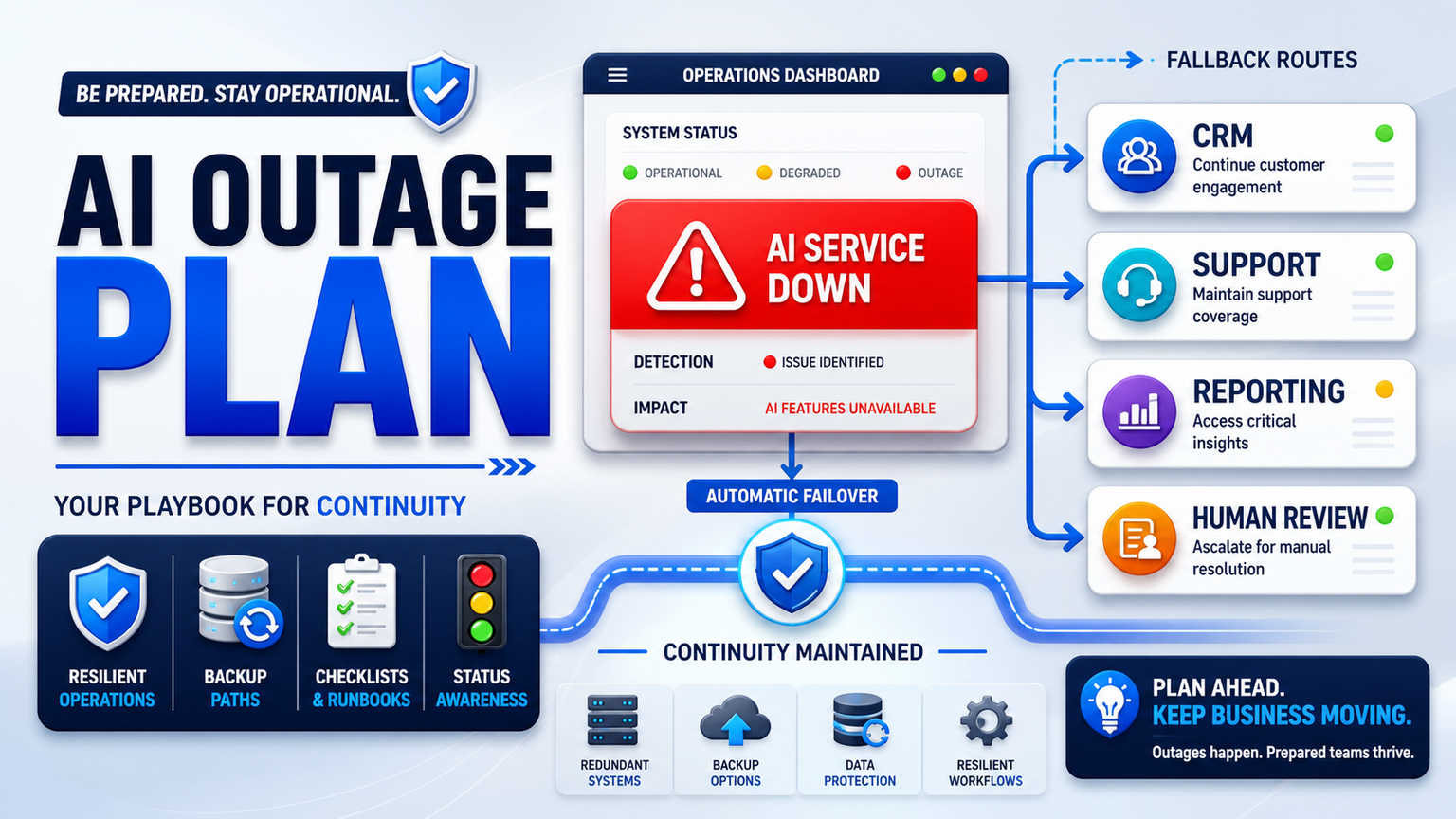
# AI Outage Planning for SMEs: Keep Sales, Support, and Reporting Running When Tools Fail Meta description: AI outage planning helps SMEs keep sales, support, reporting, and browser workflows moving when copilots or aut
AI Outage Planning for SMEs: Keep Sales, Support, and Reporting Running When Tools Fail
Meta description: AI outage planning helps SMEs keep sales, support, reporting, and browser workflows moving when copilots or automation tools fail.
Quick answer
AI outage planning means deciding what your team will do when copilots, AI agents, automation tools, or a key SaaS platform is unavailable. For SMEs, the plan should cover sales follow-up, support triage, reporting, document work, browser-based tasks, and customer communication. The goal is not to avoid AI. The goal is to make sure the business can keep moving with fallback routes, human review, action logs, and clear owners. GOFTUS builds this through practical AI automation services and controlled agent workflows that keep the workflow around the tool resilient.
What this means for SMEs
It still matters because sysadmin frustration is often an early warning for business owners: when a platform changes, slows, removes a feature, or becomes unavailable, the operational impact lands on real teams.
Some direct sources are headline-level signals only, but they support the broader lesson. AI is now wired into search, email, CRM notes, reporting, coding, support replies, and internal knowledge work. If the AI layer fails, the process behind it must still work.
For UK, US, and EU SMEs, this is becoming a practical operations question. What happens when a sales assistant cannot summarize calls? What happens when a support bot cannot answer? What happens when a reporting workflow misses a scheduled run? What happens when a browser agent cannot complete a supplier portal task? The risky answer is "someone will notice." The better answer is a defined fallback workflow.
AI outage planning should start with the business workflow, not the vendor status page. List the customer-facing processes that now depend on AI or automation. Then mark which steps are critical, which can pause, which need manual backup, and which require customer communication. A sales follow-up workflow may need a manual CRM queue. A support triage workflow may need approved fallback replies. A reporting workflow may need a last-known-good dashboard plus a human review note. A browser automation workflow may need approval before any retry, upload, payment, or submission.
Bharatvaj's view
Bharatvaj's view is that AI reliability is no longer only an IT issue. It is a workflow ownership issue. The companies that benefit most from AI are not the ones that assume every tool will be available all the time. They are the ones that design the handoff when tools fail.
That is why GOFTUS treats outage planning as part of automation design. A basic automation can send data from one system to another. A resilient workflow also records what was attempted, where it failed, who owns the next step, and what the customer or manager sees while the issue is open. The workflow should not leave a lead, ticket, invoice, document, or browser session sitting in a silent unknown state.
The same thinking applies to AI agents. If an agent can read a CRM record, draft an email, open a browser, or update a support case, it also needs stop rules. It needs a clear list of actions it can take automatically, actions that need approval, and actions that must never happen without a person. Outage planning and agent security overlap because both ask the same question: what keeps the business safe when the tool cannot be trusted to complete the work normally?
What SMEs should do next
First, create an AI dependency map. Pick the ten workflows where AI or automation now saves the most time. For each workflow, write down the trigger, tools used, data touched, final business outcome, owner, and customer impact if it fails.
Second, define fallback lanes. A fallback lane should be simple enough for staff to use under pressure. Sales follow-up can fall back to a CRM view of uncontacted leads. Support can fall back to approved templates and a triage form. Reporting can fall back to a previous report plus a comment that the automated refresh is pending. Browser tasks can fall back to a human-approved checklist.
Third, add monitoring and logs. Every important automation should leave evidence: success, failure, skipped step, approval request, and handoff owner. Without logs, the team cannot tell whether the problem is a model answer, a SaaS outage, a bad credential, a changed webpage, or a broken integration.
Finally, connect the fix to a practical service path. For broad workflow resilience, start with GOFTUS AI automation services. If the failure involves agents acting in tools or browsers, review the AI agents service so approvals, browser boundaries, and logs are designed before the agent is trusted.
Competitor lens
SaaS tools such as Zapier, n8n, Make, Bardeen, Gumloop, Lindy, Relevance AI, and Stack AI can help teams move data and trigger actions. AI consultancies and software delivery firms such as Faculty AI, Deeper Insights, Waracle, Brainpool AI, LeewayHertz, Markovate, SoluLab, BairesDev, Addepto, STX Next, Netguru, and 10Clouds can also support AI delivery.
The missing layer for many SMEs is not a connector or a model. It is operational ownership. Tools automate tasks. GOFTUS automates the workflow around the task. That means fallback routes, approval points, exception queues, CRM or support updates, and monthly improvement when the workflow fails in the real world.
This is the competitor-aware difference. A tool can say "the run failed." A GOFTUS workflow should show what failed, what is safe to do next, who owns the handoff, and how the business keeps moving.
Summery for SMEs
AI outage planning is not pessimism. It is the normal next step after AI becomes useful. Once a business depends on AI for sales, support, reporting, documents, or browser work, it needs fallback routes that are just as practical as the automation itself.
Start with one workflow. Define the normal AI-assisted path, the failure signals, the human owner, the approval gate, and the manual fallback. Then add logs so the team can learn from every failure instead of relying on memory. GOFTUS can help with this through workflow automation and AI agent design, including the £100 Startup Kit style diagnostic for SMEs that want a small, concrete starting point rather than a broad transformation project.
FAQ
Is AI outage planning only for large companies?
No. SMEs often have fewer people available when an AI tool, automation platform, or SaaS workflow fails. A small fallback plan can protect sales follow-up, support triage, reporting, and browser tasks without adding enterprise complexity.
What is the first workflow to protect?
Protect the workflow closest to customers or cash. For many SMEs, that means new enquiries, support tickets, invoices, bookings, sales follow-up, or scheduled reporting. Start where a silent failure would cause real confusion.
How does this connect to browser with AI controls?
Browser agents are useful but risky because they work inside real websites. If a browser task fails or loops, the business needs approvals, logs, login boundaries, and stop rules before any retry, upload, submit, or payment action.