AI Hallucination Controls for SMEs: Review Gates Before Model Upgrades Change Workflow Quality
AI hallucination controls help SMEs review model upgrades, catch errors, log approvals, and keep CRM, support, and reporting workflows safe.
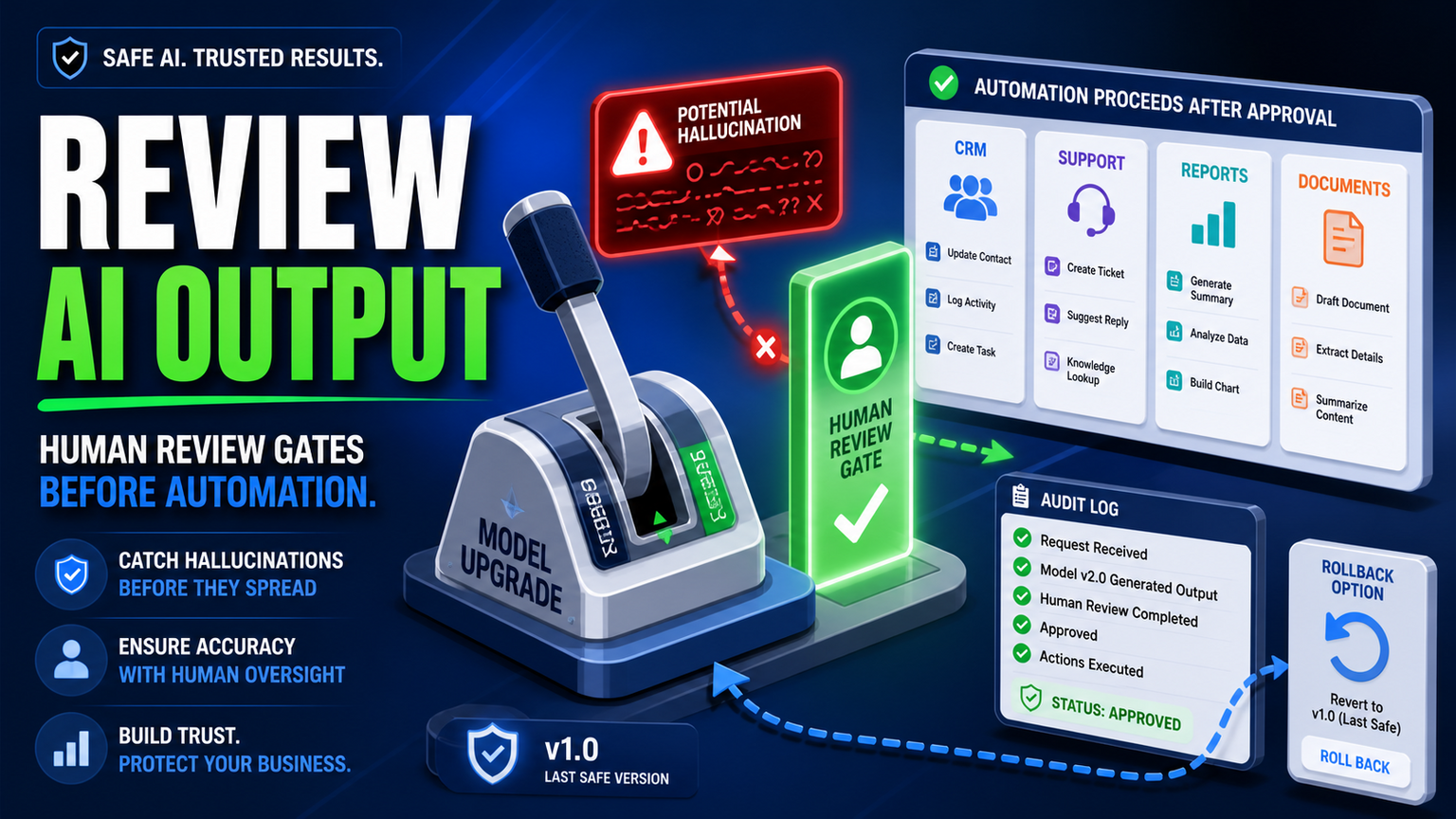
# AI Hallucination Controls for SMEs: Review Gates Before Model Upgrades Change Workflow Quality **Meta description:** AI hallucination controls help SMEs review model upgrades, catch errors, log approvals, and keep CRM
AI Hallucination Controls for SMEs: Review Gates Before Model Upgrades Change Workflow Quality
Meta description: AI hallucination controls help SMEs review model upgrades, catch errors, log approvals, and keep CRM, support, and reporting workflows safe.
AI hallucination controls are the review gates, exception queues, approval steps, logs, and rollback paths that stop a model-quality change from quietly changing how a business works. That does not prove the complaint is true. It does show a real operator worry: when AI becomes part of sales, support, reporting, or document work, businesses need controls around the workflow, not blind trust in the model.
For UK, US, and EU SMEs, the buyer problem is simple. Your team may use Claude, ChatGPT, Gemini, Perplexity, n8n, Zapier, or a custom agent this month, then switch models or settings next month. If the automation writes CRM notes, drafts support replies, extracts invoice data, updates a report, or submits information through a browser, quality drift matters. GOFTUS helps teams design these checkpoints through practical AI automation services at /services and agent workflows at /agents.
What this means for SMEs
The fresh signal is not that one vendor has failed. It is that model upgrades are now operational events. A new model can be cheaper, faster, better at coding, or stronger at reasoning, yet still behave differently inside a specific workflow. A prompt that worked yesterday may produce a longer answer today. A support classifier may become more confident. A reporting assistant may summarize exceptions in a different order. A CRM follow-up agent may sound more polished but miss a key constraint from the customer record.
That is why AI hallucination is no longer only a content problem. It is a workflow-control problem. SMEs should treat important AI outputs like any other business change: define the job, test known examples, approve the change, monitor exceptions, and keep a route back to the last safe process.
Hajikreena's view: the winning SMEs will not be the ones that ban every new model or chase every launch. They will be the ones that let teams experiment quickly while keeping customer-facing and money-moving actions behind review gates. The goal is not to slow everyone down. The goal is to decide which AI actions can be automatic, which need a human check, and which must never happen without explicit approval.
A practical control map starts with four lanes. First, low-risk drafting can be fast. Let AI prepare email outlines, meeting notes, or knowledge-base drafts, but show the source fields it used. Second, medium-risk workflow updates need a reviewer. CRM notes, support replies, and document summaries should queue for a named owner before they affect a customer. Third, high-risk actions need two-step approval. Refund decisions, invoice changes, account updates, and browser submit actions should require confirmation, logging, and stop rules. Fourth, unknown cases should route to a human instead of forcing the model to guess.
This is where GOFTUS differs from a tool-only setup. A SaaS tool may trigger the AI call. A workflow builder may connect the app. But the business still needs the policy around the step: who reviews it, what evidence appears next to the output, how exceptions are logged, and what happens when the model changes.
Faculty AI, Deeper Insights, Waracle, Brainpool AI, LeewayHertz, Markovate, SoluLab, BairesDev, Addepto, STX Next, Netguru, and 10Clouds can all be useful partners for AI projects. Zapier, n8n, Relevance AI, Lindy, Gumloop, Bardeen, Make, and Stack AI can also help teams connect tools quickly. The gap appears after the first working demo.
Tools automate tasks. GOFTUS automates the workflow around the task. That means defining the acceptance rule, reviewer role, exception path, audit record, service handoff, and monthly improvement loop. If a model upgrade changes output quality, the SME should not discover it through angry customers or messy reports. It should appear in a review queue, an error sample, or a workflow dashboard before damage spreads.
The competitor-aware question is not whether to use SaaS, consultants, or internal scripts. Most businesses will use a mix. The question is who owns the control design when the model, prompt, data source, or browser action changes. Without that owner, the business gets scattered automations. With it, the business gets a managed workflow.
What SMEs should do next
Start by listing every AI output that reaches a customer, updates a record, changes a number, or influences a decision. For each one, write the current source of truth, the owner, the review rule, and the fallback route. If you cannot name those four items, the workflow is not ready for unsupervised automation.
Then build a small test pack before switching models or prompts. Include clean examples, messy examples, edge cases, and known failure cases. Run the old and new setup side by side. Do not ask if the new model feels smarter. Ask whether it preserves required fields, flags uncertainty, follows tone rules, respects customer context, and sends risky cases to the right person.
Next, add logs that humans can actually use. A good log should show the input source, the AI output, the reviewer decision, the action taken, and the reason for rejection when something fails. This is more useful than a vague success metric. It helps sales leaders, support managers, and founders see where automation is saving time and where it still needs process work.
Finally, connect the control to the right service path. If the AI drafts support replies or routes questions, start with /services or /services#faq-automation. If the AI agent uses tools, browses portals, or takes action across systems, review /agents. If you are unsure where risk sits, use /contact for a GOFTUS diagnostic or the £100 Startup Kit conversation.
AI hallucination controls are not paperwork. They are the operating system for safe automation. New AI can be useful and still require review gates.
Before a model upgrade touches CRM, support, reporting, documents, finance, or browser-based work, decide which actions are draft-only, which need approval, which require extra evidence, and which must stop. GOFTUS can help turn that map into a practical workflow with approvals, logs, fallback routes, and measurable improvement.
Does every AI output need human approval?
No. Low-risk drafts can move quickly. The control should match the business risk. Customer-visible replies, record updates, financial changes, legal wording, browser submit actions, and management reports need stronger review than internal brainstorming.
How do SMEs know if a model upgrade changed quality?
Keep a small test pack of real examples. Compare required fields, tone, uncertainty handling, citations, exception routing, and reviewer rejections before moving the new model into production.
Where should GOFTUS start?
Start with one workflow where bad AI output would create customer confusion or staff rework. GOFTUS can map the process, add approval gates, connect logs, and improve it through /services or /agents.