AI Hallucination Controls for SMEs: Review Model Reasoning Before It Reaches Customers
AI hallucination controls help SMEs review model reasoning, approve risky outputs, log evidence, and protect CRM, support, documents, and browser workflows.
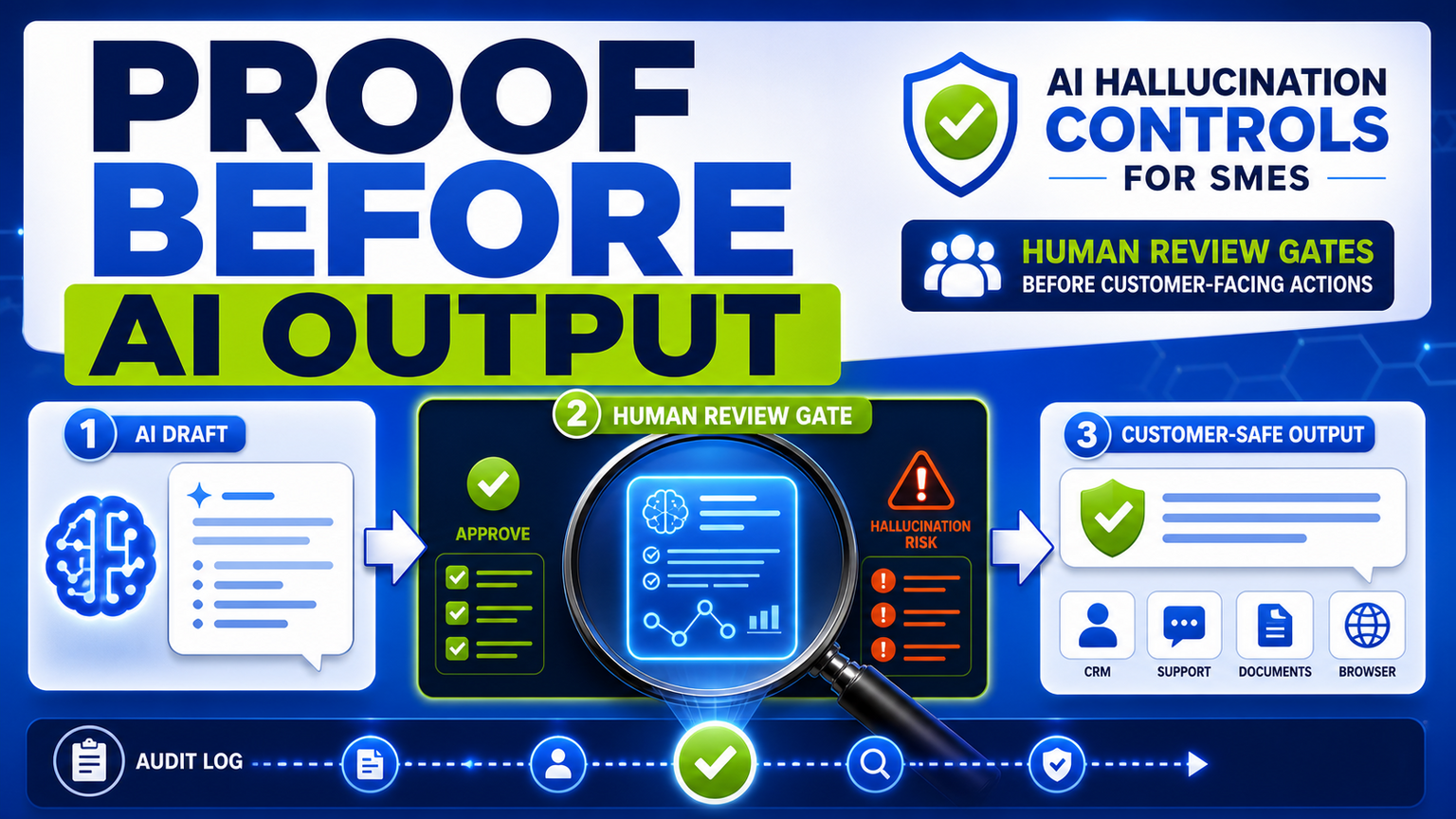
# AI Hallucination Controls for SMEs: Review Model Reasoning Before It Reaches Customers AI hallucination controls are the review gates, proof checks, action logs, and stop rules that stop a confident model answer from
AI Hallucination Controls for SMEs: Review Model Reasoning Before It Reaches Customers
AI hallucination controls are the review gates, proof checks, action logs, and stop rules that stop a confident model answer from becoming a business mistake. The buyer problem is simple: SMEs need AI hallucination controls before model reasoning reaches customers, CRM, support, documents, or browser-based workflows.
For GOFTUS, the point is not to scare teams away from AI. It is to make AI useful in production. A model can draft, summarise, compare, and recommend. A business workflow decides what evidence is required before that output is trusted.
What this means for SMEs
Small and mid sized businesses in the UK, US, and Europe are moving from AI experiments to real work. Staff use models to answer customer questions, write follow-up emails, summarise calls, prepare reports, search documents, and suggest next actions. The risk is no longer only a silly answer in a chat window. The risk is a plausible answer moving into a system of record.
That can happen quietly. A support assistant may draft a refund answer without checking policy. A sales workflow may update CRM with guessed company context. A document assistant may cite an outdated procedure. A browser agent may prepare a form submission from an AI summary that nobody reviewed.
AI hallucination controls turn that risk into an operating process. The workflow asks: what source did the model use, what confidence is acceptable, who approves customer-facing output, what system gets updated, and where is the evidence stored? If the answer affects money, legal commitments, personal data, customer promises, access, or a browser submission, the model should not be the final authority.
Thirumurugan's view
Thirumurugan's view is that businesses should stop treating hallucination as a model-only problem. Better models help, but workflow design decides whether an error becomes expensive. The practical question is not whether Claude, ChatGPT, Gemini, or another model is smarter this month. The question is whether your process has a review lane before AI output becomes action.
A useful first design is the three lane model. Green outputs are low risk and can be automated after basic checks. Amber outputs need human review, such as customer replies, CRM updates, supplier messages, and internal policy answers. Red outputs should not be automated until the business has stronger evidence and ownership, such as legal, finance, HR, regulated advice, or account access changes.
GOFTUS builds this layer around the task. We help SMEs define the source of truth, approval owner, evidence trail, and fallback route. That means staff can use AI faster without pretending every answer deserves the same level of trust.
A practical hallucination-control workflow
Start with one workflow where AI output already touches real work. Good candidates are customer support replies, sales follow-up, internal knowledge answers, report commentary, document processing, or browser-based admin tasks. Map the path from input to output. Then mark each step as observe, prepare, approve, or act.
Observe means AI can read or summarise information. Prepare means it can draft an answer, checklist, CRM note, report explanation, or browser action. Approve means a named person reviews the draft and evidence. Act means automation can update a system, send a message, create a ticket, or submit a browser step after the rule is met.
Next, define proof requirements. A customer answer may need a policy link. A CRM update may need a source URL or call note. A report explanation may need the data table behind it. A document answer may need a document version. A browser action may need an approval record before submission.
This is where GOFTUS services help. We connect AI output to approvals, logs, CRM, support, documents, and controlled agent workflows. If the task requires AI to act in a browser, GOFTUS agents can add login boundaries, human approval, and stop rules rather than letting a generic agent roam through web apps.
SaaS tools and AI platforms are useful. Zapier, n8n, Make, Bardeen, Gumloop, Lindy, Relevance AI, and Stack AI can move data and trigger automations. Consultancies such as Faculty AI, Deeper Insights, Waracle, Brainpool AI, LeewayHertz, Markovate, SoluLab, BairesDev, Addepto, STX Next, Netguru, and 10Clouds can support data, AI, and software projects.
The gap for many SMEs is the workflow around the answer. A tool can produce a draft. A consultant can design a strategy. A model vendor can ship a stronger release. None of that automatically decides who approves an uncertain output, where the proof is stored, how exceptions are reviewed, or when a workflow should stop.
Tools automate tasks. GOFTUS automates the workflow around the task. That means the business gets controls that survive model upgrades, vendor changes, staff turnover, and monthly process improvements.
What SMEs should do next
Pick one AI-assisted output that could embarrass the business if it was wrong. Choose one customer reply, CRM update, report note, document answer, or browser action. Write down the source inputs, proof needed, reviewer, allowed action, and escalation path.
Then test ten real examples. Which ones are safe to automate? Which need review? Which need better source data? Which should be blocked? This gives you a practical hallucination-control policy instead of a vague AI policy document.
GOFTUS can turn that map into a working workflow with approvals, logs, safe automation lanes, and a measurement loop. The £100 Startup Kit diagnostic is a focused way to find the first workflow worth controlling before your team scales AI output across sales, support, reporting, and operations.
AI hallucination controls are not paperwork. They are the guardrails that let SMEs use AI in real work without letting confident guesses reach customers or systems unchecked. Use AI to prepare and explain. Use workflow controls to approve, log, route, and improve. The safest first win is one narrow process with proof requirements, human review for risky outputs, and clear stop rules before CRM, support, document, finance, or browser actions happen.
What are AI hallucination controls for a small business?
They are practical workflow rules that decide when AI output needs proof, review, approval, logs, or a stop rule before it becomes customer-facing work or a system update.
Should SMEs wait for perfect models before using AI automation?
No. SMEs should use AI where it helps, but add review gates around risky outputs. Better models reduce errors, while workflow controls reduce business damage when errors still happen.
Where do browser with AI controls fit into hallucination risk?
Browser controls matter when AI prepares actions inside web apps. GOFTUS can add login boundaries, approval gates, screenshots, logs, and stop rules before an AI-assisted browser submits forms or changes records.
These are treated as social and operator signals, not verified incident evidence. Direct full-article claims were not used where only RSS headlines were accessible.