AI Governance Workflow for SMEs: Review Gates Before AI Updates Change Your Knowledge Base
AI governance workflow helps SMEs review AI-updated documentation, preserve source truth, and approve knowledge-base changes before teams rely on them.
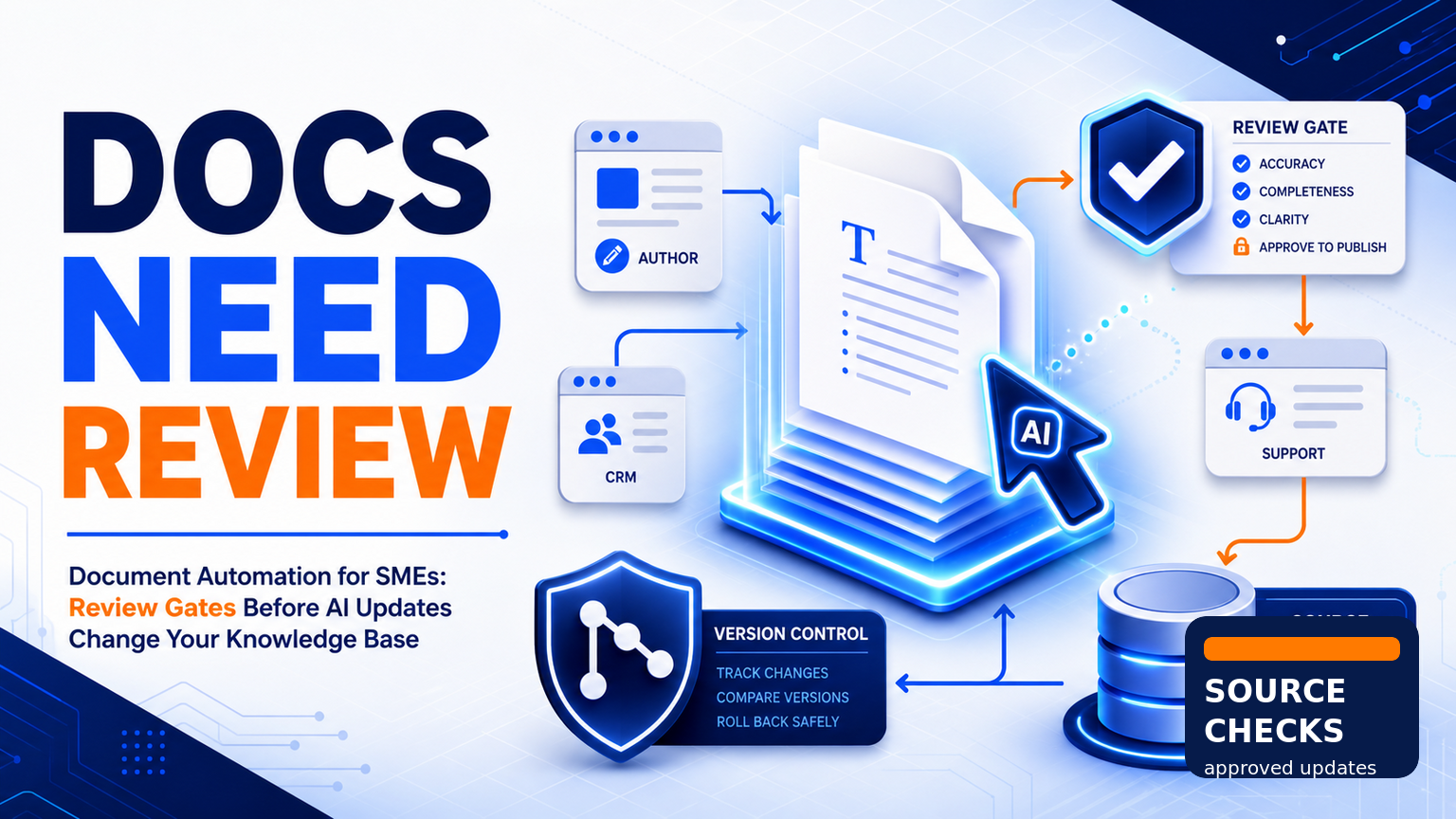
# AI Governance Workflow for SMEs: Review Gates Before AI Updates Change Your Knowledge Base **Meta description:** AI governance workflow helps SMEs review AI-updated documentation, preserve source truth, and approve kn
AI Governance Workflow for SMEs: Review Gates Before AI Updates Change Your Knowledge Base
Meta description: AI governance workflow helps SMEs review AI-updated documentation, preserve source truth, and approve knowledge-base changes before teams rely on them.
An AI governance workflow is the set of review gates, source checks, approval rules, logs, and rollback steps that sit around AI-generated work. For SMEs, it matters most when AI starts changing the documents that staff and customers rely on: help articles, sales notes, onboarding guides, policy pages, SOPs, knowledge-base answers, and support macros.
The buyer lesson is practical: model upgrades can improve output, but they can also change tone, missing context, citations, formatting, or internal instructions. If the knowledge base becomes automated, the workflow around it needs governance.
For UK, US, and EU SMEs, the question is whether your team can turn customer questions, internal notes, and process changes into approved answers without creating a second source of truth. GOFTUS handles this through practical workflow automation on /services: define the source, draft the update, route it to the right human, publish only approved changes, and log what changed.
What this means for SMEs
Many small teams already use AI to tidy notes, rewrite website copy, summarise calls, or produce support answers. That is useful, but it often happens in scattered places: a chat tab, a document editor, a shared drive, a CRM note, or a support desk. The risk appears later. A salesperson may quote an old policy. Support may paste an answer that no longer matches pricing. A new employee may follow a process that was rewritten by AI but never reviewed by the owner.
A good AI governance workflow makes documentation automation boring and dependable. It starts by choosing one source of truth. That might be the current website, a Notion workspace, Google Drive, SharePoint, a help desk, or a CRM knowledge base. Next, the workflow defines which changes AI may draft and which changes require review. Low-risk spelling and formatting edits can move quickly. Pricing, legal wording, refund policy, security language, technical setup, and customer-facing promises should stop for human approval.
This is why the evergreen keyword for this post is AI governance workflow. Governance is not a meeting agenda or a PDF policy. It is the living control layer that decides what AI can draft, what humans must approve, which systems receive the approved answer, and how exceptions are measured over time.
Bharatvaj's view is simple: if AI helps write the answer, the business still owns the answer. A model can draft a clear support article, summarise customer pain, or suggest a better internal checklist. It cannot decide your refund rule, change a regulated process, or promise delivery times without accountability.
The current wave of better models makes this more important, not less. When a model feels fluent, teams are more likely to trust the output quickly. That is where documentation governance earns its keep. The workflow should show who requested the change, what sources were used, what AI changed, who approved it, where it was published, and when it needs review again.
GOFTUS usually recommends starting with one workflow rather than a full knowledge-management rebuild. Pick the repeated question or internal process that causes the most avoidable interruption. Connect the source content. Let AI draft the update. Add a reviewer. Publish the approved answer to the website, help desk, CRM, or internal assistant. Then track unanswered questions and update the workflow monthly.
What SMEs should do next
First, list the documents that staff or customers rely on every week. Include website FAQs, onboarding notes, pricing explanations, support snippets, proposals, call summaries, and delivery checklists. Mark which documents are customer-facing and which ones affect money, compliance, access, or delivery.
Second, choose the first automation lane. A safe starting lane is repeated support and sales questions. AI can cluster similar questions, draft answers from the approved source, and flag missing topics. If your main problem is public questions and lead capture, GOFTUS can connect this to the FAQ automation service at /services#faq-automation. If the problem is wider document governance, start at /services and scope the review gates first.
Third, separate drafting from publishing. AI may draft, compare, summarise, or suggest. A named owner should approve before the answer reaches customers, CRM records, support replies, or browser-based workflows. When AI agents touch websites or admin tools, add browser-level controls through /agents so actions are logged and human-approved.
UK firms such as Faculty AI, Deeper Insights, Waracle, and Brainpool AI can help larger organisations with AI strategy, data science, or specialist implementation. US and European builders such as LeewayHertz, Markovate, SoluLab, BairesDev, Addepto, STX Next, Netguru, and 10Clouds can deliver custom systems. SaaS tools such as Zapier, n8n, Make, Lindy, Gumloop, Bardeen, Relevance AI, and Stack AI can move data and trigger tasks quickly.
Those options can be useful. The gap for SMEs is that documentation work rarely fails because one task was not automated. It fails because nobody owns the full path from question to draft, review, approval, publication, CRM or support update, and improvement loop. Tools automate tasks. GOFTUS automates the workflow around the task.
That is the counter-positioning. GOFTUS designs the practical operating flow, connects the systems, adds human review where risk is real, and keeps improving the workflow as customer questions change.
AI documentation is useful when it is connected to source truth, review gates, approvals, and logs. It is risky when each employee uses a different chat, document, or model output as the answer. If your team wants AI to help with support articles, sales enablement, policies, onboarding, or internal knowledge, start by designing the governance workflow. Decide what AI can draft, who approves, where the approved answer goes, and what gets measured after publishing.
GOFTUS can help SMEs turn this into a practical system through /services, with optional FAQ automation at /services#faq-automation and controlled AI-agent actions through /agents.
Can SMEs use AI to update documentation safely?
Yes, if AI drafts are kept separate from approved answers. The workflow should use known source documents, show changes clearly, route risky updates to a named owner, and publish only after approval. Start with repeated support or sales questions before automating policy, pricing, or regulated content.
How does AI governance workflow differ from a document chatbot?
A chatbot answers questions. An AI governance workflow controls how the answer is created, reviewed, approved, published, and improved. SMEs often need both, but the workflow matters first because it protects the source of truth.
When should GOFTUS review an SME documentation workflow?
Ask GOFTUS when staff are copying AI answers manually, support teams repeat the same replies, CRM notes are inconsistent, or website answers go stale. A focused diagnostic through /contact can identify the first workflow to automate safely.
These are treated as operator sentiment, not verified product claims.