How SMEs Keep AI-Built Workflows Deterministic in Production
AI governance workflow helps SMEs keep AI-built automations predictable with approvals, logs, monitoring, and human review.
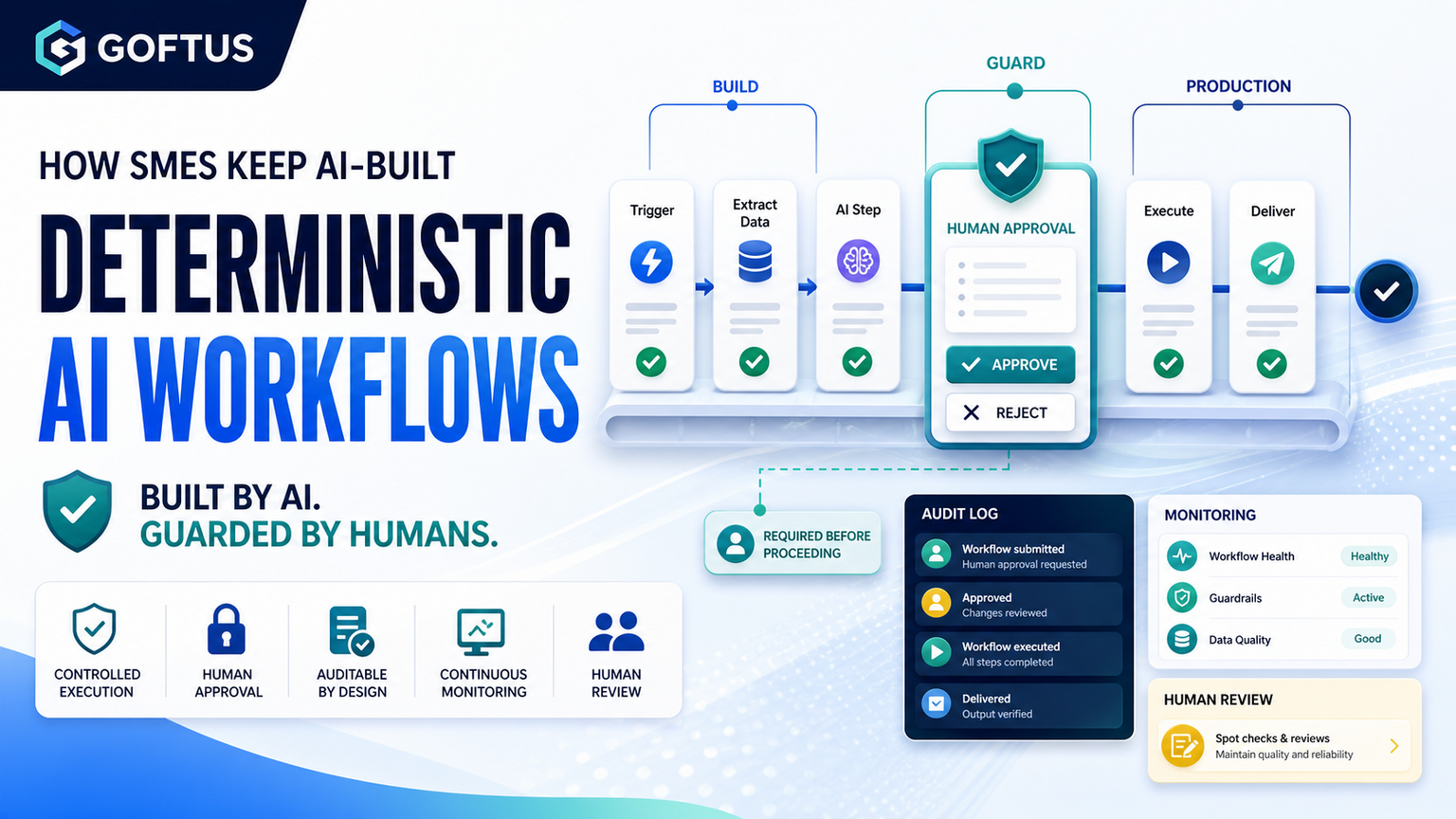
# How SMEs Keep AI-Built Workflows Deterministic in Production Meta description: AI governance workflow helps SMEs keep AI-built automations predictable with approvals, logs, monitoring, and human review. ## Quick answ
How SMEs Keep AI-Built Workflows Deterministic in Production
Meta description: AI governance workflow helps SMEs keep AI-built automations predictable with approvals, logs, monitoring, and human review.
Quick answer
An AI governance workflow is the practical control layer around AI-built automation. It defines what the workflow is allowed to do, who approves risky actions, what gets logged, how failures are escalated, and how the system is improved after real use. For SMEs in the UK, US, and Europe, this matters because teams are starting to build automations with AI, n8n, scripts, browser agents, and SaaS connectors faster than they can govern them. GOFTUS helps businesses turn those useful experiments into controlled AI automation workflows that are predictable in production.
What this means for SMEs
Today's source signal came from operator research: a high-scoring r/Automation item asked how teams keep an AI-built pipeline deterministic in production. The linked Octigen article, "Systematic reporting in under an hour, not months," is a practical example of a workflow being built quickly around repeatable reporting. It still points to a real operator concern: fast automation is easy to demo, but production reliability depends on boring controls.
That is the gap many SMEs now face. A manager can ask AI to draft a script, build a workflow in n8n, connect a CRM, produce a report, or automate a browser task. The first version may work. The second version may work for one team member. The risk appears when it touches live customer records, finance data, support tickets, stock levels, inboxes, or management reports without clear limits.
Deterministic does not mean the AI never helps. It means the business knows which parts are fixed rules, which parts are AI-assisted, which outputs need review, and what happens when confidence is low. In practice, that means the workflow around the AI matters more than the prompt that created the first version.
Why AI-built workflows drift in production
AI-built automations often fail for simple reasons. The source data changes shape. A SaaS button moves. A report column is renamed. A support ticket includes an edge case. A sales rep edits a field in an unexpected way. A model produces a plausible explanation that is not safe to send to a customer. None of those are exotic AI failures. They are normal business exceptions.
The problem is that AI makes teams move faster than their operating rules. A workflow may be created by one person, copied by another, then patched by a third. If there is no owner, version history, approval step, or exception queue, the business cannot tell whether the automation is saving time or quietly creating rework.
A production-ready AI governance workflow should answer five questions before rollout: what job is being automated, what data can it read, what actions can it take, who approves exceptions, and where the evidence is stored. If a team cannot answer those questions, the automation is still a prototype.
Hajikreena's view
Hajikreena's view is that SMEs should not wait for a large governance programme before using AI. The better route is to place small, specific controls around each useful workflow. Start with one reporting, CRM, support, document, or follow-up process that already repeats every week. Keep the automation narrow. Add human approval where the action changes money, customers, compliance, or public communication. Log inputs, outputs, edits, approvals, and failures.
This is where GOFTUS is different from a one-off tool setup. A Zapier, Make, n8n, Lindy, Bardeen, Gumloop, Stack AI, or Relevance AI workflow can move data and trigger tasks. A consultant can help prototype quickly. But the SME still needs owners, review points, exception handling, and monitoring after the workflow goes live. GOFTUS builds the operating layer around the automation, not just the automation step itself.
For example, an AI reporting workflow should not simply generate a management update. It should record which sources were used, highlight missing inputs, ask for approval before sending, keep a copy of the final report, and show what changed from the previous period. A support triage workflow should not only classify tickets. It should route uncertain cases to a human, mark urgent issues, update CRM or helpdesk records, and show managers which questions were not answered well.
What competitors are missing
The market is crowded for a good reason. Faculty AI, Deeper Insights, Waracle, Brainpool AI, LeewayHertz, Markovate, SoluLab, BairesDev, Addepto, STX Next, Netguru, and 10Clouds all serve serious buyers. SaaS tools such as Zapier, n8n, Relevance AI, Lindy, Gumloop, Bardeen, Make, and Stack AI can also be useful for specific tasks.
The missing layer is ownership of the full workflow. Tools automate tasks. GOFTUS automates the workflow around the task. That means discovery, process design, integrations, approval gates, audit logs, exception queues, monitoring, and monthly improvement.
What SMEs should do next
First, choose one important workflow that already repeats every week. Good candidates include reporting, CRM follow-up, support triage, invoice checks, proposal drafting, document extraction, lead routing, and website question capture.
Second, separate fixed rules from AI judgment. Rules should handle routing, deadlines, required fields, permissions, and handoffs. AI can summarize, classify, draft, compare, extract, or suggest. Human review should remain where the workflow affects customers, money, contracts, compliance, or public claims.
Third, create a small evidence trail. Store the input, AI output, human edit, approval status, action taken, and exception reason inside the CRM, helpdesk, spreadsheet, database, or workflow tool the team already uses.
Fourth, review failures every month. The question is whether the workflow caught the issue, routed it, and improved. GOFTUS can help map this through a practical diagnostic, including the £100 Startup Kit where a business needs a small first step before a wider workflow automation service.
Summery for SMEs
AI-built workflows are useful when they are treated as business systems, not clever demos. The fresh r/Automation signal shows operators are already asking how to keep pipelines deterministic after AI helps build them. The answer is a practical AI governance workflow: narrow scope, clear owners, approval gates, logs, monitoring, and exception handling. SMEs do not need to stop using AI. They need to make sure AI works inside a workflow the business can trust.
FAQ
What is an AI governance workflow?
An AI governance workflow is the operating structure around an AI-assisted process. It defines allowed data, allowed actions, review steps, owners, logs, escalation paths, and improvement checks. For SMEs, it turns AI from a one-off prompt or demo into a controlled business workflow.
How can SMEs make AI-built automation deterministic?
SMEs can make AI-built automation more deterministic by keeping rules outside the model, limiting what the AI can change, requiring approval for risky actions, logging every output, and routing exceptions to people. GOFTUS builds this control layer around existing tools and custom workflows.
When should a business ask GOFTUS for help?
A business should ask GOFTUS for help when an AI, n8n, CRM, reporting, support, or document workflow is useful but not yet safe to run without supervision. GOFTUS can map the process, add controls, connect tools, and monitor improvements through practical AI automation services.