AI DLP Agents Show Security Automation Needs Human Workflow Control
AI DLP agents show why SMEs need human approval, audit logs, and workflow control before security automation remediates sensitive business risk.
# AI DLP Agents Show Security Automation Needs Human Workflow Control Meta description: AI DLP agents show why SMEs need human approval, audit logs, and workflow control before security automation remediates sensitive b
AI DLP Agents Show Security Automation Needs Human Workflow Control
Meta description: AI DLP agents show why SMEs need human approval, audit logs, and workflow control before security automation remediates sensitive business risk.
Quick answer
That is a useful cybersecurity signal for SMEs, but it should not be read as a reason to let AI quietly change files, block users, or close incidents on its own. The operational lesson is simpler: AI can speed up detection and triage, while the business still needs human approval, clear ownership, and logs around every sensitive action.
The source pass also found Microsoft's 27 July 2026 Google News headline, Rethinking security for the age of AI, plus Hacker News discussion around AI security testing and agent safeguards. Direct Microsoft article access was blocked during this unattended run, so Microsoft is treated as a headline-level cross-check rather than a fully scraped source. Reddit exact feeds for OpenAI and ChatGPT returned rate limits, while r/Anthropic RSS was available but only offered adjacent model-operations sentiment. This post treats the DLP item as a reputable news signal, not a claim that every AI security agent is production-ready.
For UK, US, and EU SMEs, the important question is not whether AI can classify a risky document. It is whether the company knows what happens after classification. Who reviews the recommendation? Which remediation actions are allowed? Does a ticket get created? Is the data owner notified? Can the workflow pause before a customer, supplier, payroll, finance, or legal document is moved?
What this means for SMEs
Many smaller businesses now store sensitive data across inboxes, drives, CRMs, spreadsheets, support desks, finance tools, and browser portals. Traditional security tools can flag problems, but teams often struggle with the work after the alert: checking context, deciding severity, notifying the right owner, creating the support or IT ticket, and confirming that the fix did not break a live process.
AI DLP agents are attractive because they promise to reduce that manual queue. They can read document context, group similar incidents, recommend the next step, and draft a remediation plan. Used carefully, that can help a business respond faster to accidental data exposure, policy drift, and messy file-sharing habits.
The risk appears when a tool jumps from recommendation to action without workflow design. A false positive might block an urgent contract. A poor rule might interrupt payroll. A browser automation might update the wrong portal record. A remediation step might hide evidence that compliance or management needs to review. Even when the AI is technically correct, the business still needs a process that preserves accountability.
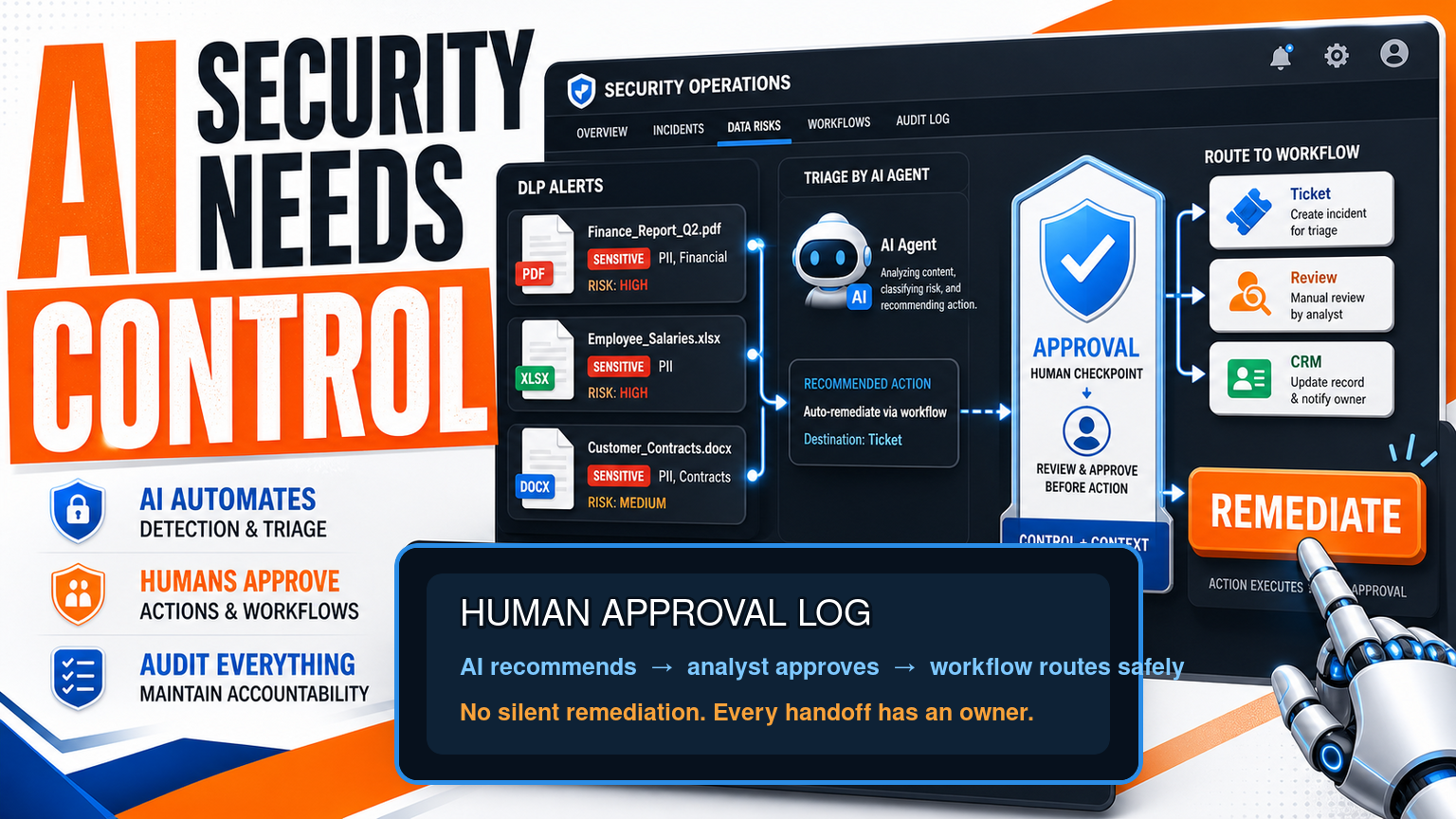
GOFTUS would design this as a controlled workflow, not a loose security bot. The AI can classify the issue and propose an action. A named human can approve or reject sensitive steps. The system can create tickets, update CRM or support records, send document-owner notifications, and preserve a plain audit trail. If a case is high risk, uncertain, customer-facing, or financially sensitive, it should route to a review queue instead of executing silently.
Bharatvaj's view
Bharatvaj's view is that security automation should be judged by how safely it hands work across the business. AI that finds risk is useful. AI that explains the risk in language the operations team understands is more useful. AI that connects the finding to a ticket, owner, approval, deadline, and evidence log is where the real business value appears.
SMEs do not need a giant security transformation programme to start. They need to choose one repeatable security workflow and define the control points. A good first candidate is document exposure: which folders, mailboxes, customer files, supplier contracts, or finance documents should be checked? What does the AI read? What is allowed to be auto-labelled? What needs approval? Which actions are forbidden without a manager or data owner?
This is also where AI security links naturally to broader automation. The same pattern works for support triage, CRM follow-up, browser-based portal actions, document processing, and reporting. Start with the action boundary. Then add automation around it.
Competitor lens
SaaS tools and AI builders are useful. Zapier, n8n, Relevance AI, Lindy, Gumloop, Bardeen, Make, and Stack AI can connect alerts to tickets, messages, documents, dashboards, and follow-up tasks. Consultancies such as Faculty AI, Deeper Insights, Waracle, Brainpool AI, LeewayHertz, Markovate, SoluLab, BairesDev, Addepto, STX Next, Netguru, and 10Clouds can support larger AI and security programmes.
The gap for many SMEs is the workflow around the tool. A connector can send an alert. A model can summarise a risky document. A security platform can recommend remediation. But somebody still has to define permissions, approvals, exception handling, evidence retention, owner notifications, and handoff into existing work.
Tools automate tasks. GOFTUS automates the workflow around the task. That means designing the route from signal to decision to action, then making sure the business can monitor it, improve it, and stop it when needed.
What SMEs should do next
First, list the security tasks that already create delays: document review, access requests, sensitive-file alerts, vendor questionnaires, incident summaries, inbox triage, or browser portal updates. Choose one task where delays matter but full autonomy would be risky.
Second, define the safe action boundary. The AI may be allowed to classify, summarise, draft, tag, or create a ticket. It may need approval before deleting, moving, submitting, notifying customers, or changing permissions. For browser-based security or compliance work, connect this to human-approved browser actions and login boundaries through /agents and /services.
Third, build the audit trail before scaling. Every AI recommendation should show the source, confidence context, human decision, owner, timestamp in the system of record, and next task. The goal is not to make staff watch the AI all day. The goal is to make exceptions visible.
If your team wants a practical diagnostic, GOFTUS can map one security or operations workflow, identify the AI-safe steps, and design the approval route before automation goes live. Start with /services or use /contact to ask for a workflow review.
Summery for SMEs
AI DLP agents are a strong signal that cybersecurity work is moving from alerts to action. SMEs should welcome the speed, but not skip workflow control. The safe pattern is AI triage, human approval for sensitive remediation, clear ownership, and an audit trail that connects security findings to the tools staff already use.
FAQ
Should SMEs let AI remediate security incidents automatically?
Not by default. Let AI classify, summarise, recommend, and prepare the next step first. Require approval for actions that affect customers, payroll, contracts, legal documents, system access, or live browser submissions.
Where should GOFTUS fit in this type of project?
GOFTUS can help design the workflow around the AI signal: approvals, CRM or ticket handoff, browser-action boundaries, reporting, and monitoring. The service starts with practical process mapping at /services.
Source notes
Reddit OpenAI and ChatGPT feeds returned 429 rate limits; r/Anthropic RSS was available but only adjacent to model-operations sentiment.