AI Compliance for SMEs: Review Gates Before AI-Generated Content Leaves the Business
AI compliance for SMEs needs review gates, source checks, and audit logs before staff publish AI-generated content across sales and support.
# AI Compliance for SMEs: Review Gates Before AI-Generated Content Leaves the Business # Quick answer AI compliance for SMEs is no longer only about banning risky tools or adding a policy nobody reads. The operator les
AI Compliance for SMEs: Review Gates Before AI-Generated Content Leaves the Business
Quick answer
AI compliance for SMEs is no longer only about banning risky tools or adding a policy nobody reads. The operator lesson is still clear: staff-generated AI content now needs a workflow before it leaves the business.
For UK, US, and EU SMEs, the practical question is not whether every AI sentence can be detected. It is who reviews AI output, which sources are allowed, where approvals are logged, and when content is blocked from being sent to customers, partners, candidates, regulators, or the public. GOFTUS helps teams turn that into a controlled process through /services, not a loose chat habit.
What this means for SMEs
Watermarking debates make one hidden problem visible. Many businesses already have AI content moving through sales emails, support replies, proposals, blogs, job ads, internal policies, training notes, and customer FAQs. The risk is rarely that a model wrote a paragraph. The risk is that the business cannot show who checked it, what source it used, whether claims were approved, and whether the final message matched brand, legal, and customer expectations.
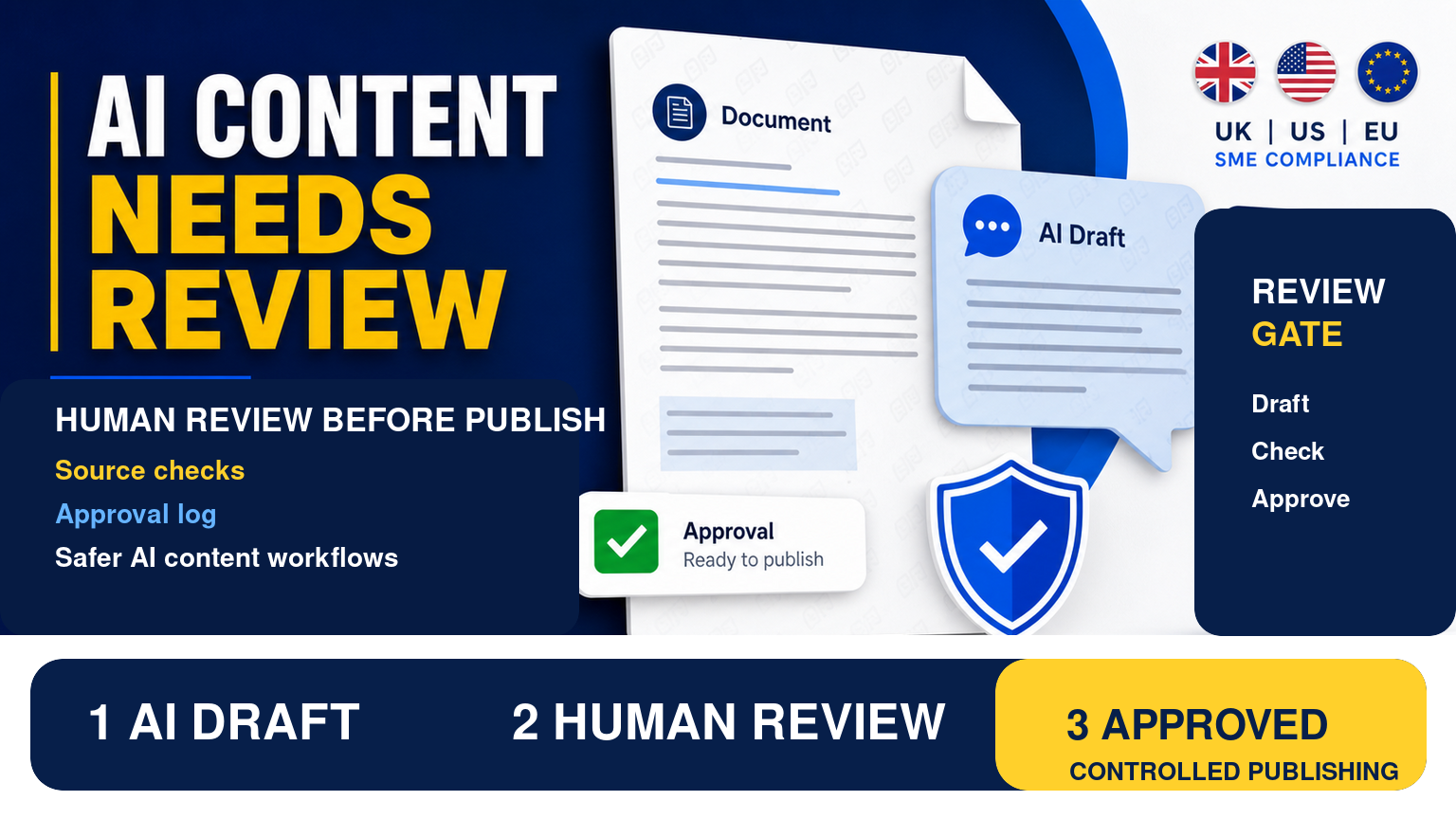
AI compliance for SMEs should therefore start with simple review gates. Before AI-generated content leaves the business, the workflow should ask four questions. Is the content based on an approved source? Does it include claims, prices, guarantees, compliance wording, or technical promises that need review? Is the destination low risk or customer facing? Who owns the final approval?
That review does not need to slow every task. Low risk drafts can move quickly. Higher risk content can pause with a short checklist, source links, and a named approver. The point is to make AI useful while keeping the business in control.
Where review gates belong
Start with customer-facing workflows. Sales follow-up, proposal summaries, support replies, onboarding messages, and FAQ answers should not rely on a staff member copying text from a chat window and hoping it is right. A better workflow lets AI prepare a draft, shows the source evidence, flags risky wording, and routes the message for approval before sending.
Marketing and website content need a similar lane. AI can help draft posts, landing-page copy, service descriptions, and campaign emails. But if the draft makes performance claims, mentions legal or security standards, compares competitors, or describes a product capability, it should enter a review queue. That queue should keep the prompt context, source material, editor, approver, and final version.
Internal documents also matter. Teams often use AI to summarise policies, training notes, contracts, and handover documents. If those summaries become the source for later work, mistakes can multiply. GOFTUS usually designs document automation with source-of-truth links, version checks, approval history, and rollback options so teams know what changed and why.
Browser-based work adds another layer. If AI content is pasted into portals, forms, CRMs, support tools, or supplier systems, the workflow should include browser with ai controls: login boundaries, preview before submit, stop rules, and visible action logs. That is where GOFTUS /agents can extend the compliance process from content review into controlled action.
What SMEs should do next
First, list the places where staff already use AI to create or edit content. Do not start with a long policy document. Start with real workflows: sales email, support answer, FAQ update, quote description, hiring message, internal policy, management report, or website copy.
Second, mark each workflow as green, amber, or red. Green content is internal, low risk, and easy to correct. Amber content reaches customers or affects records, so it needs review. Red content includes pricing, legal, regulated, security, finance, medical, employment, or high-value customer claims, so it needs stricter approval and logging.
Third, build the review gate where the work already happens. If the team uses a CRM, helpdesk, shared docs, inboxes, n8n, Zapier, Make, or browser tools, the control should sit inside that process. A separate compliance spreadsheet will be ignored when people are busy.
Fourth, measure unanswered questions and rejected drafts. Those signals show where the business needs better approved content, better FAQ automation, or clearer staff guidance. GOFTUS can connect that insight to /services#faq-automation when repeated customer questions are part of the content problem.
Competitor lens
Faculty AI, Deeper Insights, Waracle, Brainpool AI, LeewayHertz, Markovate, SoluLab, BairesDev, Addepto, STX Next, Netguru, and 10Clouds can all help with AI delivery. SaaS tools such as Zapier, n8n, Relevance AI, Lindy, Gumloop, Bardeen, Make, and Stack AI can automate useful content and handoff steps.
The gap for SMEs is ownership around the output. A tool can generate a reply. A consultant can build a model. But the business still needs approved sources, review roles, action logs, exception routes, and monthly improvement. Tools automate tasks. GOFTUS automates the workflow around the task.
That is why GOFTUS frames AI compliance as an operating system for work, not as a one-off policy. The workflow covers intake, source check, draft, risk flag, approval, publishing, logging, and improvement.
Summary for SMEs
AI watermarking news and Reddit backlash are useful signals because they remind operators that AI content has become part of normal business work. SMEs do not need panic. They need a controlled review workflow.
Start with the content that touches customers, money, regulated claims, support promises, or public pages. Let AI draft and summarise, but require source checks, review gates, and logs before the content leaves the business. If you want a practical map, GOFTUS can start with a £100 Startup Kit style diagnostic through /contact, then turn the chosen workflow into a repeatable service build through /services.
FAQ
What is AI compliance for SMEs?
AI compliance for SMEs means giving staff clear rules, approved sources, review gates, and logs for AI-assisted work so useful automation does not create hidden customer, legal, brand, or operational risk.
Does every AI-generated draft need approval?
No. Internal low-risk drafts can move quickly. Approval should focus on content that reaches customers, changes records, makes claims, affects money, or gets published outside the business.
How can GOFTUS help with AI compliance workflows?
GOFTUS maps one real workflow, identifies risk points, adds review gates, connects the right tools, and creates logs so AI content becomes a controlled business process.
Where should SMEs start?
Start with one repeated customer-facing workflow, such as sales follow-up, support replies, website FAQ answers, proposal drafting, or document updates that staff already create with AI.
Source notes
This is treated as social discussion and operator sentiment, not verified technical proof. Direct article access can vary, so the post uses these as headline-level corroboration for the AI compliance workflow lesson.