How to Turn AI Automation Traffic Into Booked Workflow Diagnostics
Most AI automation pages do not need more traffic first. They need a conversion path that turns interest into one clear workflow diagnostic.
# Quick answer AI automation traffic turns into booked workflow diagnostics when the page stops trying to sell every possible AI use case and asks for one specific business problem. The visitor should understand what GO
Quick answer
AI automation traffic turns into booked workflow diagnostics when the page stops trying to sell every possible AI use case and asks for one specific business problem. The visitor should understand what GOFTUS does, what kind of workflow is a good fit, what happens in the diagnostic, and what they get even before a larger build is discussed.
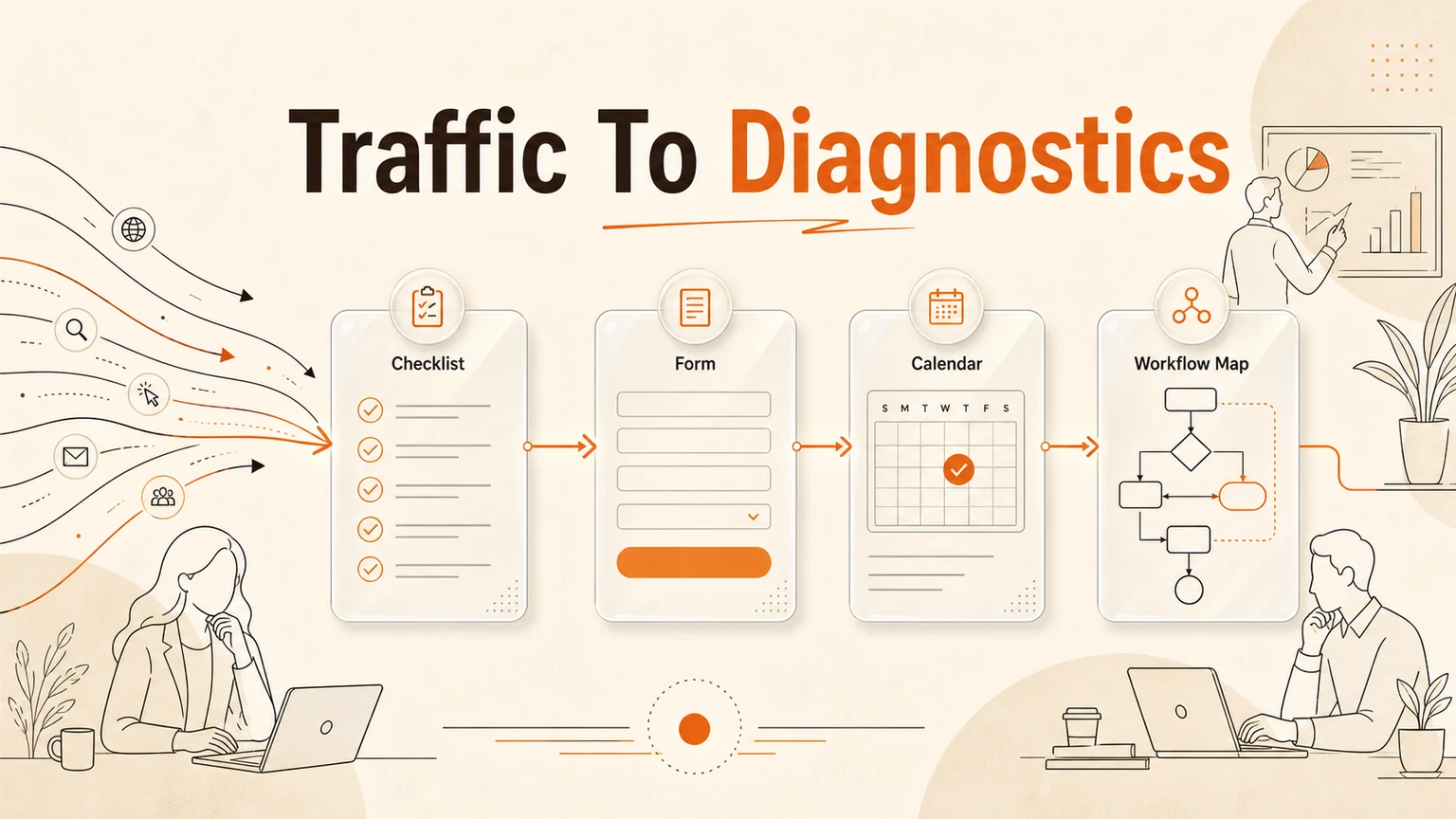
For a small or mid-sized business, the best conversion path is usually simple: one useful page, one practical checklist or diagnostic promise, one short form, and one calendar route. The goal is not to make AI sound bigger. The goal is to make the next step safer, clearer, and easier to say yes to.
Why AI automation traffic often fails to convert
Many AI automation pages attract curious visitors but lose serious buyers. They talk about agents, tools, integrations, models, dashboards, and productivity at the same time. A founder or operations lead may agree that AI can help, but still leave because the page never answers the operational question: where should we start?
Traffic without diagnosis creates three problems.
First, the visitor has to translate broad AI claims into their own workflow. That is hard when they are busy, non-technical, or already cautious about automation.
Second, the offer feels too open-ended. If the page says GOFTUS can automate sales, support, operations, documents, marketing, reporting, and agents, the buyer may not know which conversation to book.
Third, the form asks for a demo before the buyer knows what will be reviewed. A better path is to invite them to bring one workflow that is eating time and show how it will be mapped.
The better conversion path
A high-converting AI automation page should lead to a workflow diagnostic, not a vague demo. That diagnostic can be positioned as a low-friction first step with a clear output.
The page should answer five questions:
1. What workflow should the visitor bring?
2. What will GOFTUS check during the diagnostic?
3. What risks or approval gates will be considered?
4. What does the buyer receive after the session?
5. What happens if the workflow is not a good automation fit?
This turns the page from a brochure into a decision tool.
A practical diagnostic promise could be: bring one repeated workflow and GOFTUS will map the current process, the automation opportunity, the approval points, the data or tool connections, and the smallest useful pilot.
Where lead magnets fit
A lead magnet should not be a generic ebook. For AI automation, the best lead magnets are working documents that prepare the buyer for a diagnostic:
an AI agent governance checklist
a workflow automation readiness checklist
an approval workflow map
an ROI worksheet
a browser-agent safety checklist
a CRM or support automation intake sheet
These resources work because they help the buyer name the problem before speaking to GOFTUS. They also filter better leads. A person who completes a workflow checklist is more likely to book with a real operational need.
A simple page structure
A GOFTUS page built for this conversion path should use a structure like this:
Hero
State the result: map your first AI automation before you commit.
Problem section
Describe the cost of unmanaged manual work: slow follow-up, repeated questions, scattered approvals, unclear ownership, and poor visibility.
Diagnostic section
Show the diagnostic output: workflow map, automation candidate, approval gates, data and tool connections, risk points, and pilot recommendation.
Proof of fit
List the workflows GOFTUS is best suited for: support, CRM follow-up, document routing, sales handoff, reporting, browser tasks, and operational admin.
Resource CTA
Offer a checklist for visitors who are not ready to book.
Booking CTA
Ask for one workflow and route to /contact.
What to avoid
Do not make the page sound like an AI transformation manifesto. Serious buyers are not only asking whether AI is powerful. They are asking whether the workflow will be safe, owned, measurable, and worth the change.
Avoid vague claims such as “automate your business with AI.” Use operational language instead: reduce repeated manual steps, route requests, draft replies, prepare records, log actions, and approve risky changes.
GOFTUS recommendation
For GOFTUS, the strongest path is to make the Startup Kit diagnostic the main conversion bridge between traffic and sales. The blog, resources, Q&A page, and service pages should all point to the same action: bring one workflow and get it mapped.
That is how AI automation traffic becomes a booked conversation instead of another anonymous page view.
Next step
Use the AI governance checklist at /resources/ai-agent-governance-checklist, then book a diagnostic at /contact when you have one workflow ready to review.