AI Automation Landing Pages Need Workflow Proof Before Buyers Book a Call
SMEs buying AI automation need landing pages that prove the workflow, owner, approval gate, handoff, and business outcome before a sales call.
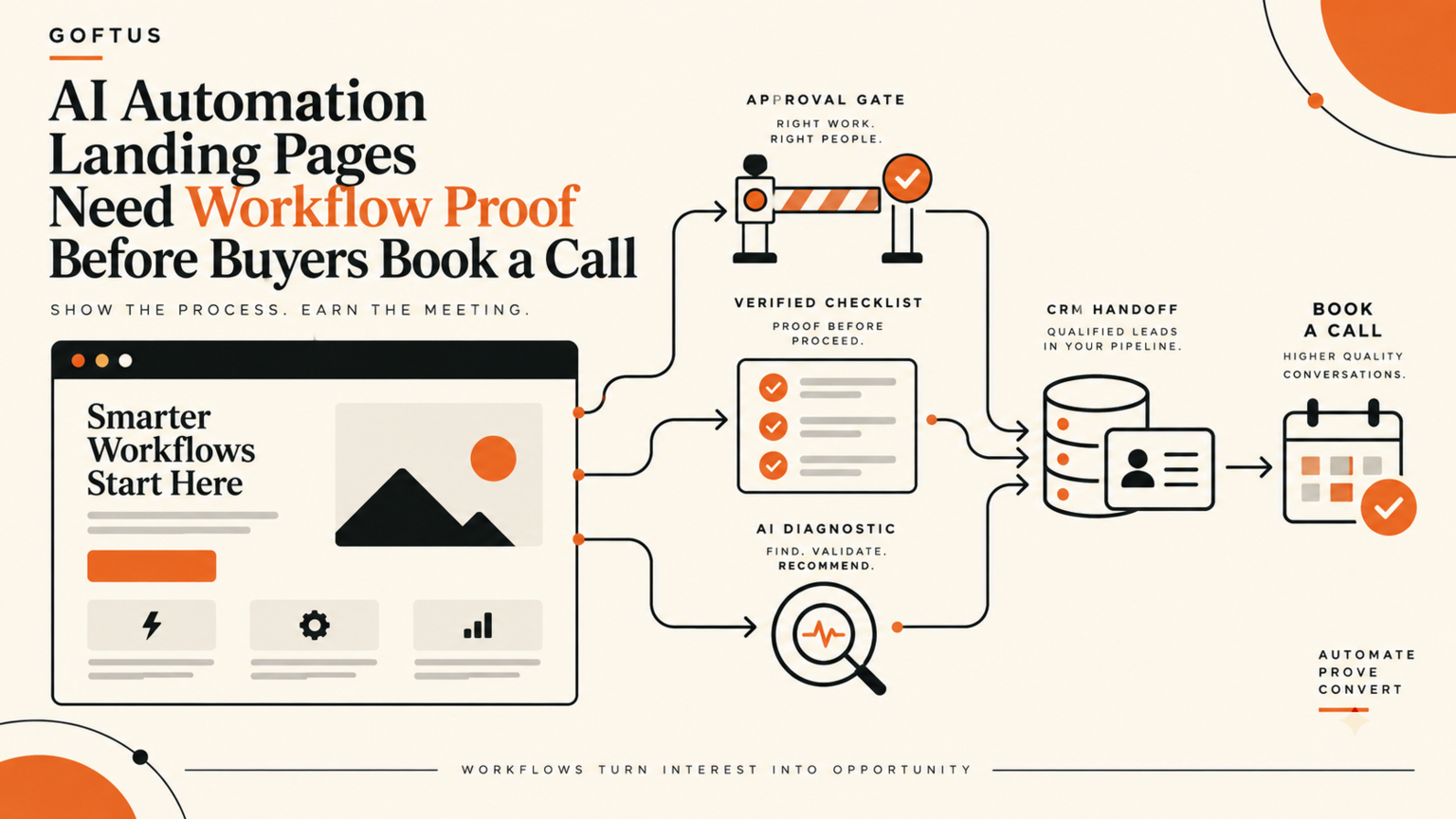
## Quick answer An AI automation landing page converts better when it proves the workflow, the human owner, the approval gate, the system handoff, and the measurable business outcome before asking a buyer to book a call
Quick answer
An AI automation landing page converts better when it proves the workflow, the human owner, the approval gate, the system handoff, and the measurable business outcome before asking a buyer to book a call.
AI automation buyers are not short of promises. They have seen pages that say an agent can save time, answer customers, write reports, update CRM, generate content, or automate operations. The problem is that most of those pages still leave the serious buyer with one question: what exactly happens after the demo?
For an SME founder, operator, sales leader, or marketing leader, that gap is expensive. A weak page can attract curiosity but fail to create trust. A strong page does more than describe AI. It shows the business workflow, the control points, the people involved, and the next step.
GOFTUS treats this as a conversion and operations problem. If a landing page sells automation without workflow proof, the sales conversation starts with doubt. If the page shows the workflow clearly, the buyer can picture where AI fits, what stays human-approved, and why a diagnostic is worth booking.
Why AI automation pages lose serious buyers
Many AI automation pages are written like tool brochures. They lead with model names, broad capability lists, or generic claims about productivity. That may work for a casual reader, but it does not answer the questions that hold back a business buyer.
The buyer wants to know which workflow changes first. They want to know whether customer data is exposed, who approves the output, what happens when the agent is unsure, how the result reaches CRM or support, and what evidence will prove the system is working.
This is where landing page CRO for AI automation is different from normal software CRO. A normal software page can often sell a feature. An AI workflow page has to sell trust in a sequence. The sequence matters because the buyer is not only buying output. They are buying reduced operational risk.
A page that says "we build AI agents" is easy to ignore. A page that says "we map one support, sales, document, or reporting workflow, add review gates, connect the handoff, and measure the result" gives the buyer something concrete to evaluate.
The five proof points every page should show
The first proof point is the workflow. Name the before and after state. For example: inbound website questions are currently answered manually, copied into a spreadsheet, and forgotten after the first reply. The improved workflow captures the question, classifies it, drafts an answer, flags risky cases for review, and creates a follow-up task in CRM.
The second proof point is ownership. Buyers need to see who owns the workflow after launch. That might be a sales manager, support lead, founder, or operations owner. AI should not become an orphaned tool that everyone uses and nobody improves.
The third proof point is the approval gate. Show where the human reviews, edits, rejects, or approves the output. For some workflows, AI can prepare and route information. For higher-risk actions, a person approves before anything is sent, submitted, changed, or escalated.
The fourth proof point is the handoff. A good page explains where the result lands: CRM, helpdesk, inbox, reporting dashboard, document folder, or browser-based portal. Buyers trust automation more when the handoff is visible.
The fifth proof point is measurement. The page should state what gets tracked, such as response time, missed follow-ups, manual admin hours, approval volume, error rate, lead quality, or revenue influenced. Without measurement, the page sells excitement instead of a business case.
What this means for SMEs
For SMEs, the page has to reduce uncertainty before the call. It should show that AI will be fitted into one real process, not dropped into the business as another vague platform. The strongest message is simple: GOFTUS helps choose the first workflow, design the control points, and connect the result to the systems the team already uses.
A practical landing page structure for SMEs
Start with a headline that names the business outcome, not the technology. "Turn repeated customer questions into qualified follow-up" is more useful than "AI-powered support automation platform".
Next, show a three-step workflow: diagnose the current process, build the controlled AI workflow, then monitor and improve it.
Then show examples by department. Sales pages can describe CRM notes and follow-up tasks. Support pages can describe triage and escalation. Marketing pages can describe content review and campaign handoff.
After that, handle the main objections in plain English. Say how data is handled, where people approve work, what happens when the system is unsure, how errors are logged, and how the workflow can be paused.
Finally, make the CTA specific. Instead of asking every visitor to book a vague AI consultation, point them to a workflow diagnostic at /contact. The diagnostic should promise a focused review of one workflow, the approval points, and the first business metric worth measuring.
What GOFTUS would build behind the page
A good page should reflect the real service behind it. For GOFTUS, that means the landing page points toward governed implementation, not tool reselling.
If the first workflow is sales follow-up, GOFTUS would map the current handoff, identify the customer data source, define what AI can draft, set the review gate, connect the approved output to CRM, and create a simple weekly report. If browser activity is involved, the safer path is to use /agents style controls: observe first, prepare the action, ask for approval, then log what happened.
If the first workflow is FAQ automation, GOFTUS would connect common website questions to approved answers, escalation rules, and sales or support follow-up.
If the first workflow is marketing content, GOFTUS would add a brand review step before AI-generated briefs, images, or copy go live.
Competitor lens
No-code platforms and SaaS tools can be useful when the workflow is already clear. Consultants can also help teams choose tools. The gap GOFTUS should own is the implementation layer: workflow design, approval rules, integration, monitoring, and improvement after launch. That is the difference between showing AI capability and proving business control.
Summery for SMEs
AI automation landing pages should not behave like generic AI pitch decks. They should work like a guided workflow diagnostic. A buyer should leave the page knowing what process changes, who approves the risky parts, where the output goes, and how success will be measured.
More traffic is useful, but better page proof is what turns qualified visitors into calls. GOFTUS can win by making every automation page answer the buyer's real question: "Can this improve one workflow without creating a new risk for my team?"
FAQ
What should an AI automation landing page prove first?
It should prove the workflow before the technology. Name the current problem, the improved process, the human owner, the approval gate, the system handoff, and the business metric that shows whether the workflow is working.
Should AI automation pages mention specific tools?
They can, but tools should support the workflow story. Buyers care more about whether the process is controlled, measurable, and connected to their systems than whether the page lists every model, platform, or integration.
Where should GOFTUS send buyers from this kind of post?
The best next step is /contact for a workflow diagnostic. Related readers can also explore /services for implementation options, /agents for controlled agent workflows, and /questions for practical buyer answers.
Source notes
This article was shaped by recent operator and marketing conversations about weak handoffs, unclear ownership, tool overload, and conversion paths for AI automation services. Current marketing automation coverage was used as market context, but the public recommendation is based on GOFTUS workflow implementation principles.