AI Automation Budget Governance for SMEs: Control Model Costs Before Workflows Scale
AI automation budget governance helps SMEs control model spend, approvals, fallback routes, and logs before AI workflows scale across teams.
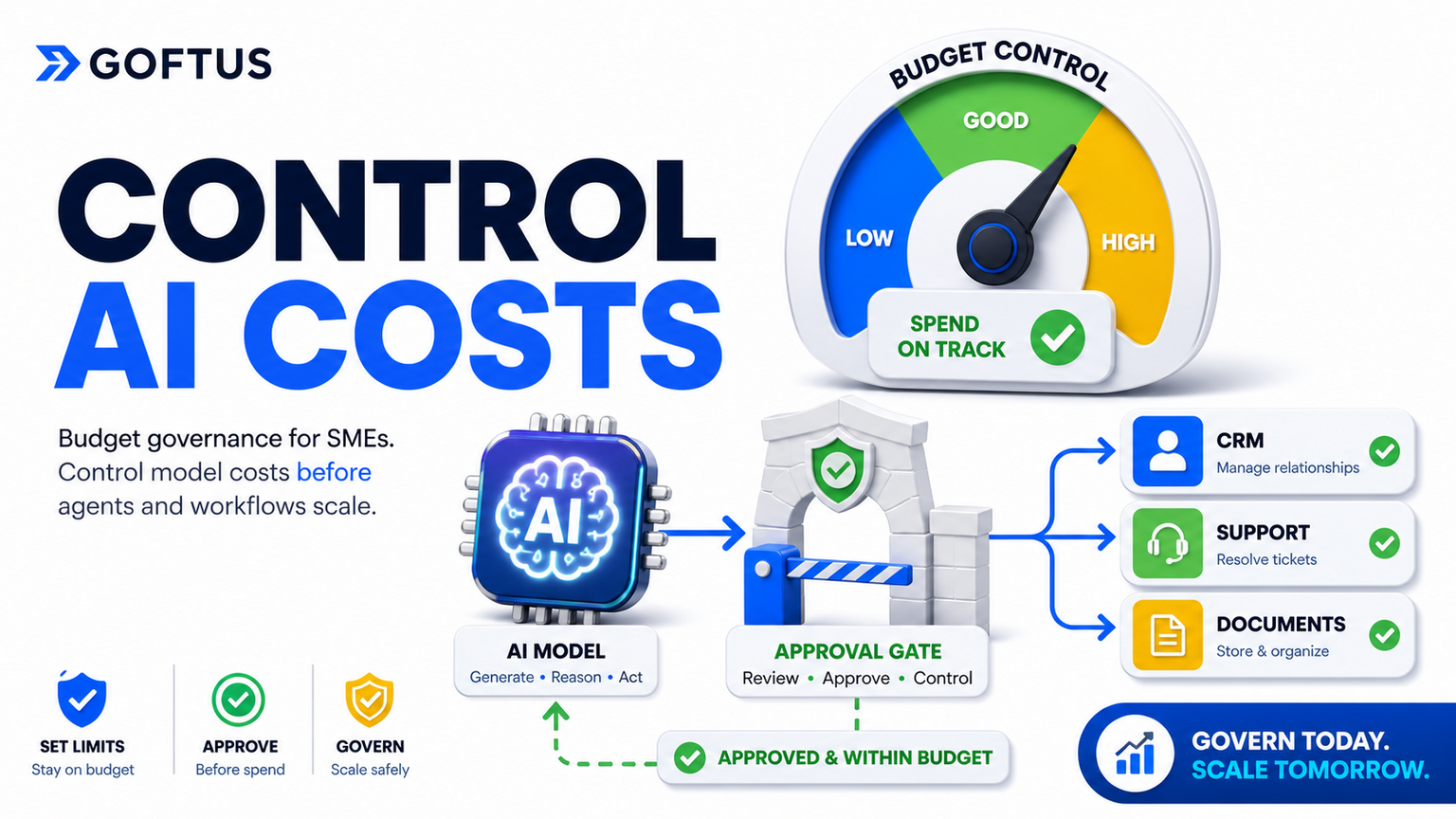
# AI Automation Budget Governance for SMEs: Control Model Costs Before Workflows Scale **Meta description:** AI automation budget governance helps SMEs control model spend, approvals, fallback routes, and logs before AI
AI Automation Budget Governance for SMEs: Control Model Costs Before Workflows Scale
Meta description: AI automation budget governance helps SMEs control model spend, approvals, fallback routes, and logs before AI workflows scale across teams.
AI automation budget governance means deciding how AI tools, agents, and model calls are approved, budgeted, measured, and paused before they become daily operations. The useful business lesson is broader: once AI moves from experiments into support, CRM, reporting, documents, or browser-based work, cost control becomes a workflow design problem.
For UK, US, and EU SMEs, the question is not only whether a model is cheap or powerful. It is whether the business knows which workflow may spend money, who can approve higher usage, which tasks need a cheaper fallback route, and what happens when a tool behaves unexpectedly. GOFTUS approaches this through practical workflow automation: set limits, add review points, log usage, connect work to outcomes, and improve monthly. If your team is starting to scale AI across live operations, the safest starting point is a focused review of the workflow on /services.
What this means for SMEs
The latest model cycle is making AI feel easier to deploy, but harder to govern. None of those signals should be treated as a single source of truth. Together, they show the same operator concern: AI is no longer a one-off subscription line.
In a small business, cost risk often hides inside useful work. A support workflow may ask an AI agent to draft replies, summarise tickets, update CRM fields, and create follow-up tasks. A reporting workflow may process long documents, call a frontier model for analysis, and rerun when a manager changes the prompt. A browser automation may revisit pages, retry forms, and generate logs. Each step can be valuable. Each step can also create waste if there is no budget rule, owner, or stop condition.
AI automation budget governance gives the team a simple operating layer. Define the workflow outcome, decide which parts require approval, set spend thresholds by workflow, route low-risk work to cheaper models or deterministic automation, and review logs against outcomes. Operators need budget signals where the work happens: in CRM tasks, support queues, document pipelines, browser actions, and reporting runs. GOFTUS designs those controls as part of the workflow itself, so teams can scale useful automation without turning every employee into an AI billing analyst.
Hajikreena's view is that AI budget governance should feel practical, not bureaucratic. SMEs do not need a heavy enterprise committee for every prompt. They need clear rules around recurring work. For example, a draft-only support assistant may run freely under a daily cap, but sending refunds, changing account data, or escalating a legal complaint should require approval. A document assistant may summarise supplier files, but any step that emails a decision or updates a system should be logged and reviewed.
The same thinking applies to model selection. The newest frontier model may be right for complex reasoning or high-value exceptions. It is usually unnecessary for every classification, note cleanup, FAQ match, or CRM field update. A good workflow can combine deterministic rules, cheaper models, cached answers, and human review. GOFTUS often starts with a lightweight diagnostic: which workflows repeat, where judgment is needed, where mistakes cost money, and where usage could grow silently. If a proposed AI workflow cannot explain its owner, limit, fallback, log, and review loop, it is not ready to scale.
SaaS platforms such as Zapier, n8n, Make, Bardeen, Gumloop, Lindy, Relevance AI, and Stack AI can be useful for connecting apps and launching fast automations. Consultancies such as Faculty AI, Deeper Insights, Waracle, Brainpool AI, LeewayHertz, Markovate, SoluLab, BairesDev, Addepto, STX Next, Netguru, and 10Clouds can also help with specialist builds.
The gap appears when automation crosses from a task into an operating process. A connector can send a request to a model. A consultant can build a pilot. But an SME still needs a named workflow owner, budget rule, approval step, exception path, audit log, monthly review, and a way to compare the automation with the outcome it promised. Without that layer, AI cost control becomes a spreadsheet after the damage is done.
GOFTUS counter-positioning is workflow-first: not "which model is cheapest", but "which customer, support, document, CRM, or reporting outcome deserves this level of AI spend".
What SMEs should do next
Start with one workflow that already consumes time every week. Map the trigger, inputs, AI step, human decision, system update, and final outcome. Add a spend owner and a safe daily or weekly limit. Decide which actions can be draft-only, which can update internal records, and which need explicit approval before they affect a customer, bank account, supplier, or public website.
Next, create fallback routes. If a frontier model becomes expensive, unavailable, or unnecessary, the workflow should know when to use a smaller model, a rule-based path, an FAQ answer, a template, or a human queue. This is especially important for customer support, CRM follow-up, reporting automation, document processing, and browser-based agents. Where agents touch live websites, pair budget governance with browser action controls on /agents so the business can approve submits, downloads, logins, and updates before they happen.
Finally, review the numbers as operating evidence, not vanity data. Count completed tasks, avoided rework, response time, escalation rate, and human approvals. If the AI step does not improve the workflow, reduce it or remove it. If it does, expand carefully with the same controls. GOFTUS can help SMEs turn this into a practical automation plan through /services, from the first diagnostic through implementation, monitoring, and continuous improvement.
AI automation budget governance is the operating system around AI spend. Today's Reddit and news signals show why SMEs should not wait for a surprise invoice before setting rules. The practical move is to design approval gates, limits, fallback routes, logs, and outcome reviews into every AI workflow before it scales.
What is AI automation budget governance? It is the set of workflow rules that decides where AI can spend money, when human approval is needed, how usage is logged, and how the business checks whether the automation produced a useful outcome.
Does this mean SMEs should avoid frontier models? No. It means frontier models should be used where their capability matters, while simpler steps use cheaper models, templates, rules, cached answers, or human queues.
Where should an SME start? Start with one repeated workflow in support, CRM, reporting, documents, or browser-based work. Add a spend owner, usage limit, approval gate, fallback route, and monthly review before expanding.
How does GOFTUS help? GOFTUS designs the task and the workflow around it: integrations, approvals, logs, monitoring, exception routing, and measurable improvement through practical AI automation services.
Direct article access was not required for factual claims beyond headline-level context.