AI Automation Attribution Needs Lead Routing Before Bigger Dashboards
A practical guide for SMEs that want AI automation to route leads, prove follow-up, and turn traffic into booked workflow diagnostics.
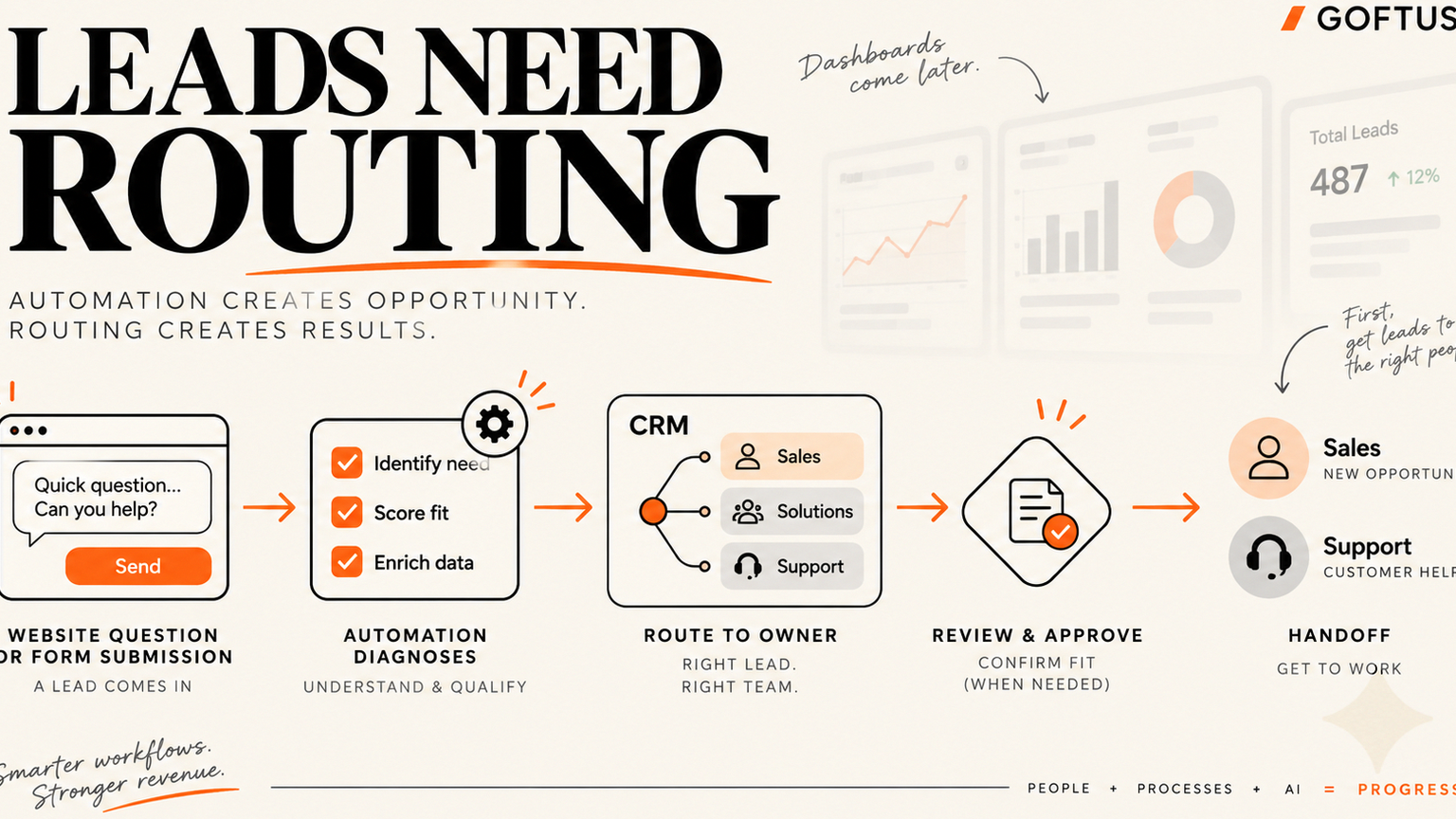
## Quick answer AI automation attribution works when every useful buyer action is routed to an owner, logged in the CRM, and tied to a next step before the dashboard gets another chart. A bigger dashboard can make a tea
Quick answer
AI automation attribution works when every useful buyer action is routed to an owner, logged in the CRM, and tied to a next step before the dashboard gets another chart.
A bigger dashboard can make a team feel informed while the actual lead is still drifting. For many SMEs, the problem is not that marketing reports lack more graphs. The problem is that nobody can answer the next operational question: who saw the enquiry, what context arrived with it, what follow-up happened, what was approved, and what changed in the pipeline afterward?
That is where AI automation should earn its place. It should not only summarise traffic, campaign activity, form fills, chatbot questions, or content engagement. It should help the business move the right context to the right person with the right guardrails. A visitor reading three automation pages, asking a pricing question, or downloading a checklist is not just a number. It is a workflow event that needs routing.
GOFTUS sees this as a RevOps and sales enablement problem, not a reporting decoration problem. If you want automation to improve revenue, start with the handoff. The clean path is simple: capture the buyer question, classify the intent, enrich the record, prepare the recommended follow-up, ask for approval when risk is present, then log the action and outcome.
What this means for SMEs
Many small and mid-sized businesses already have enough signals to improve follow-up. Website forms, contact pages, booking tools, support inboxes, live chat, analytics events, CRM notes, email replies, and sales call outcomes all contain useful context. The issue is that those signals often live in separate places. Marketing sees clicks. Sales sees names. Support sees repeated questions. Leadership sees a monthly report after the chance has cooled.
AI can help, but only if it is attached to a governed workflow. A loose assistant that generates summaries is not enough. The workflow needs defined roles, routing rules, CRM fields, review gates, and exception handling. If the AI prepares a follow-up email, someone should own approval. If the AI flags a high-intent account, sales should see why. If the AI suggests a support handoff, the support team should receive the original question and the customer history, not a vague summary.
The workflow example
Imagine an SME that sells managed services. A visitor lands on a blog post about AI workflow diagnostics, clicks through to /questions, searches for CRM automation, and then submits a contact form asking whether AI can qualify inbound leads before a sales call.
A weak setup records the form fill, sends a generic notification, and waits. A slightly better setup adds the contact to a CRM. A stronger GOFTUS-style workflow does more without giving AI unsafe control.
First, the system captures the source page, question, form message, region, company domain, and any matching CRM history. Second, an AI classifier labels the enquiry as a workflow diagnostic fit, a support-style question, a pricing question, or a low-fit request. Third, the workflow prepares a recommended next step for the owner: book a diagnostic, ask two qualifying questions, route to support, or add to a nurture sequence.
Fourth, an approval gate decides what the AI can do. Low-risk internal notes can be written automatically. A customer-facing email can be drafted but held for review. A CRM stage change can be suggested but not committed if deal value, compliance, or existing account ownership is unclear. Fifth, the final action is logged: who approved it, what message was sent, what CRM fields changed, and what happened next.
Competitor lens
Dashboard tools, CRM add-ons, chatbot builders, and no-code automation platforms can all be useful. The risk is assuming the tool itself owns the business process. Most platforms are built to show activity or move data. They are not automatically designed around your approval rules, sales motion, support boundaries, or service promise.
A consultant can help interpret reports, but interpretation still needs a delivery system. A no-code workflow can move leads, but someone must decide when to enrich, when to hold, when to escalate, and when to let AI act. A chatbot can answer common questions, but it should not become a dead end that hides buying intent from sales.
GOFTUS fits between those gaps. The work is not just connecting apps. It is designing the operating route from signal to decision to approved action. That is why /agents and /services matter together. Agents can prepare, classify, and draft. Services define the workflow, ownership, monitoring, and improvement loop.
Build the attribution workflow before adding more AI
A good first pass does not need to be complex. Start with five fields that make follow-up useful: buyer question, workflow category, urgency, owner, and next approved step. Then add three logs: source page, action taken, and outcome.
From there, the business can improve month by month. If many leads ask the same question, create a better /questions answer and route it to a service page. If sales rejects many leads as low fit, update the qualification rules. If support keeps receiving sales-ready questions, create a clean handoff. If a content page brings interest but no booked calls, improve the CTA or add a diagnostic offer.
The goal is not to replace judgment. The goal is to remove delays between interest and ownership. A human should still approve sensitive messages, pricing promises, contract changes, refunds, account updates, and any browser action that submits information through a portal.
Summery for SMEs
If your reports show traffic but your team cannot explain which enquiries became qualified conversations, fix the routing layer first. Make every useful action produce a clear owner, a context bundle, an approved next step, and a CRM record.
That is the difference between AI automation as a toy and AI automation as an operating system for follow-up. The best dashboard is not the one with the most widgets. It is the one that proves the business acted on the right buyer question at the right time.
For SMEs, the practical next step is a workflow diagnostic. Map where leads arrive, where context gets lost, which actions need approval, and which records must be updated. Then build one focused automation around that route through /contact.
FAQ
What should AI automation attribution track first?
Track the buyer question, source page, workflow category, owner, approved next step, CRM update, and outcome. Those fields tell you whether automation improved follow-up, not just whether traffic increased.
Should AI send follow-up emails automatically?
Usually not at first. Let AI prepare the draft, gather context, and recommend timing. Keep human approval for customer-facing messages until the workflow has clear rules, safe templates, and reliable exception handling.
How does this connect to GOFTUS services?
GOFTUS starts with the workflow route: intake, classification, approval, CRM update, and monitoring. The /services page explains how governed automation turns scattered tasks into owned business workflows.
When should a business use AI agents for lead routing?
Use agents when the workflow needs context gathering, intent classification, draft preparation, CRM updates, or browser-based checks. Keep approval gates around any action that changes customer records, sends messages, or submits information.
Source notes
This article was shaped by current operator discussions about marketing reports, attribution gaps, and AI-assisted troubleshooting, plus GOFTUS analytics observations around automation-related search demand. Public source references used for context: https://www.reddit.com/r/marketing/comments/1wbyetf/i_think_a_lot_of_marketing_reports_answer_the/ and https://www.reddit.com/r/SaaS/comments/1wbqq73/my_side_project_finally_reached_1k_mrr_after/