AI Agents Need Workflow Controls Before They Act
TechInformed highlights why SMEs need clean data, approval gates, logs and human oversight before letting AI agents act inside business tools.
# AI Agents Need Workflow Controls Before They Act Meta description: TechInformed highlights why SMEs need clean data, approval gates, logs and human oversight before letting AI agents act inside business tools. # Quic
AI Agents Need Workflow Controls Before They Act
Meta description: TechInformed highlights why SMEs need clean data, approval gates, logs and human oversight before letting AI agents act inside business tools.
Quick answer
TechInformed's July 2026 article, "What businesses must fix before letting AI agents act", is a useful signal for UK, US and EU SMEs because it moves the agent conversation away from demos and into operating discipline. The article says AI agents are entering the tools smaller companies already use, but safe deployment depends on clean data, clear governance and human oversight. It also points to recent cyber-agency guidance on agentic AI risk, plus market signals showing automated agents and agentic browsers becoming more visible online.
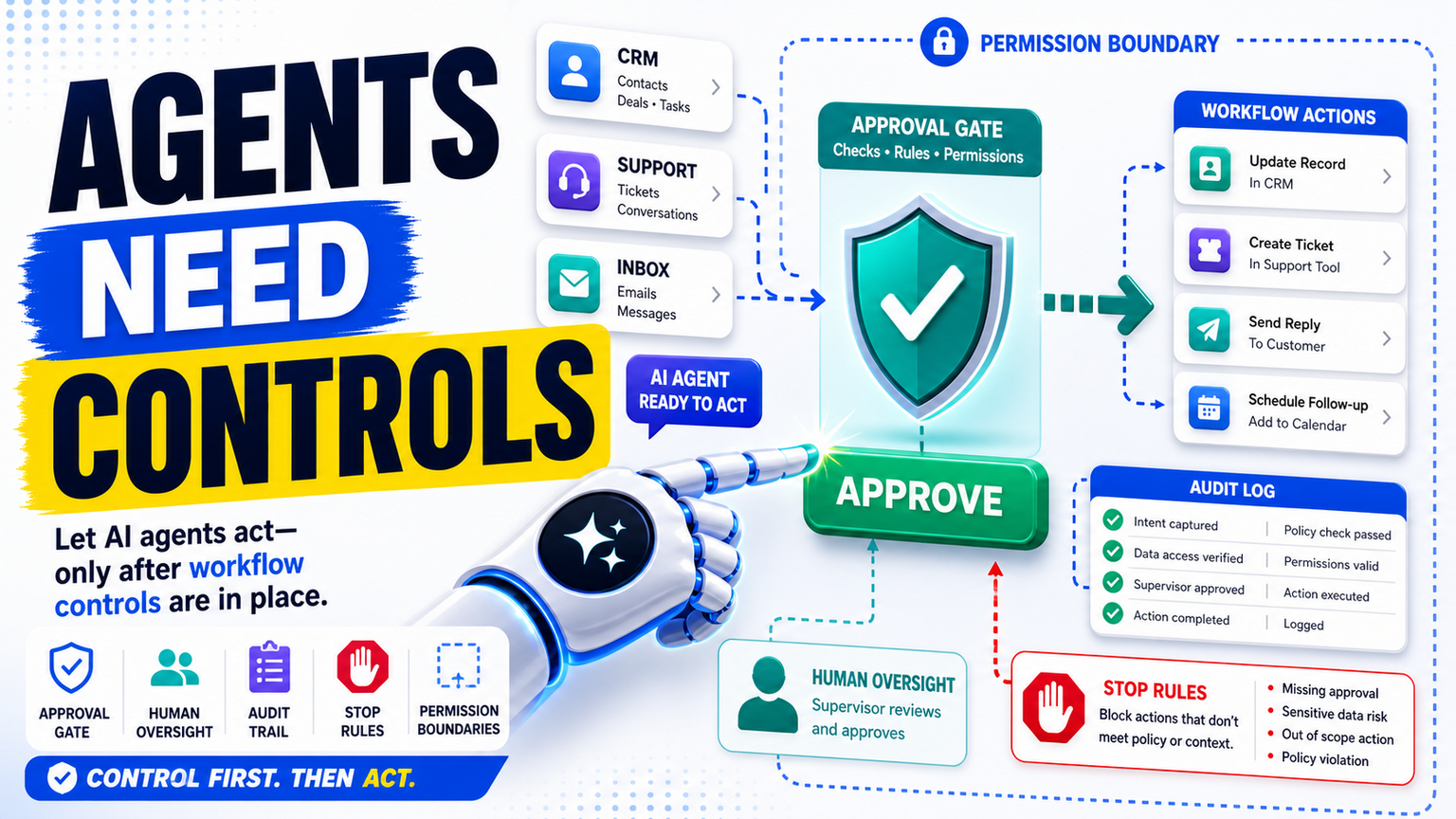
For GOFTUS, the lesson is simple: do not buy an agent and then search for a process. Start with the workflow. Decide what the agent may read, what it may change, when it must pause for approval, where the audit trail lives, and who reviews exceptions. That is why GOFTUS links agent projects to /agents and /services rather than treating them as one-off tool installs.
What this means for SMEs
Most SMEs already have work spread across CRM, inboxes, spreadsheets, accounting systems, help desks, document portals and browser tabs. An AI agent can reduce manual switching between those tools, but only if the business has a reliable operating model around the agent.
The risk is not that an agent writes an imperfect paragraph. The larger risk is that it updates the wrong customer record, sends a reply before context is checked, pulls sensitive information into the wrong place, or keeps retrying a broken action without anyone noticing. That is why action-level controls matter. The business needs permissions, stop rules, approval gates and logs before an agent is allowed to move from suggestion to execution.
A practical SME rollout should begin with one narrow workflow. For example, an agent might draft a support response from known FAQ content, prepare a CRM follow-up after a form submission, classify a supplier email, or reconcile fields between two internal tools. The workflow should define the allowed data sources, the exact output, the human review step, the escalation route and the success measure.
If the workflow touches a browser portal, the same logic applies to browser with ai controls. The agent should only operate in approved sites, avoid password handling, stop before final submission and create a readable activity log. GOFTUS treats browser-based workflow automation as a controlled agent pattern, not a free-roaming assistant.
Bharatvaj's view
Bharatvaj's view is that SMEs should treat AI agents like junior operators with speed, not like magic software. A junior operator needs a checklist, permissions, context, review and a manager. An AI agent needs the same structure, plus technical logging.
This is also where many pilot projects get stuck. A team tries an exciting tool, sees a useful demo, then struggles to make it safe enough for day-to-day work. The missing piece is rarely the model alone. It is the workflow design around the model: who owns the process, what data is trusted, what happens when the agent is unsure, and how managers spot drift over time.
GOFTUS builds that missing layer for SMEs. A good first project might connect FAQ automation to customer support triage, CRM follow-up and reporting. Another might connect document intake to approval routing and staff review. Another might use /agents to create a controlled research or operations assistant that prepares work but does not act until the business approves.
Competitor lens
The market gives SMEs plenty of options. Faculty AI, Deeper Insights, Waracle and Brainpool AI in the UK can help with data and AI programmes. LeewayHertz, Markovate, SoluLab and BairesDev in the US often build broader software and AI systems. In Europe, Addepto, STX Next, Netguru and 10Clouds bring delivery capacity. SaaS tools such as Zapier, n8n, Relevance AI, Lindy, Gumloop, Bardeen, Make and Stack AI can automate tasks quickly.
Those options can be useful. The important difference is ownership of the workflow around the task. Tools automate tasks. GOFTUS automates the workflow around the task. That means mapping the current process, cleaning the inputs, defining approvals, integrating CRM or support systems, monitoring exceptions and improving the automation after real users touch it.
For an SME, this matters because a loose agent can create more management work than it removes. A designed workflow should make work clearer: fewer missed follow-ups, fewer repeated answers, fewer manual handoffs, better records and faster decisions with human approval where it counts.
What SMEs should do next
First, list three workflows where staff copy information between systems every week. Pick one with visible pain but low regulatory risk. Customer questions, lead routing, internal reporting, document intake and appointment follow-up are often better starting points than sensitive finance or legal actions.
Second, define the action boundary. Write down what the agent may read, draft, classify, update or submit. Add a stop rule for anything outside that boundary. If a browser is involved, define approved domains and the point where a human must click approve.
Third, connect the agent to existing records. A support draft should link back to the ticket. A lead follow-up should update CRM. A document workflow should keep the original file, extracted fields and review status together. This is where /services can help because the value is in the operational handoff, not only the AI output.
Fourth, measure unanswered questions and exceptions. The best automation projects improve over time. If an agent repeatedly asks for human help on the same issue, that is not failure. It is a signal to improve the FAQ, update a rule, add a data source or redesign the workflow.
If you want a safe starting point, GOFTUS can run a practical diagnostic through /contact and identify where AI automation, FAQ automation, agent workflows or browser controls would create measurable operational value without letting software act blindly.
Summery for SMEs
AI agents are moving into normal business tools, but SMEs should not give them broad action rights without workflow controls. Start narrow, clean the data, define permissions, require approval for risky actions, log every step and connect outputs to CRM, support, documents or reporting. The goal is not more AI activity. The goal is controlled work that saves time and still gives people a clear review path.
FAQ
Should SMEs let AI agents act automatically? Only after the workflow has clear permissions, approval points, logs and stop rules. Start with drafts or low-risk updates before final submissions.
Where should GOFTUS link this work? Agent projects should start at /agents, wider workflow automation at /services, and diagnostic requests at /contact.
Does this replace SaaS automation tools? No. Tools can be useful building blocks, but SMEs still need workflow design, integration, monitoring and improvement.
Source notes
Primary source: TechInformed, "What businesses must fix before letting AI agents act", published 22 July 2026.