AI Agents Should Ask Before Acting in SME Workflows
AI agents are moving from suggestions to actions. SMEs need approval gates, audit logs and stop rules before automating browser workflows.
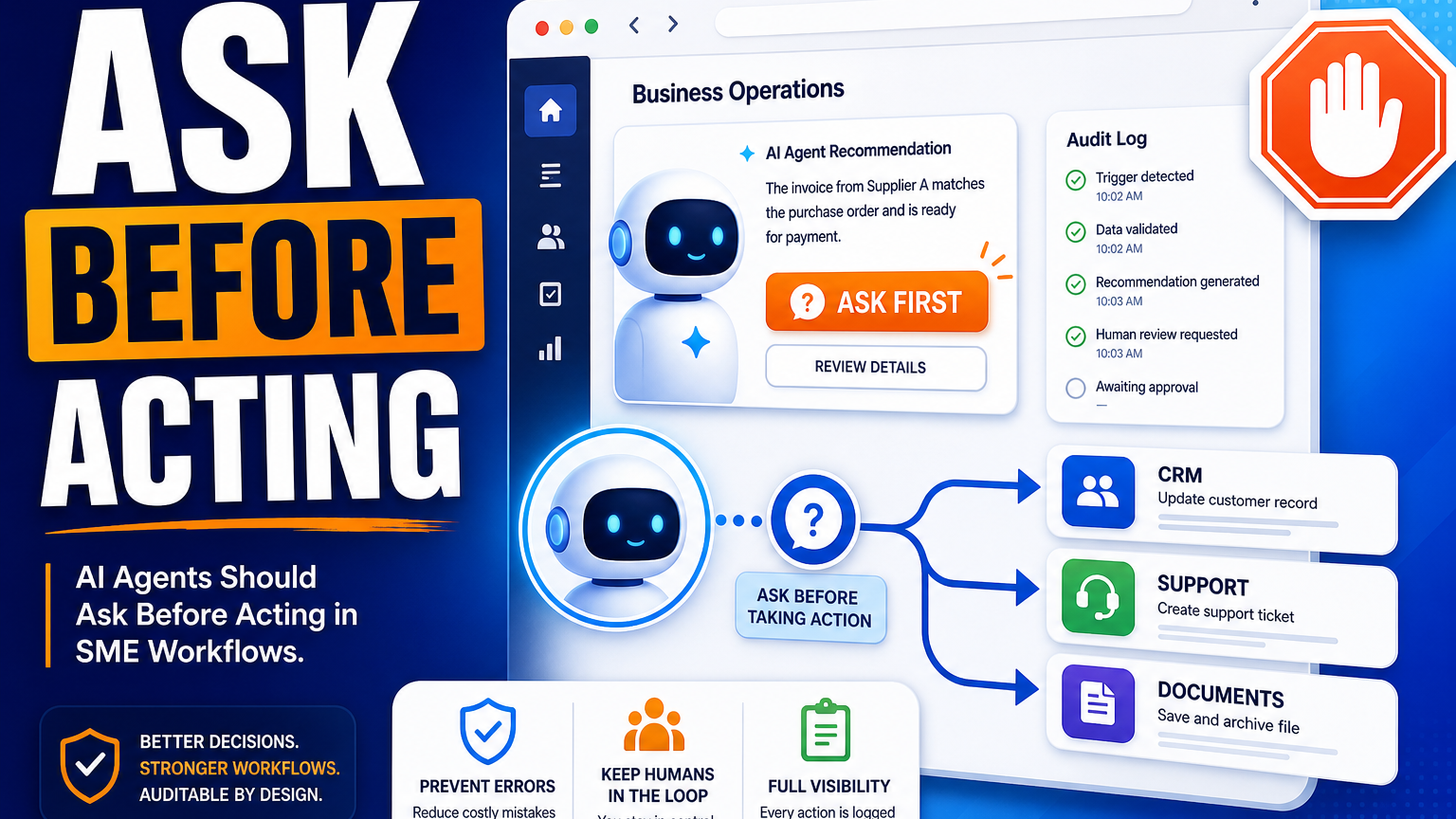
# AI Agents Should Ask Before Acting in SME Workflows A fresh AI operations signal is getting louder: business teams like the promise of agents that can click, submit, update and route work, but they are nervous when th
AI Agents Should Ask Before Acting in SME Workflows
A fresh AI operations signal is getting louder: business teams like the promise of agents that can click, submit, update and route work, but they are nervous when the agent stops asking and starts acting.
Thirumurugan's view is simple. The useful question is not whether an SME should use AI agents. The useful question is which actions should be automated, which actions need human approval, and which actions should never be delegated.
For UK, US and EU SMEs, the next phase of AI automation is less about chatbots and more about controlled execution. An agent that drafts a customer reply is helpful. An agent that sends the reply, updates the CRM, creates a support ticket and changes a billing record without a review step can become a workflow risk.
That is why GOFTUS frames AI agents as workflow systems, not magic workers. Start with a narrow workflow, define the approval point, log every action, route exceptions and review performance each month. If you are exploring agentic workflows, start with /agents and the wider automation map on /services.
What this means for SMEs
SMEs do not need to copy enterprise AI labs. They need a safe operating model for everyday work. The pressure will come from repetitive tasks that already live in browser tools: supplier portals, customer support dashboards, CRM updates, spreadsheets, onboarding forms, booking systems, finance tools and document portals.
These are exactly the workflows where browser-based automation looks attractive. Staff spend time copying data between screens. Leads are missed because nobody updates the CRM quickly enough. Support tickets sit unanswered. Documents wait for review. Reports need the same checks every week.
AI agents can help, but the agent should not be given open-ended permission to act across every tool. The better pattern is a controlled lane:
1. Define the job in plain English, such as "collect missing onboarding documents" or "prepare a support-ticket summary".
2. Limit the systems the agent can touch.
3. Require approval before submit, bind, pay, delete, send or publish.
4. Write the result back to the system of record.
5. Keep an audit log that a manager can understand.
6. Review failed, skipped and escalated cases.
This is where the current search interest around "browser with ai controls" matters. The browser is where many SME workflows still happen. The control layer is what makes automation safe enough to use.
What SMEs should do next
First, map the workflow before selecting the tool. If the current process is unclear, an AI agent will only make unclear work faster. List the trigger, the source system, the decision step, the human approval point, the final action and the record that proves what happened.
Second, separate recommendations from actions. An agent can read a supplier invoice, compare it with a purchase order and recommend payment. That does not mean it should pay. It can draft a customer answer from your FAQ and ticket history. That does not mean it should send the message without policy checks.
Third, start with a workflow that has obvious business value but limited downside. Good first candidates include support triage, CRM follow-up, document collection, FAQ-to-ticket routing, lead enrichment and weekly reporting. GOFTUS often connects these into practical systems with /services, /agents, FAQ automation via /services#faq-automation, and answer pages on /questions.
Fourth, create stop rules. Stop when confidence is low. Stop when the customer is angry. Stop when money, legal commitments, account deletion, sensitive data or regulated decisions are involved. Stop when the agent sees a screen it was not designed to handle.
Fifth, measure the workflow, not the novelty. Track time saved, cases routed, approvals completed, exceptions caught, unanswered questions discovered, customer follow-ups created and records updated. That is more useful than saying the company "uses agents".
The market is crowded for good reasons. UK firms such as Faculty AI, Deeper Insights, Waracle and Brainpool AI can help larger teams with AI strategy and delivery. US and European development partners such as LeewayHertz, Markovate, SoluLab, BairesDev, Addepto, STX Next, Netguru and 10Clouds can build custom software. SaaS tools such as Zapier, n8n, Relevance AI, Lindy, Gumloop, Bardeen, Make and Stack AI can automate useful pieces of work.
The gap for SMEs is ownership of the complete workflow. A tool may click the browser. A consultant may describe the roadmap. A developer may connect the API. The business still needs the operating design: who approves, what gets logged, what happens on exception, how records are corrected and how the workflow improves.
Tools automate tasks. GOFTUS automates the workflow around the task.
That counter-positioning matters when AI agents move from chat to action. GOFTUS is not trying to replace every tool. GOFTUS helps SMEs decide where tools fit, how agent actions are bounded, how CRM, support, documents and reporting connect, and how humans stay in control.
AI agents are becoming more action-oriented, and that can be valuable for SMEs with repetitive browser-based work. The risk is not automation itself. The risk is unowned automation, where no one has defined the approval gate, login boundary, audit trail, exception route or stop rule.
The safest route is to start small. Pick one workflow. Give the agent a narrow lane. Make it ask before meaningful action. Connect the result to the right business system. Review the exceptions. Then expand only when the workflow is stable.
A GOFTUS Startup Kit style diagnostic can help identify the first safe workflow, whether that is support triage, FAQ automation, CRM follow-up, document processing, reporting automation or browser-based agent work. If you want a practical starting point, use /contact to map one workflow before you buy another tool.
Should SMEs let AI agents take browser actions?
Yes, but only in narrow workflows with clear permissions. Let the agent collect information, prepare recommendations and fill drafts first. Require human approval before submit, pay, delete, publish or send actions. Browser automation is useful when it has boundaries, logs and stop rules.
What is the first safe AI agent workflow for a small business?
Support triage, FAQ-to-ticket routing, CRM follow-up and document collection are good starting points. They have clear inputs, visible outputs and easy review steps. Avoid starting with payments, legal commitments or sensitive HR decisions.
How does GOFTUS make AI agents safer?
GOFTUS designs the workflow around the agent. That includes triggers, approvals, tool boundaries, CRM or support updates, exception handling, audit logs and monthly improvement. The goal is practical automation that staff can trust, not an agent running loose across every system.