AI Agent Visibility Gap Shows SMEs Need Workflow Control
Fresh AI-agent visibility coverage shows why SMEs need logs, approvals, and workflow owners before agents touch CRM, support, or browser tasks safely.
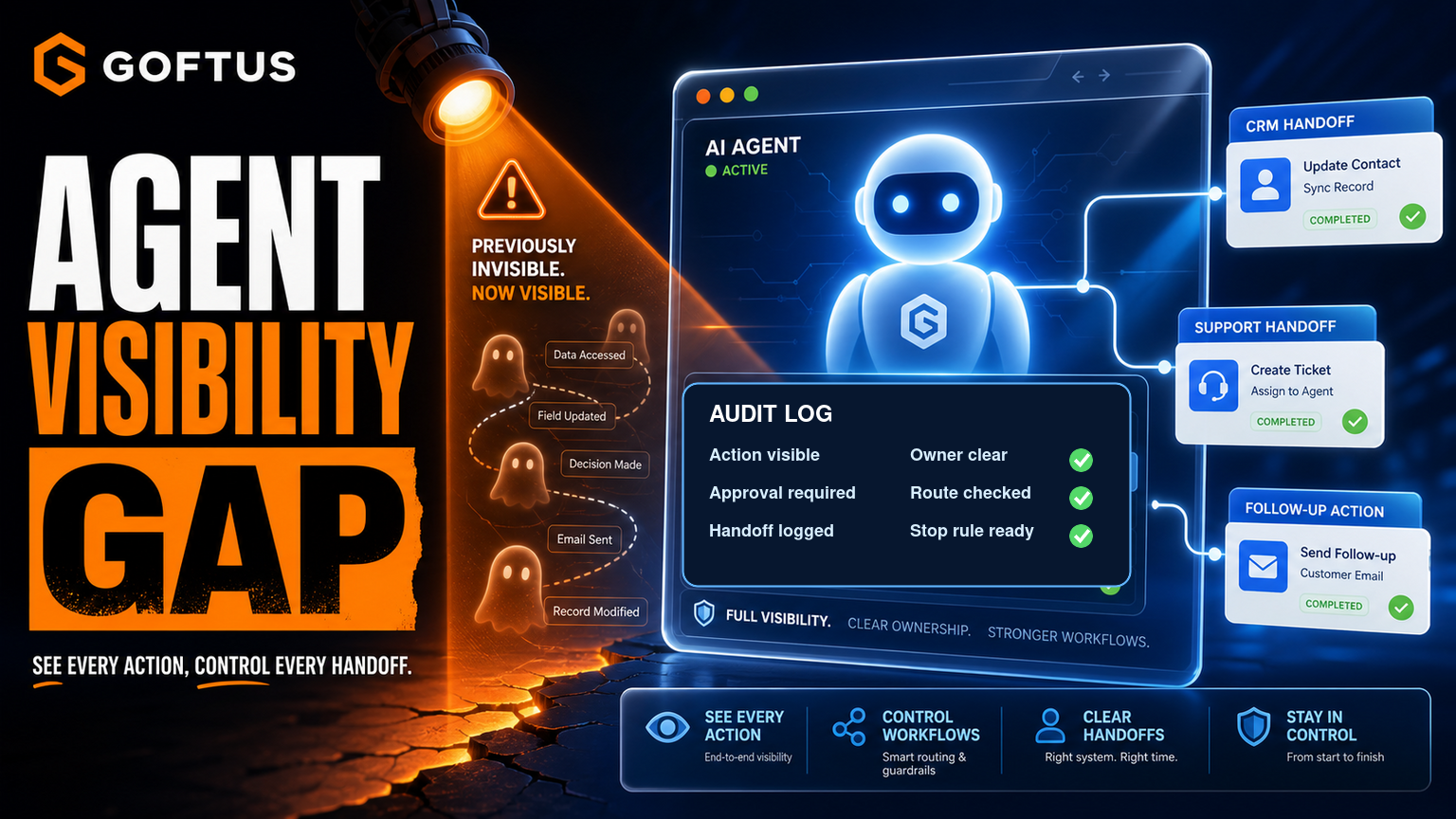
# AI Agent Visibility Gap Shows SMEs Need Workflow Control Meta description: Fresh AI-agent visibility coverage shows why SMEs need logs, approvals, and workflow owners before agents touch CRM, support, or browser tasks
AI Agent Visibility Gap Shows SMEs Need Workflow Control
Meta description: Fresh AI-agent visibility coverage shows why SMEs need logs, approvals, and workflow owners before agents touch CRM, support, or browser tasks safely.
Quick answer
The listing points to coverage titled "You Cannot Govern What You Cannot See: Closing the Visibility Gap in AI Agents." On the same day, Google News also listed Reuters and SC Media coverage about rogue-agent and enterprise-control concerns around AI systems that move from passive chat into operational action.
For SMEs in the UK, US, and EU, the signal is simple. The risk is not that every AI agent is unsafe. The risk is that teams buy an agent, connect it to tools, and only later ask who saw each action, who approved the risky steps, what the agent changed, and where the handoff went. That is where GOFTUS focuses: practical AI automation and AI agents with workflow owners, approval gates, audit logs, CRM and support handoffs, and clear stop rules.
What this means for SMEs
AI agents are becoming useful because they can work across messy business systems: inboxes, spreadsheets, CRMs, support desks, billing portals, browser dashboards, and internal documents. That usefulness also makes visibility harder. A human employee usually explains what they did. An agent can read a record, draft a response, update a field, open a browser page, or route a ticket faster than the team can review the trail.
Treat visibility as part of workflow design, not as an afterthought. Before an agent touches a real customer record, define what must be logged: trigger, source data, proposed action, approval decision, final action, and destination system. If the automation is browser-based, add domain boundaries, login rules, and human-approved submit buttons. That is where the search demand for browser with ai controls fits: businesses want agent productivity without blind clicking.
AI governance should also be operational, not theoretical. A policy will not help a sales manager if a lead is routed incorrectly, or a support team if an automated answer creates confusion. SMEs need small controls inside the process: owner, exceptions, approvals, data boundaries, and a report showing whether the agent helped.
Start narrow. A safer first project might be support triage, CRM follow-up, document intake, FAQ automation, reporting, or a browser task where a person approves final submit. That gives the team a measurable workflow and review loop before expanding.
Bharatvaj's view
The visibility gap is a delivery problem as much as a security problem. Many businesses already have Zapier zaps, n8n workflows, CRM rules, chatbots, and AI copilots operating in different corners of the company. The hard part is not adding one more tool. The hard part is making the whole path visible enough for the owner to trust it.
A good AI-agent workflow should answer five questions in seconds. What triggered the action? What did the agent read? What did it decide? Who approved the risky step? What system changed afterward? If the answer is spread across chat history, a browser session, a CRM note, and a spreadsheet, the business has fragments, not control.
GOFTUS builds around the workflow instead. In support, the agent can classify a question, draft from approved knowledge, ask for approval when confidence is low, update the ticket, and log the CRM handoff. In sales, automation can enrich a lead, draft a follow-up, wait for approval, create the CRM task, and report unanswered leads. In a browser, the agent can navigate a portal, prepare the change, stop before submission, and record the decision trail.
That is practical visibility. It helps the owner improve the workflow next month instead of merely hoping the tool behaved correctly.
Competitor lens
Faculty AI, Deeper Insights, Waracle, Brainpool AI, LeewayHertz, Markovate, SoluLab, BairesDev, Addepto, STX Next, Netguru, and 10Clouds can all be useful partners for larger AI strategy or custom builds. SaaS tools such as Zapier, n8n, Relevance AI, Lindy, Gumloop, Bardeen, Make, and Stack AI can also move tasks quickly.
The gap for SMEs is not whether a tool can automate one step. It is whether the surrounding workflow is owned, monitored, reviewed, and improved. Tools automate tasks. GOFTUS automates the workflow around the task. That means mapping the real process, deciding where AI should act, adding approvals, connecting CRM, support, documents, and reporting, and giving the owner a clean way to see what happened.
This is especially important when agents work in browsers or business portals. A browser action can look small, but it may create a ticket, bind a policy, update a customer record, or send a message. GOFTUS treats those moments as workflow-control points, not just clicks.
What SMEs should do next
Start with one workflow where visibility already feels weak. Good candidates are repeated website questions, slow lead follow-up, manual CRM updates, support triage, document processing, or reporting that depends on copied data. Write down the current path from trigger to final outcome. Then mark the moments where an AI agent could help and the moments where a human should approve.
Next, choose the evidence you want every run to produce. A practical setup should show source data, action taken, owner, approval status, exception reason, and follow-up destination. If the workflow touches web portals, include /agents style browser boundaries: allowed sites, blocked actions, login handling, download rules, and stop points. If the workflow begins with customer questions, connect it to /services#faq-automation so repeated answers can become a controlled support and lead-capture layer.
Finally, review the workflow monthly. The best AI system is not the one that looks most advanced on day one. It is the one that shows where customers got stuck, where staff still intervened, which handoffs failed, and what can be improved next.
GOFTUS can help with a Startup Kit style diagnostic for SMEs that want AI agents, automation, or browser-based workflow control without losing operational oversight. Start at /services or /contact and bring one real workflow that needs better visibility.
Summery for SMEs
AI-agent visibility is becoming a business requirement, not a nice-to-have. If an agent can read, decide, click, update, or hand off work, the business needs logs, approvals, ownership, and stop rules around it. GOFTUS helps SMEs turn AI tools into controlled workflows across CRM, support, documents, reporting, FAQ automation, and browser-based tasks.
FAQ
What is the AI-agent visibility gap? It is the difference between an agent doing work and the business being able to see, approve, audit, and improve that work.
Does this mean SMEs should avoid AI agents? No. It means they should start with narrow workflows, clear approvals, and visible handoffs before giving agents broader responsibility.
Where does browser with ai controls fit? It fits when agents need to use portals or browser tools without APIs. The business should keep domain rules, login boundaries, approvals, logs, and stop points.
How can GOFTUS help? GOFTUS designs the workflow around the tool: triggers, approvals, CRM and support handoffs, reporting, exception handling, and monthly improvement.
Source notes
Hacker News Algolia showed adjacent developer interest in browser-agent visibility and control tools such as ContextFort, Stagehand, and browser-control protocols.