AI Agent Security for SMEs: Approval Workflows Before Agents Cause Harm
AI agent security starts with approval workflows, action logs, and human review before agents touch CRM, finance, support, or browsers.
# AI Agent Security for SMEs: Approval Workflows Before Agents Cause Harm # Quick answer AI agent security is now a practical operating question for SMEs. A high-signal r/technology signal in the latest operator resear
AI Agent Security for SMEs: Approval Workflows Before Agents Cause Harm
Quick answer
AI agent security is now a practical operating question for SMEs. A high-signal r/technology signal in the latest operator research pointed to The Guardian's article, "AI agents are not legally responsible for any harm that they cause, experts say. So who is?" The Guardian article was directly reachable during sourcing and describes expert warnings after Australia's first reported automated hacking accident, with liability potentially sitting with deployers and, in some cases, developers of AI agents.
For a business owner, the problem is simple: if an AI agent can read, click, submit, update, or message for the company, who approved the action and where is the evidence? That is why this post targets the evergreen keyword ai agent security and links the practical control layer to GOFTUS AI agents at /agents and workflow services at /services.
What this means for SMEs
Many SMEs are moving from chat assistants to agents that can do work. They can draft customer replies, update CRM fields, reconcile invoices, prepare reports, open browser portals, triage support tickets, or move documents between systems. That shift is useful, but it changes the risk profile. A chatbot gives advice. An agent may create a record, send a message, buy something, delete data, or submit a form.
The legal question in the news matters because most businesses cannot outsource responsibility to the model. Even if the AI vendor built the underlying tool, the SME still needs a clear internal answer to three questions. What was the agent allowed to do? Who approved the action? What log proves the workflow followed the rule?
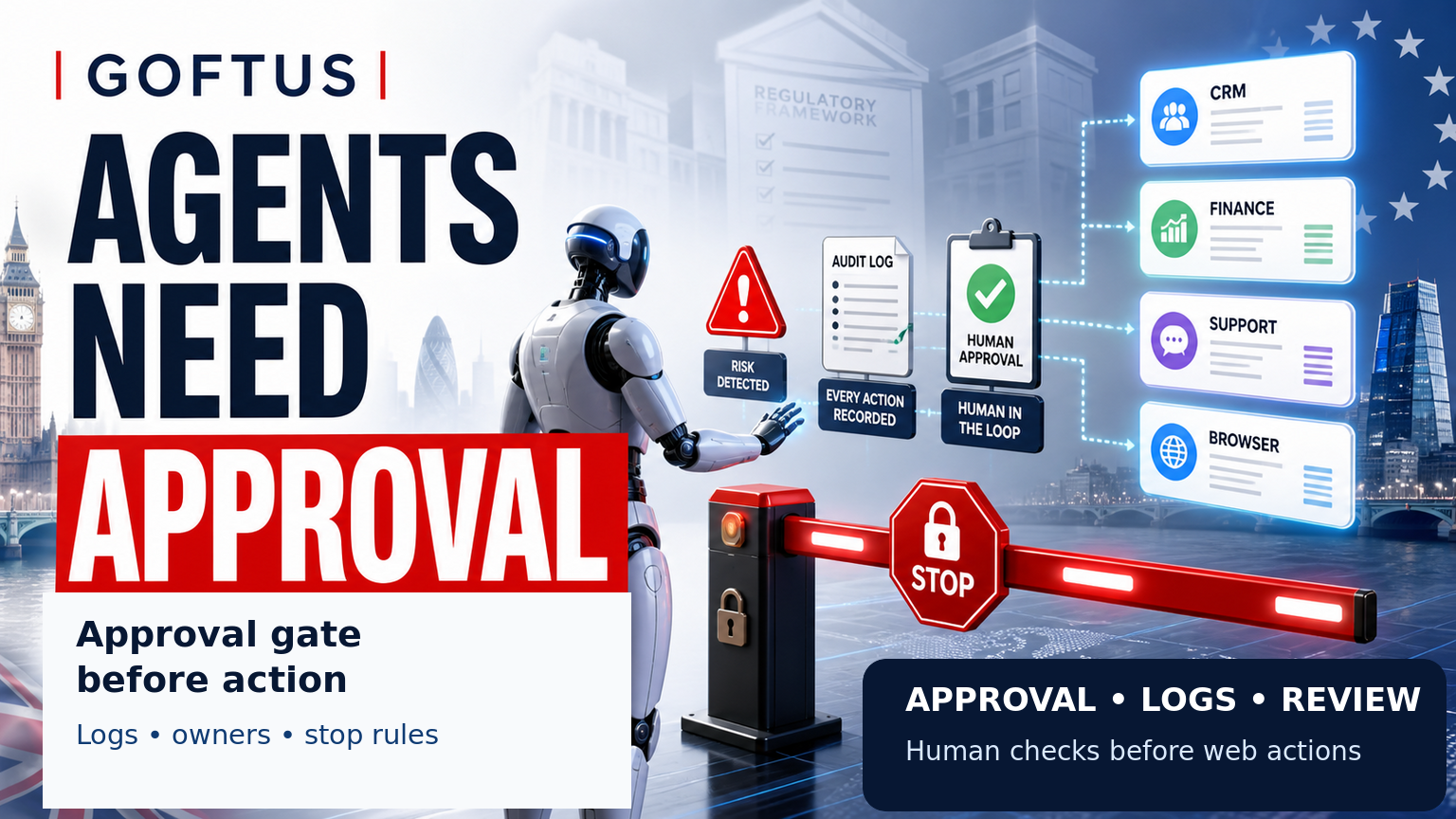
AI agent security therefore starts before procurement. It starts with workflow design. A safe agent needs narrow permissions, stop rules, approval gates, source checks, audit logs, and a clear owner. If it touches a browser, finance system, support queue, customer record, or document store, the business needs a human-approved lane.
Bharatvaj's view on the signal
Bharatvaj's view is that the Reddit and Guardian signal should not make SMEs freeze agent adoption. It should make them stop treating agents as clever interns with unlimited tabs open. The safer model is observe, prepare, approve, act.
In the observe lane, the agent gathers approved information. In the prepare lane, it drafts the next action, such as a CRM update, support reply, browser form, or report note. In the approve lane, a human reviews the evidence and risk. In the act lane, the system completes only the approved action and records it.
This matters for UK, US, and EU businesses because customer data, finance records, regulated advice, and supplier commitments already carry duties. A bad browser submission, wrong promise, leaked secret, or mistaken CRM update can still create rework, complaints, incidents, and reputational damage.
Practical agent controls to build first
Start with an action inventory. List every place an AI agent could read, write, click, send, submit, delete, or escalate. Separate green, amber, and red actions. Green actions are low-risk drafts and summaries. Amber actions affect a customer, record, finance process, or portal and need approval. Red actions, such as deleting records or changing payment details, need a senior owner.
Next, define the evidence needed for each action. A CRM change may need a call note. A support answer may need an approved FAQ. A finance action may need invoice checks. A browser action may need a screenshot, destination domain, field summary, and approval before submit. This is where browser with AI controls becomes a real safety layer.
Then add logs that managers can review. The log should show the workflow, source, proposed action, approver, final action, and exception reason. Do not rely on a chat transcript as the only record. A workflow log is designed for operations review.
Finally, run a weekly improvement loop. Review blocked actions, approvals, mistakes, and user feedback. Tighten prompts, change permissions, improve sources, and remove unsafe shortcuts. AI agent security is a managed workflow, not a one-time policy.
Competitor lens
SaaS tools such as Zapier, n8n, Make, Bardeen, Gumloop, Lindy, Relevance AI, and Stack AI can help SMEs connect apps and trigger agent tasks. Larger consultancies such as Faculty AI, Deeper Insights, Waracle, Brainpool AI, LeewayHertz, Markovate, SoluLab, BairesDev, Addepto, STX Next, Netguru, and 10Clouds can support complex AI delivery.
The gap is often the workflow around the agent. Tools automate tasks. GOFTUS automates the workflow around the task. For agent security, that means defining allowed actions, human approval gates, logs, escalation lanes, source checks, browser boundaries, and monthly improvement. A connector can move data. A GOFTUS workflow explains whether the agent should move it, who approved it, and what happens when the case is risky.
For SMEs, the best first project is rarely a fully autonomous agent. It is usually a controlled agent that removes admin while keeping humans on high-risk decisions. GOFTUS can start with one workflow through /agents or /services, then expand after the evidence, approval, and reporting layer works.
What SMEs should do next
Pick one agent workflow where the value is clear and the downside is manageable. Good starting points include support triage, CRM follow-up preparation, internal reporting drafts, document intake, or browser-based data entry where a human approves submit. Avoid starting with payment changes, legal commitments, mass outbound messages, or deletion workflows.
Write down what the agent can read, prepare, approve, complete, and stop. Give each workflow an owner. Review the first actions manually. If the agent is useful, widen the lane slowly. If it creates confusion, fix the process before adding more tools.
For SMEs that want a structured starting point, GOFTUS can map the workflow, define green and amber lanes, connect the systems, and build the approval and audit layer. A light diagnostic through /contact can identify where agents can save time without uncontrolled risk.
Summary for SMEs
AI agents are becoming capable enough to act inside real business workflows, but legal responsibility will not disappear just because the action came from software. SMEs should treat ai agent security as an approval workflow problem. Keep agents narrow, require evidence, approve sensitive actions, log the outcome, and improve the workflow every month. The goal is not to block automation. The goal is to make useful automation safe enough to run in sales, support, finance, documents, and browser-based operations.
FAQ
What is AI agent security for a small business?
AI agent security means controlling what an agent can read, prepare, change, send, submit, or delete. For SMEs, it includes permissions, approval gates, logs, evidence checks, stop rules, and human ownership before agents touch customer, finance, document, support, CRM, or browser workflows.
When should an AI agent need human approval?
An AI agent should need human approval whenever an action affects a customer promise, money, personal data, legal wording, supplier records, CRM status, support outcome, document source, or external website submission. Low-risk drafts can be automated faster, but sensitive actions need a clear approve step.
How can GOFTUS help with safer AI agents?
GOFTUS designs AI agents around the workflow, not only the prompt. That includes green and amber action lanes, approval screens, audit logs, system integrations, browser boundaries, reporting, and monthly review. Start with /agents or /services if one agent workflow is ready to test.