AI Agent Rollout Controls for SMEs: Test New Models Before They Touch Customer Workflows
AI agent rollout controls help SMEs test new models, approvals, logs, and stop rules before automating CRM, support, finance, or browser work.
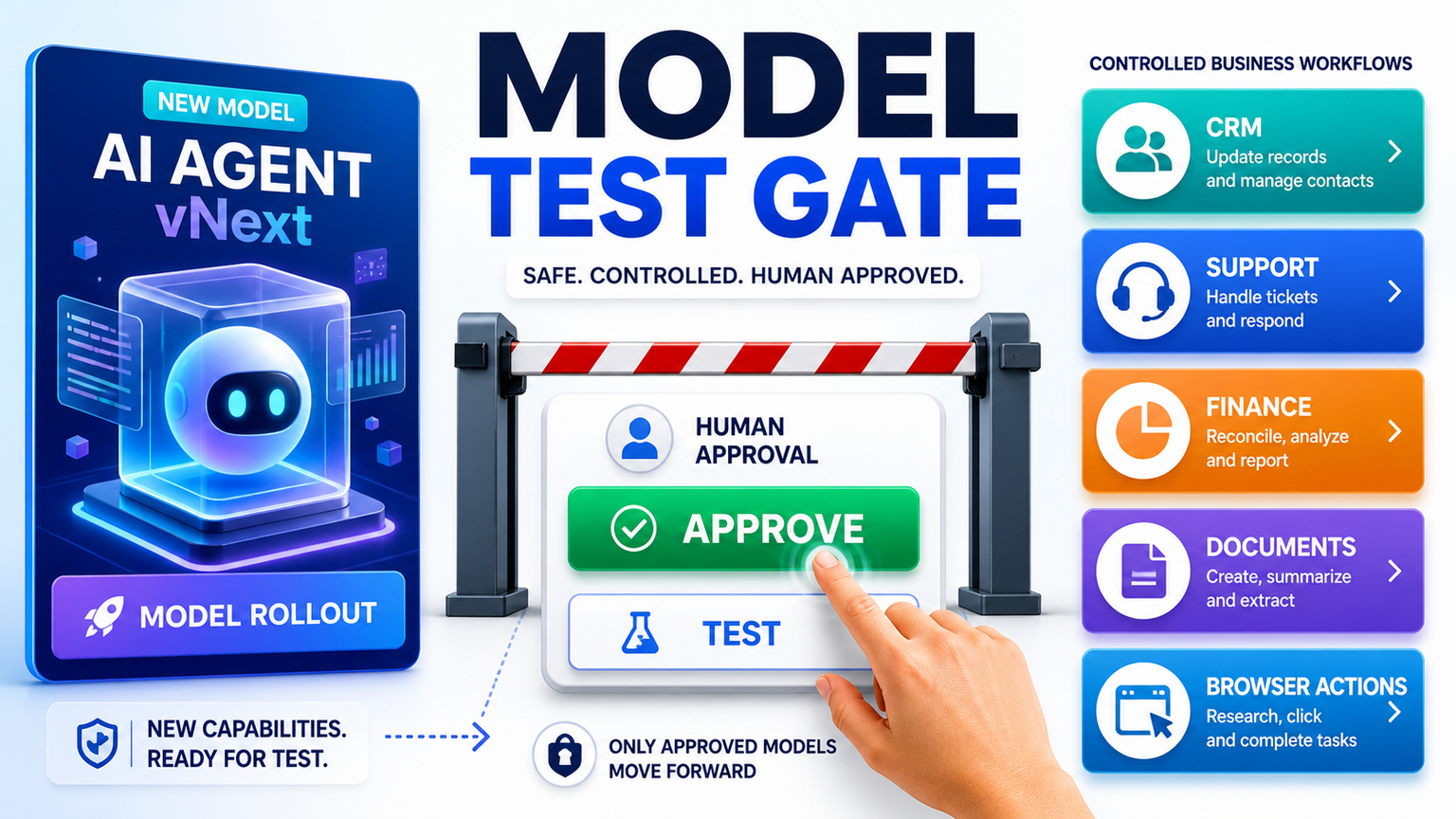
# AI Agent Rollout Controls for SMEs: Test New Models Before They Touch Customer Workflows **Meta description:** AI agent rollout controls help SMEs test new models, approvals, logs, and stop rules before automating CRM
AI Agent Rollout Controls for SMEs: Test New Models Before They Touch Customer Workflows
Meta description: AI agent rollout controls help SMEs test new models, approvals, logs, and stop rules before automating CRM, support, finance, or browser work.
AI agent rollout controls are the checks a business puts between a new model release and real work. The business problem is still real: when a model changes, SMEs need a safe rollout workflow before AI touches customers, finance, CRM, support, documents, or browser actions.
For UK, US, and EU businesses, the answer is not to freeze AI adoption. It is to separate model excitement from operational permission. A team can test the new model, compare output quality, run small internal jobs, and decide which workflows deserve approval. GOFTUS helps SMEs design that operating layer through /agents and /services, so an AI agent can become useful without becoming uncontrolled.
What this means for SMEs
Most SMEs now use AI through several paths at once. Staff may ask ChatGPT or Claude for emails, developers may use coding assistants, support teams may test AI replies, and founders may connect agents to spreadsheets, forms, web portals, or CRM records. A new model launch can improve speed and reasoning, but it can also change tone, confidence, tool use, latency, cost, or failure modes. If every employee upgrades informally, nobody owns the risk.
AI agent rollout controls turn that uncertainty into a repeatable process. First, define the jobs where AI is allowed to assist. Low-risk examples include drafting internal notes, summarising documents, preparing CRM updates for review, classifying support tickets, or generating first-pass reports. Higher-risk jobs need stricter rules: sending customer messages, changing records, submitting forms, handling refunds, reconciling invoices, or browsing logged-in systems. The model can prepare work, but a person or policy should decide when it moves forward.
Second, test with real workflow examples, not demo prompts. A new model should be checked against past tickets, sales objections, document packs, messy spreadsheet rows, and common edge cases. The team should record what changed: better reasoning, worse formatting, extra hallucinated details, missed escalation rules, higher cost, or slower response time. This creates a decision record instead of a Slack argument about whether the model feels better.
Third, keep approval gates close to the business action. If an AI drafts a support reply, the approval belongs before the message is sent. If it prepares a CRM change, the approval belongs before the record updates. If it uses a browser, the approval belongs before submit, purchase, publish, or delete. That is where browser with ai controls becomes important: businesses need allowed domains, login boundaries, action logs, field-level limits, and stop rules before any browser AI agent works online.
Thirumurugan's view: the model launch is not the project. The project is the workflow that decides where the model is useful, where it is unsafe, and where it needs a human check. SMEs that build this layer once can evaluate the next model faster because the test cases, approvals, and logs already exist.
New AI models can be valuable, but SMEs should not let every upgrade jump straight into production work. Use a controlled rollout: choose the workflows, test against real cases, log differences, require approval before customer or system actions, and expand only after the evidence is clear. GOFTUS can help turn that into a managed AI agent and workflow automation setup at /agents and /services.
Tools automate tasks. GOFTUS automates the workflow around the task.
SaaS platforms such as Zapier, n8n, Make, Lindy, Gumloop, Bardeen, Relevance AI, and Stack AI can connect apps and trigger useful automations. AI consultancies and build partners in the UK, US, and Europe, including Faculty AI, Deeper Insights, Waracle, Brainpool AI, LeewayHertz, Markovate, SoluLab, BairesDev, Addepto, STX Next, Netguru, and 10Clouds, can also help teams build AI systems. Those options can be valuable.
The missing layer for many SMEs is operating ownership. Who approves a new model for a workflow? Which prompts and test cases count as the rollout pack? Which systems can the agent read? Which systems can it write to? What gets logged? What happens when the model is unavailable, expensive, or wrong? GOFTUS counter-positions around that workflow layer: integration, approval design, monitoring, review, fallback routes, and continuous improvement.
This matters because most failures do not look dramatic. They look like a sales follow-up with the wrong context, a support ticket routed to the wrong person, a document summary that misses a condition, a browser action submitted too early, or a CRM field changed without review. A tool can execute the step. GOFTUS designs the process that keeps the step useful, measured, and reversible.
What SMEs should do next
Start with an AI agent rollout checklist. Pick three workflows where AI is already being used or requested. For each one, write down the business owner, the allowed input data, the output that AI may produce, the action that needs approval, the log you need afterward, and the stop rule that sends work back to a human. Then test the new model against five to ten real examples from that workflow.
If the model is only drafting, keep the controls light but visible. If it is touching CRM, support, finance, documents, reporting, or browser-based systems, add stronger approvals and logs. If the workflow involves customer-facing decisions, regulated information, payments, contract terms, or account access, keep the agent in prepare-and-review mode until the business has enough evidence.
GOFTUS can help SMEs turn this into a practical rollout plan through /agents for controlled AI agents and /services for wider workflow automation. For founders who want a low-risk start, the £100 Startup Kit diagnostic can map one workflow, identify the approval points, and show whether the next step should be an agent, automation, FAQ layer, CRM flow, or document process.
Are new AI model releases safe to use in business workflows?
They can be useful, but a new model should be tested before it affects real customers or systems. Use internal examples, compare outputs, add approval gates, and log decisions before expanding access.
Where should SMEs put human approval in an AI agent workflow?
Put approval immediately before the business action: sending a reply, updating CRM, submitting a browser form, reconciling finance data, publishing content, or changing a customer record.
How does GOFTUS help with AI agent rollout controls?
GOFTUS maps the workflow, defines permissions, builds approval steps, connects tools, adds logs, and helps the business review performance before the agent gets more responsibility.