AI Agent Payments Need Approval Workflows Before Autonomy
AI agent payment standards show why SMEs need approval workflows, spend limits, audit logs and CRM handoff before autonomous purchasing.
# AI Agent Payments Need Approval Workflows Before Autonomy Meta description: Agent payment standards from Visa, Mastercard and Stripe show why SMEs need approval workflows, spend limits and audit logs before autonomy.
AI Agent Payments Need Approval Workflows Before Autonomy
Meta description: Agent payment standards from Visa, Mastercard and Stripe show why SMEs need approval workflows, spend limits and audit logs before autonomy.
Quick answer
Related Google News results also point to Startup Fortune, CoinDesk and earlier Forbes coverage of payment rails for agentic commerce. The signal is not that every SME should let an AI agent spend money tomorrow. The signal is that payment networks are preparing for software that can search, select, buy and reconcile without a person clicking every step.
For UK, US and EU operators, Bharatvaj's view is simple: agent payments are useful only when the workflow around the payment is stricter than the payment button itself. An AI agent might reorder stock, book travel, pay a supplier invoice or buy software seats. GOFTUS would not start by asking which payment protocol looks most exciting. We would start with approval limits, vendor rules, evidence capture, exception routing and the handoff into CRM, accounts or support systems. That is where the risk and value live.
Why this signal matters now
AI agents are moving from chat screens into actions. Browser agents can use portals. Coding agents can ship changes. Support agents can draft replies. Payment agents are the next pressure point because money turns a helpful recommendation into a business commitment.
The July 2026 news cycle around Visa, Mastercard, Stripe and open agent-payment standards shows that large payment and commerce players are trying to shape how autonomous buying should work. Earlier reporting around x402 and agentic payment rails points in the same direction: the infrastructure is being built before most smaller firms have written their operating rules.
That gap matters. Many SMEs still run purchasing through email approvals, spreadsheet budgets, Slack messages, finance inboxes and supplier portals. If an AI agent is added on top without workflow design, it can create confusing orders, duplicate subscriptions, weak evidence trails or unclear ownership when a purchase needs to be challenged.
What this means for SMEs
The safe starting point is not full autonomous buying. It is assisted buying with visible controls. A business can let an agent collect supplier options, compare invoice details, draft a purchase request, fill a checkout or prepare a renewal decision while a human approves the final commitment.
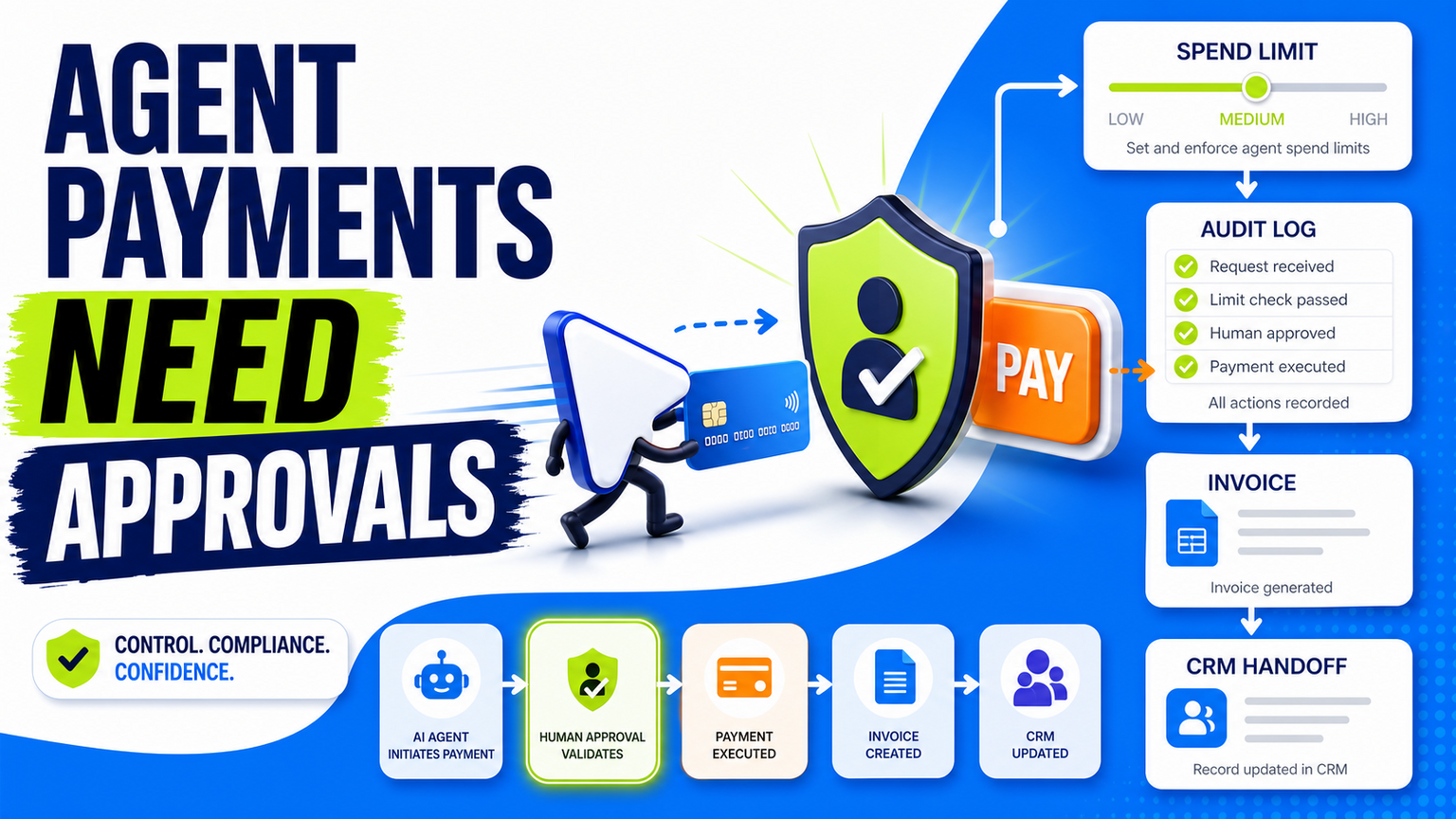
A good payment workflow needs at least six controls. First, define allowed categories such as stationery, software renewals or replacement parts. Second, define allowed vendors and blocked vendors. Third, set spend limits by role, team and urgency. Fourth, require human approval for new suppliers, unusual totals, contract changes and refunds. Fifth, log the source documents, screenshots, invoice IDs, conversation history and approval trail. Sixth, update the system of record after the payment, not just the chat thread.
GOFTUS builds these patterns as practical automation systems. The same project might connect an AI agent to a supplier inbox, an approval form, a browser task, a CRM record and a finance tracker. See our AI agent and workflow automation work at /agents and /services.
Competitor lens
The market will offer several paths. SaaS tools such as Zapier, n8n, Make, Bardeen, Gumloop, Lindy, Relevance AI and Stack AI can connect tasks and trigger actions. Consultancies such as Faculty AI, Deeper Insights, Waracle, Brainpool AI, LeewayHertz, Markovate, SoluLab, BairesDev, Addepto, STX Next, Netguru and 10Clouds can help larger teams design AI projects.
Those options can be useful. The missing piece for many SMEs is ownership of the end-to-end operating workflow. Tools automate tasks. GOFTUS automates the workflow around the task. That means we care about who can request a purchase, what the agent is allowed to see, when the action pauses, where evidence is stored, how exceptions are routed and how the process improves each month.
In payment automation, that difference is critical. A connector that can press pay is not the same as a buying workflow that protects cash, supplier trust and audit evidence.
What SMEs should do next
Start with a narrow payment-adjacent workflow, not a company-wide payment agent. Good candidates include renewal reminders, invoice matching, purchase request drafting, supplier quote comparison, travel pre-approval or low-risk replenishment. Keep the first version read-only or prepare-only until the business has clear confidence in approvals and logs.
Map the stop rules before choosing tools. The agent should stop when a supplier is new, a total is above the limit, an invoice field does not match, a login requires sensitive access, a refund is involved or the payment creates a long-term commitment. It should also stop when the evidence is weak. A confident answer without a receipt, order number or approval note is not enough.
Then connect the action to the rest of the workflow. A paid invoice should update finance. A renewed subscription should update the software register. A purchased lead list or event booking should update CRM. A customer refund should update support notes. Payment is only one step in the chain.
Summery for SMEs
AI agent payment standards are a sign that autonomous commerce is becoming real, but SMEs should not confuse payment capability with payment readiness. The practical opportunity is to build controlled workflows where agents research, prepare and route purchases while owners keep approval, spend limits and evidence in place.
GOFTUS can help turn that into a safe first automation project: define the workflow, connect the tools, add approval gates, log the evidence and measure exceptions. If you want to test whether an agent-payment or purchasing workflow is ready, start with a short diagnostic through /contact.
FAQ
Should SMEs let AI agents make payments?
Not by default. SMEs should begin with agent-assisted purchasing where the agent gathers evidence, prepares the payment or drafts the request, and a human approves final spend. Full autonomy should wait until limits, vendors, evidence and stop rules are working.
What is the safest first use case?
Renewal tracking, invoice matching and purchase-request drafting are safer than open-ended buying. They let the agent reduce admin work without giving it unlimited authority over cash.
Where does GOFTUS fit?
GOFTUS designs the workflow around the agent: approvals, browser steps, CRM or finance updates, audit logs and monthly improvement. The goal is practical control, not a flashy payment demo.