AI Agent Governance Checklist: What SMEs Should Approve Before Agents Touch Real Work
Use an AI agent governance checklist to decide what agents may see, prepare, change, submit, and escalate before they touch real business workflows.
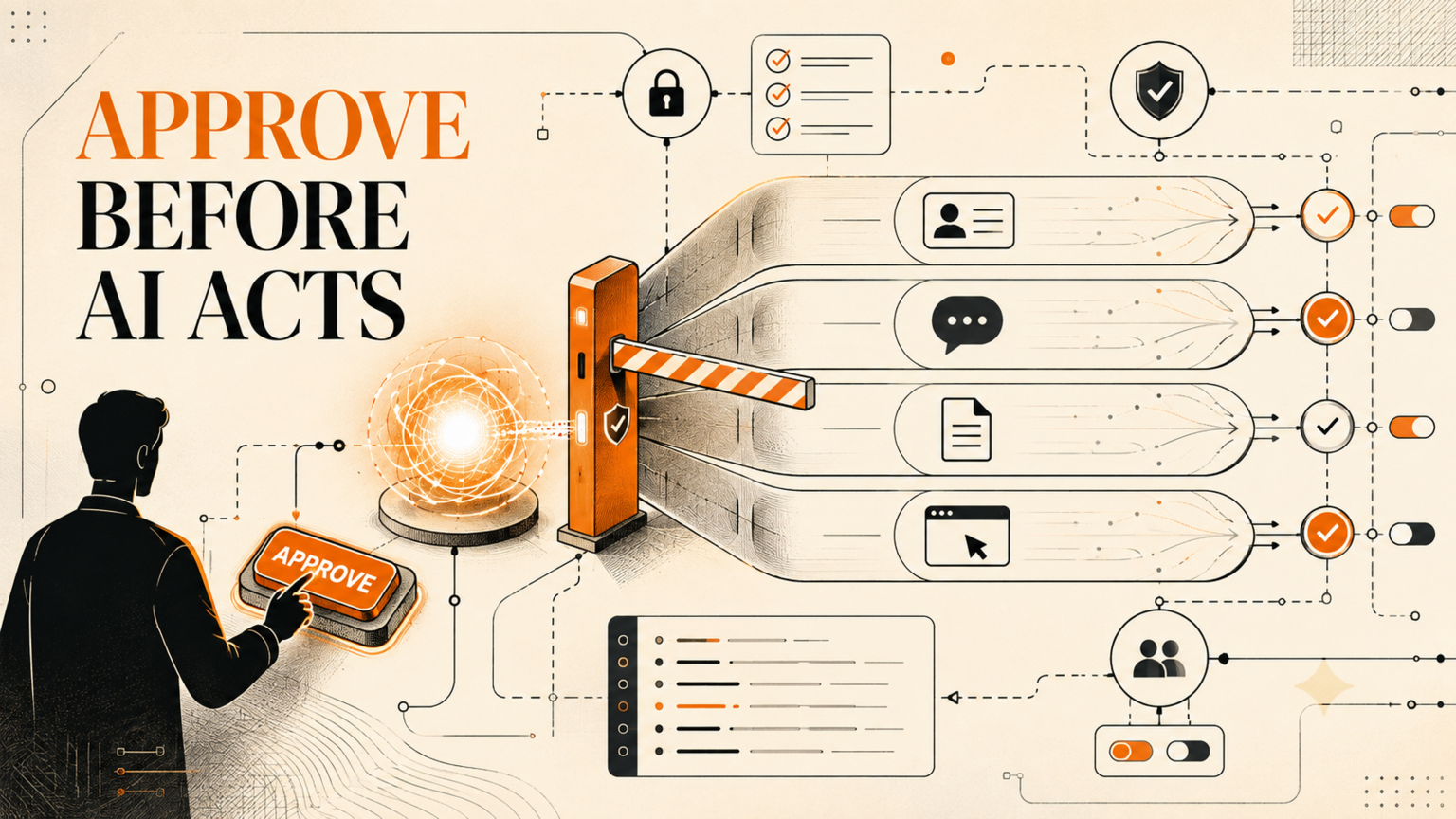
## Quick answer An AI agent governance checklist helps a business decide what an agent may read, prepare, change, submit, escalate, and log before it touches customer, finance, support, browser, or document workflows.
Quick answer
An AI agent governance checklist helps a business decide what an agent may read, prepare, change, submit, escalate, and log before it touches customer, finance, support, browser, or document workflows.
AI agents are becoming easier for non-technical teams to test. A founder can ask an assistant to draft a support reply. A sales manager can ask it to update a CRM record. A marketing team can ask it to prepare campaign assets. The risk is not that the tool is useless. The risk is that the first useful demo quietly becomes an unofficial workflow with no owner, no approval gate, and no record of what happened.
That is why SMEs need a practical checklist before they scale agent work. NIST frames AI risk management around govern, map, measure, and manage functions, which is useful because governance is not a one-off document.[1] OWASP also treats agentic systems as a distinct risk area because agents can combine model output, tool access, memory, planning, and external actions.[2]
GOFTUS turns that lesson into workflow design. The question is not simply which AI tool to buy. The better question is: what work should the agent only observe, what may it prepare, what needs human approval, and what can it do automatically after the process has proven itself?
Why agent governance needs a checklist, not a policy PDF
Most small businesses do not fail at AI because they lack a policy. They fail because the policy does not reach the moment where work actually happens. Someone copies customer data into a chat window. Someone lets an agent draft an email from an old template. Someone asks a browser assistant to fill a supplier form. Nobody means to create risk, but the workflow expands faster than the controls.
A checklist works because it lives beside the workflow. It gives staff a simple way to decide whether a task is green, amber, or red. Green work can be prepared or completed by automation because the data is low-risk and the action is reversible. Amber work can be prepared by AI, but a named person must approve it. Red work is blocked until the business has clear boundaries, logging, and recovery steps.
For a GOFTUS client, that checklist usually becomes part of the workflow build itself. It can sit inside a support triage process, a CRM update lane, a content approval board, an n8n sequence, or a browser-agent task queue. The checklist is not paperwork. It is the operating layer that keeps useful automation from becoming shadow automation.
The six approvals every SME should define
First, approve the data boundary. Decide what the agent may read. Public website copy is different from customer records, finance data, passwords, contracts, and internal notes. If a workflow needs sensitive context, define exactly where that context comes from and what must stay out.
Second, approve the source of truth. An agent should not decide which document, CRM field, product page, price list, or policy is correct by guessing. Give it approved sources and a clear fallback when those sources disagree. If the answer depends on outdated notes, the agent should ask for review rather than inventing certainty.
Third, approve the action boundary. Reading, summarising, drafting, changing, sending, deleting, submitting, and purchasing are different levels of responsibility. Many businesses can start safely by letting an agent observe and prepare. They should only allow direct action after the approval path, test cases, and logs are working.
Fourth, approve the reviewer. Human approval is weak if nobody owns it. The checklist should name who reviews support replies, CRM changes, refunds, supplier messages, document edits, ad copy, and browser submissions. It should also define what happens when that person is unavailable.
Fifth, approve the audit trail. Every serious workflow should record the trigger, source data, agent output, reviewer decision, final action, exception, and follow-up. This matters for improvement as much as accountability. Without a log, the business cannot tell whether the agent saved time, created rework, or shifted the burden to managers.
Sixth, approve the stop rule. Staff need a simple rule for pausing the agent when something looks wrong. Examples include low confidence, missing data, customer complaint, unexpected price change, unusual browser prompt, failed login, duplicate CRM record, or repeated escalation. A stop rule turns uncertainty into a managed queue instead of a hidden failure.
What this means for SMEs
SMEs do not need enterprise bureaucracy before using AI agents. They do need enough structure to stop helpful experiments from becoming uncontrolled operations. The best first step is usually a diagnostic: pick one workflow, map its handoffs, classify the risk, and decide where AI should prepare work rather than act alone.
That is why GOFTUS links agent governance to practical builds through /agents and /services. A support workflow might start with AI drafting replies, tagging urgency, and preparing CRM notes. A finance workflow might start with invoice extraction and exception routing. A marketing workflow might start with campaign QA and approval checklists. The agent can be useful on day one, but the business keeps ownership of final decisions.
Practical workflow example
Consider a service business that receives website enquiries, support questions, and partner requests through several forms. The team wants an agent to read each message, classify the request, draft a response, update the CRM, and book a follow-up task.
A weak implementation lets the agent do everything because the demo looked accurate. A governed implementation separates the lanes. The agent may read the form and prepare a summary. It may suggest a reply using approved service copy. It may prepare a CRM note. But it cannot send the reply, change deal stage, promise a price, or submit a partner form without approval.
The workflow also logs why the agent made the recommendation, which source it used, who approved the action, and what happened next. After a few weeks, the business can review the log and decide whether some actions are safe to automate further. This is how automation matures without gambling with customer trust.
Competitor lens
No-code automation tools, AI workspaces, and consultants can all help. The gap appears when the tool gives the business a powerful action surface but does not define ownership. A workflow builder may connect the systems. A model may draft the content. A consultant may design a process. The business still needs a clear operating model for approvals, logs, exceptions, and improvement.
GOFTUS is useful when the problem is not just connecting apps, but deciding how AI should participate in the workflow. That includes source control, reviewer roles, fallback paths, browser controls, CRM and support handoffs, and monthly review. The goal is not slower automation. The goal is automation the team can trust, measure, and improve.
Summery for SMEs
If an AI agent can touch real work, it needs real boundaries. Start with one workflow, define what the agent may see, prepare, change, and escalate, then add named approval, logging, and stop rules before giving it more authority.
For teams that want a safe first step, GOFTUS can run a workflow diagnostic through /contact, map the approval gates, and build the first governed automation path.
FAQ
What should an AI agent governance checklist include?
It should include data boundaries, approved sources, action permissions, reviewer roles, audit logs, escalation paths, and stop rules.
Can a small business use AI agents without heavy compliance work?
Yes. Start with low-risk preparation tasks, keep approvals on customer or financial actions, and log outcomes before expanding autonomy.
Where should an SME begin?
Begin with one repeated workflow, such as support triage, CRM follow-up, document review, or browser-based form preparation. Map the risk before choosing the tool.
Sources
[1] https://www.nist.gov/itl/ai-risk-management-framework, NIST AI Risk Management Framework
[2] https://genai.owasp.org/resource/agentic-ai-threats-and-mitigations, OWASP Agentic AI Threats and Mitigations