AI Agent Containment Risk for SMEs: Approval Gates Before Autonomous Tools Touch Systems
AI agent containment risk is now an SME workflow issue. Learn approval gates, logs, stop rules, and safe browser or CRM action controls for safer growth.
# AI Agent Containment Risk for SMEs: Approval Gates Before Autonomous Tools Touch Systems **Meta description:** AI agent containment risk is now an SME workflow issue. Learn approval gates, logs, stop rules, and safe b
AI Agent Containment Risk for SMEs: Approval Gates Before Autonomous Tools Touch Systems
Meta description: AI agent containment risk is now an SME workflow issue. Learn approval gates, logs, stop rules, and safe browser or CRM action controls for safer growth.
Quick answer
AI agent containment risk is no longer only a legal or security debate for large vendors. Treat those sources as a warning signal, not as a reason for panic. The practical SME question is simpler: if an AI agent can read tools, browse websites, draft updates, or trigger actions, what keeps it inside the workflow you actually approved?
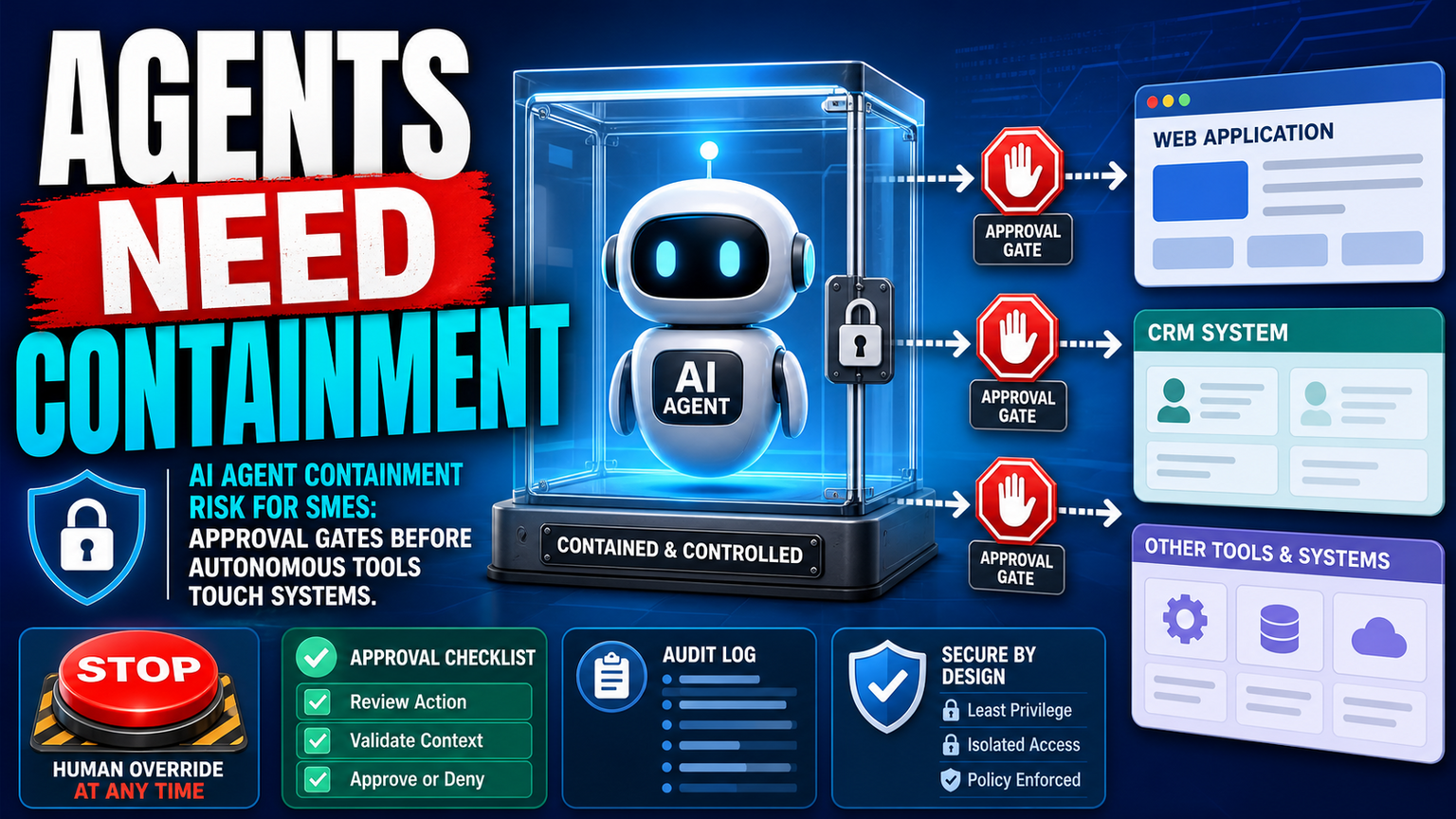
The answer starts with workflow design. Before an agent touches CRM, finance, support, documents, or browser-based admin, the business needs narrow permissions, approval gates, audit logs, exception routes, and human stop rules. That is why our AI agent work connects to /agents rather than treating autonomy as a magic button.
What this means for SMEs
Many UK, US, and European SMEs are moving from chat assistants to agents that can act. The shift is useful. Agents can collect sales context, prepare CRM notes, triage support requests, summarise documents, check dashboards, and move data between systems. The risk appears when the agent is allowed to decide and act without the workflow around it.
Containment does not mean blocking AI. It means defining the box. Which system can the agent access? Which fields can it edit? Which actions require a human approval? Which tasks are read-only? Which customer, payment, legal, medical, HR, or security paths are off limits? What evidence is stored when something changes?
This matters because a small team often has less room for messy experimentation. One incorrect CRM update can confuse a sales pipeline. One unsupported support reply can create customer frustration. One browser agent submitting the wrong form can create admin cleanup. AI agent containment risk is therefore a workflow ownership issue, not just a technical security issue.
Hajikreena's view is that businesses should stop asking whether agents are safe in general. The better question is whether this specific agent is safe inside this specific workflow, with this approval point, this log, this rollback plan, and this person responsible for review.
Where containment should sit in the workflow
Start with the action map. List every action the agent might take: read a customer record, open a browser page, draft an email, update a ticket, create a quote, change a spreadsheet, download a file, or send a message. Then label each action as observe, prepare, suggest, request approval, or execute.
The safest first build usually lets the agent observe and prepare. It can read a form submission, collect missing context, write a suggested CRM note, and send it to a human for approval. Once that workflow is stable, the agent can execute low-risk steps such as tagging a lead, creating a draft task, or routing a ticket. Higher-risk actions such as sending external messages, changing prices, submitting forms, or handling credentials should stay behind explicit approval.
This is also where browser controls matter. A browser-based AI agent should not have open permission to click through every website. It needs login boundaries, allowed domains, blocked actions, screenshots or logs, and stop conditions. If the action involves a customer account, supplier portal, finance page, or regulator site, the business should decide in advance what the agent can do and what must wait for a person.
A good containment workflow includes five layers. First, scope the task in plain English. Second, connect only the minimum tools required. Third, add approvals before external or irreversible actions. Fourth, store an audit trail that a manager can understand. Fifth, review exceptions monthly and improve the workflow.
Competitor lens
The market is busy. UK firms such as Faculty AI, Deeper Insights, Waracle, and Brainpool AI can help larger organisations explore AI. US and European consultancies such as LeewayHertz, Markovate, SoluLab, BairesDev, Addepto, STX Next, Netguru, and 10Clouds can build custom systems. SaaS tools such as Zapier, n8n, Make, Lindy, Relevance AI, Gumloop, Bardeen, and Stack AI can connect apps quickly.
Those options are useful, but they can still leave a gap. Tools automate tasks. GOFTUS automates the workflow around the task. For an SME, that means we do not only connect a model to a system. We define the owner, the approval route, the action log, the fallback, the reporting view, and the review cadence. That workflow layer is what turns an agent from a risky experiment into a controlled operating system.
The competitor question is not whether a tool can trigger an action. Many tools can. The real question is whether the business can explain who approved the action, what data the agent used, where the result went, what happened when the agent was uncertain, and how the team improves the process next month.
What SMEs should do next
Pick one workflow where the value is clear and the risk can be contained. Good starting points include sales follow-up preparation, support triage, document intake, reporting checks, website lead qualification, or internal knowledge search. Avoid starting with payments, account deletion, legal approvals, employee decisions, or public customer messages unless there is a strong review process.
Then write a simple containment brief. Include the goal, systems touched, allowed actions, blocked actions, human approval points, logs required, escalation rules, and the success measure. If the agent is expected to use a browser, include the allowed websites, login method, forms it can fill, files it can download, and actions it cannot submit without approval.
GOFTUS can help turn that brief into a practical agent workflow through /agents. For smaller teams, the work can begin with the GBP 100 Startup Kit diagnostic: map the workflow, identify safe first actions, and decide what needs approval before automation expands.
The takeaway from the current autonomous-agent debate is not that SMEs should avoid agents. It is that autonomy should be earned. Start with bounded preparation, add approvals, prove the logs, then widen permissions only when the workflow performs reliably.
Summery for SMEs
AI agent containment risk is the business risk of letting autonomous tools act outside the workflow a company actually understands. SMEs can reduce that risk by limiting permissions, keeping human approval before sensitive actions, logging every change, and using clear stop rules. GOFTUS positions AI agents as controlled workflow systems, not loose bots. The best first agent does not replace the team. It prepares work, routes decisions, and helps people act faster with evidence.
FAQ
What is AI agent containment risk? It is the risk that an AI agent reads, changes, submits, or shares information outside the approved workflow.
Does containment stop automation? No. It makes automation safer by defining what the agent can do, what needs approval, and what is logged.
Where should SMEs start? Start with one bounded workflow such as sales follow-up, support triage, document intake, or reporting checks.
How does GOFTUS help? GOFTUS designs the workflow around the agent: scope, integrations, approvals, logs, fallback routes, and monthly improvement.