AI Agent Approval Workflows for SMEs: Control Identity Access Before Automation Acts
AI agent approval workflows help SMEs control identity access, browser actions, CRM updates, and support automation before risky changes go live.
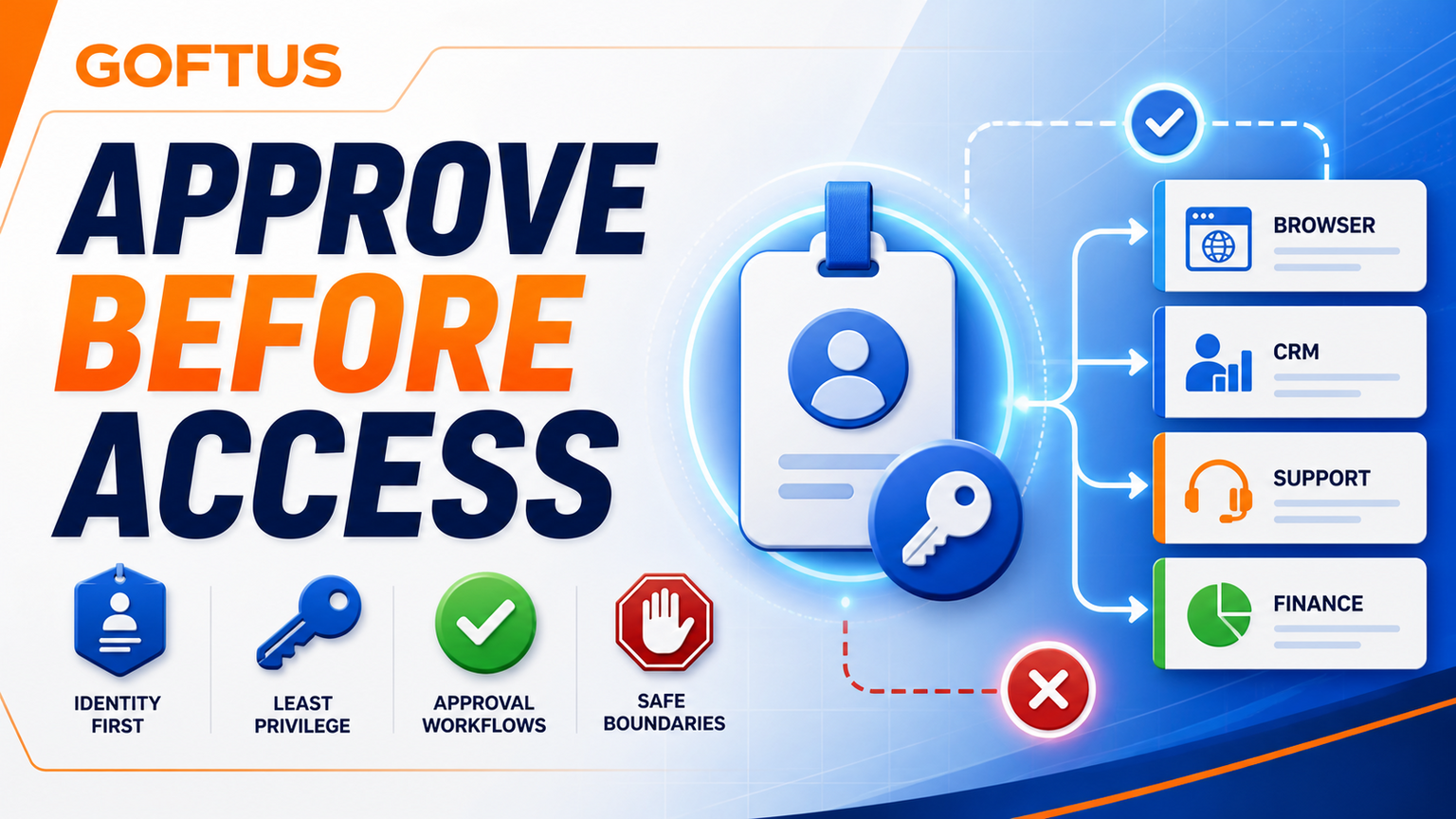
# AI Agent Approval Workflows for SMEs: Control Identity Access Before Automation Acts **Meta description:** AI agent approval workflows help SMEs control identity access, browser actions, CRM updates, and support autom
AI Agent Approval Workflows for SMEs: Control Identity Access Before Automation Acts
Meta description: AI agent approval workflows help SMEs control identity access, browser actions, CRM updates, and support automation before risky changes go live.
AI agent approval workflows give a business a controlled way to let automation help with identity, access, CRM, support, finance, and browser work without giving every tool open permission to act. That is identity operations news, not an AI-agent incident. The SME lesson is wider: any workflow that depends on access rules needs an owner, review queue, test environment, rollback path, and audit trail before agents or automations act on live systems.
For companies that want this built rather than guessed, GOFTUS designs practical AI agent workflows at /agents with approval gates, logs, and clear human ownership.
What this means for SMEs
Most small and mid-sized teams do not think of identity rules as a customer-workflow problem. They should. A group rule can decide who sees a file, who receives a ticket, who can update CRM data, who can approve an invoice, or which admin screen an automation can reach. When that rule changes or stops updating, the impact can leak into sales, support, finance, reporting, and compliance work.
The Microsoft Entra example matters because it shows how quiet infrastructure changes can create operational risk long before anyone talks about AI. A dynamic group may look like background plumbing, but it can power access packages, admin units, onboarding flows, and routing rules. If a business later adds an AI agent on top of those systems, the agent inherits the strength or weakness of that plumbing.
That is why GOFTUS treats AI agents as workflow systems. The key question is whether the business can prove who approved an action, what boundary applied, what changed, and how a person can stop or reverse it.
This is a social and documentation signal, not a claim that AI agents caused the Entra change. Microsoft Learn provides the official deadline and warns that affected rules stop updating and stay in their last known state. The business takeaway is simple: approval workflows should be designed before automation touches permissions.
A good SME pattern is to split work into three lanes: read-only assistance, proposed actions for approval, and limited execution only after the rule, owner, account, and stop condition are known.
This matters especially for browser-based work. Many real business tools still require browser actions: logging into portals, checking supplier dashboards, updating customer records, downloading statements, or submitting forms. A browser agent without approval rules is risky. A browser with AI controls, logs, and human-approved submit buttons is a safer business workflow.
Approval workflow design for identity and access automation
Start with a map of affected systems. For each system, list the action, business owner, data sensitivity, approval point, and rollback route. Do not begin with a tool choice. Begin with the workflow that must stay safe.
For example, a support automation may read customer history, classify the issue, draft the reply, and route complex cases to a person. It should not also gain open permission to edit billing, close disputes, or change account ownership. A CRM automation may enrich a lead and create a follow-up task, but the final send, discount approval, or account merge may need a human check.
The same principle applies to identity changes. A workflow can collect candidates for a group update, compare them against policy, and prepare a change request. The actual change should pass through an approval queue with a visible reason, source data, requester, approver, and rollback note. If the automation runs in a browser, it should operate inside allow-listed pages, use a bounded login, and stop before irreversible submission unless a person approves.
GOFTUS builds this kind of structure into /agents and /services engagements: narrow scope, approval gates, audit logs, exception routes, and monthly improvement. The aim is not to slow the team down. It is to stop invisible tool changes from becoming customer-facing errors.
Faculty AI, Deeper Insights, Waracle, Brainpool AI, LeewayHertz, Markovate, SoluLab, BairesDev, Addepto, STX Next, Netguru, and 10Clouds can all be useful partners for analytics, app development, or AI implementation. SaaS tools like Zapier, n8n, Relevance AI, Lindy, Gumloop, Bardeen, Make, and Stack AI can automate individual tasks quickly.
The gap appears around ownership. Tools automate tasks. GOFTUS automates the workflow around the task. That means the intake form, approval step, access boundary, exception queue, browser-control rule, CRM or support handoff, audit log, and review rhythm are designed together.
For SMEs, this difference is practical. A connector can move data. A script can update a field. An agent can open a browser and act. But the business still needs to know when the action is allowed, who signs off, what happens when source data is stale, and how results are measured.
What SMEs should do next
Review any automation that depends on user groups, permissions, shared inboxes, admin portals, or CRM roles. Mark which actions are read-only, which actions only prepare recommendations, and which actions can change live systems. If the third category exists, add a human approval point and a visible log.
Next, create a short migration habit. When a vendor announces a change like the Entra `memberOf` retirement, assign an owner, identify affected workflows, test replacements, and document what happens if the rule stops updating. Do not wait until an AI agent, browser automation, or support workflow starts acting on stale permissions.
If you want a practical diagnostic, GOFTUS can review one workflow and recommend where approvals, browser controls, logs, CRM handoffs, or support routing should sit. Start with /agents or /services.
The Entra `memberOf` retirement is an identity-management signal, but the lesson is bigger than one Microsoft feature. SMEs need approval workflows before AI agents, browser automations, or CRM/support systems act on access-sensitive work. Build the rule, owner, approval, log, stop condition, and rollback route first. Then let automation accelerate the safe parts.
Should SMEs stop using AI agents for identity or admin workflows?
No. They should separate read-only help, proposed actions, and approved execution. Most risk comes from giving a tool broad permission without a clear owner, not from using automation itself.
Where should browser with AI controls fit?
Use browser controls when the workflow requires live web tools, admin portals, or supplier systems. The agent should have narrow page access, logs, and a human-approved final action for risky steps.
What is the first workflow to review?
Start with customer-facing systems: CRM, support inboxes, billing changes, onboarding access, and browser submissions. These are the places where stale permissions or silent automation mistakes become visible quickly.