Workflow Automation for IT Security: Turn Phishing Drills Into Recovery Playbooks
Workflow automation helps SMEs turn phishing drills into calm recovery playbooks, approval gates, and measurable security follow-up.
# Quick answer Workflow automation for IT security gives SMEs a calmer way to handle phishing drills, suspicious emails, and employee mistakes. The fresh trigger for this post is a 100-score r/sysadmin Reddit discussion
Quick answer
Workflow automation for IT security gives SMEs a calmer way to handle phishing drills, suspicious emails, and employee mistakes. The fresh trigger for this post is a 100-score r/sysadmin Reddit discussion where an IT worker described the stress of failing to spot a phishing simulation. Reddit is social heat, not verified fact, so GOFTUS treats it as an operator signal about morale, process design, and security handoffs. The news cross-check is that Google News RSS is currently surfacing security-awareness and phishing-simulation coverage from Business Wire, ESET, TechTarget, Cybersecurity Dive, and other security publications.
The searchable business problem is not whether phishing simulations are good or bad. The problem is how a UK, US, or EU SME turns a stressful security moment into a repeatable workflow. A better process says what happens when someone reports a suspicious email, who triages it, when managers are told, how users are coached, what gets logged, and when a stronger response is required. GOFTUS builds practical workflow automation for exactly this kind of operational gap. Start with /services if your team needs security, support, CRM, or document processes that do not depend on one overloaded person remembering every step.
What this means for SMEs
Many SMEs buy security tools before they design the workflow around the human response. A phishing simulator can send test emails. An email gateway can flag risk. A helpdesk can hold tickets. A training platform can assign a module. But the business still needs a clear path from signal to action.
That path matters because phishing is both technical and emotional. Staff may feel embarrassed when they click. IT teams may feel blamed when a simulation goes badly. Managers may see the result as a score rather than as a process improvement opportunity. Without a workflow, every incident becomes a one-off judgement call.
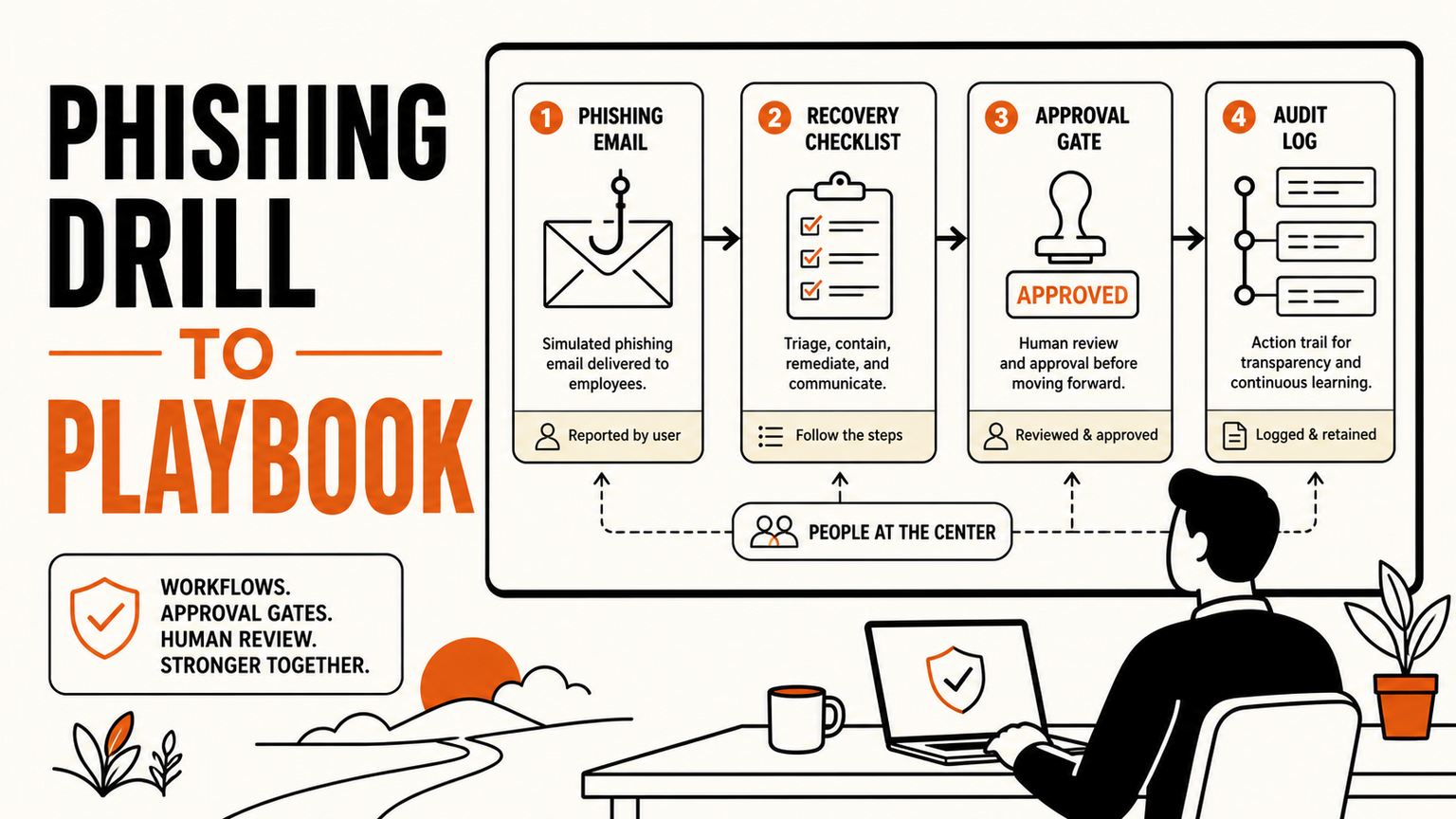
Workflow automation turns the event into a managed queue. First, the email is captured or reported. Second, triage identifies whether it is a simulation, real attack, false positive, or unclear case. Third, the system routes the next step: isolate, escalate, coach, communicate, or close. Fourth, the manager gets the right summary without public shaming. Fifth, the audit trail records what changed after the event.
This is where GOFTUS differs from a simple alerting setup. The value is not another inbox notification. The value is a repeatable process that helps people recover quickly, protects customers, and gives leaders evidence that controls are improving.
Thirumurugan's view
My view is that phishing drills fail when they are treated like traps instead of workflow tests. The important question is not just who clicked. The better question is what the organisation did next. Did the user know where to report it? Did IT get context fast enough? Did a manager understand the difference between coaching and blame? Did the business update the playbook after the event?
A strong SME workflow separates three lanes. Green lane events are safe training moments. The system logs them, sends a short explanation, and offers a simple next step. Amber lane events need review because the user entered data, forwarded the message, or touched a risky link. Red lane events require containment, leadership notice, customer protection, or outside security help.
This lane model is simple enough for a small team and strong enough for a growing business. It also avoids the common mistake of using automation to punish people faster. The goal is better response, not faster blame.
What SMEs should do next
Start by mapping the first thirty minutes after a suspicious email. Who receives the report? What evidence is needed? Which mailbox, ticket queue, or security tool is the source of truth? What message does the employee receive? Who decides whether the incident is training, real, or uncertain?
Then automate only the predictable parts. A GOFTUS workflow can create a ticket, collect screenshots or headers, notify the right owner, draft a staff response, add a CRM or customer-support note when needed, and schedule follow-up training. A human should still approve sensitive actions such as customer communication, account lockdown, regulator contact, or staff performance escalation.
Next, connect the security workflow to wider operations. If a phishing event touches invoices, customer records, supplier portals, or support inboxes, the response should not live only in an IT spreadsheet. The workflow should hand off to finance, CRM, support, document control, or browser action review when required.
Finally, measure learning without inventing theatre. Track whether reports are faster, whether handoffs are clearer, whether repeat issues drop, and whether managers can see unresolved items. Avoid fake certainty. Security awareness is not fixed by one tool or one simulation. It improves when the business owns the workflow around the tool.
Competitor lens
Faculty AI, Deeper Insights, Waracle, Brainpool AI, LeewayHertz, Markovate, SoluLab, BairesDev, Addepto, STX Next, Netguru, and 10Clouds can all be useful for broader AI, data, or engineering projects. SaaS tools such as Zapier, n8n, Relevance AI, Lindy, Gumloop, Bardeen, Make, and Stack AI can also move data between systems.
The gap for SMEs is ownership of the operational workflow. A connector can open a ticket, but it may not decide who reviews a risky case. A training tool can assign a module, but it may not connect the result to CRM, finance, support, or leadership reporting. A consultant can advise on policy, but the team still needs the day-to-day automation that people actually use.
Tools automate tasks. GOFTUS automates the workflow around the task. For phishing and security-awareness operations, that means intake, triage, approval gates, audit logs, manager summaries, exception handling, and monthly improvement. The automation is useful because it makes the business calmer under pressure.
Summery for SMEs
A phishing simulation should not leave an employee isolated or an IT owner guessing what to do next. SMEs need a playbook that turns the signal into a calm sequence of report, triage, approval, response, coaching, and evidence. GOFTUS can help design that sequence as a practical workflow across the tools you already use.
If your business is testing AI, security automation, support workflows, or staff reporting, use this moment to ask a practical question: what happens after the alert? If the answer depends on memory, goodwill, or a private spreadsheet, it is ready for workflow automation. Book a GOFTUS diagnostic through /contact or review the core automation options at /services.
FAQ
Should SMEs stop running phishing simulations?
No. The issue is not the existence of simulations. The issue is whether the business has a fair recovery workflow after them. Simulations work best when they improve reporting, coaching, triage, and playbooks rather than creating fear.
Where does AI fit in security workflow automation?
AI can help summarise suspicious emails, draft plain-English explanations, classify cases, and prepare next actions. GOFTUS recommends human approval before sensitive security, customer, finance, or HR actions move forward.
What is the first workflow to automate?
Start with suspicious-email reporting and triage. It is common, measurable, and easy to review. Once that works, connect related tasks such as support notes, CRM updates, document evidence, and management reporting.
Source notes: Reddit source signal was the 2026-08-16 GOFTUS intelligence item from r/sysadmin, "About to ruin a 30+ year IT career because I can't spot a phishing simulation..." It is treated as social sentiment only. News cross-check used Google News RSS results for phishing simulation and security-awareness training, including headline-level results from Business Wire, ESET, TechTarget, Cybersecurity Dive, and related security publications. X/xurl was unavailable because no xurl apps are registered in this cron environment.