Small business AI security starts with audit logs, not panic
Small-business AI security improves when teams turn alerts, prompts, access changes, and exceptions into logged workflows with clear owners.
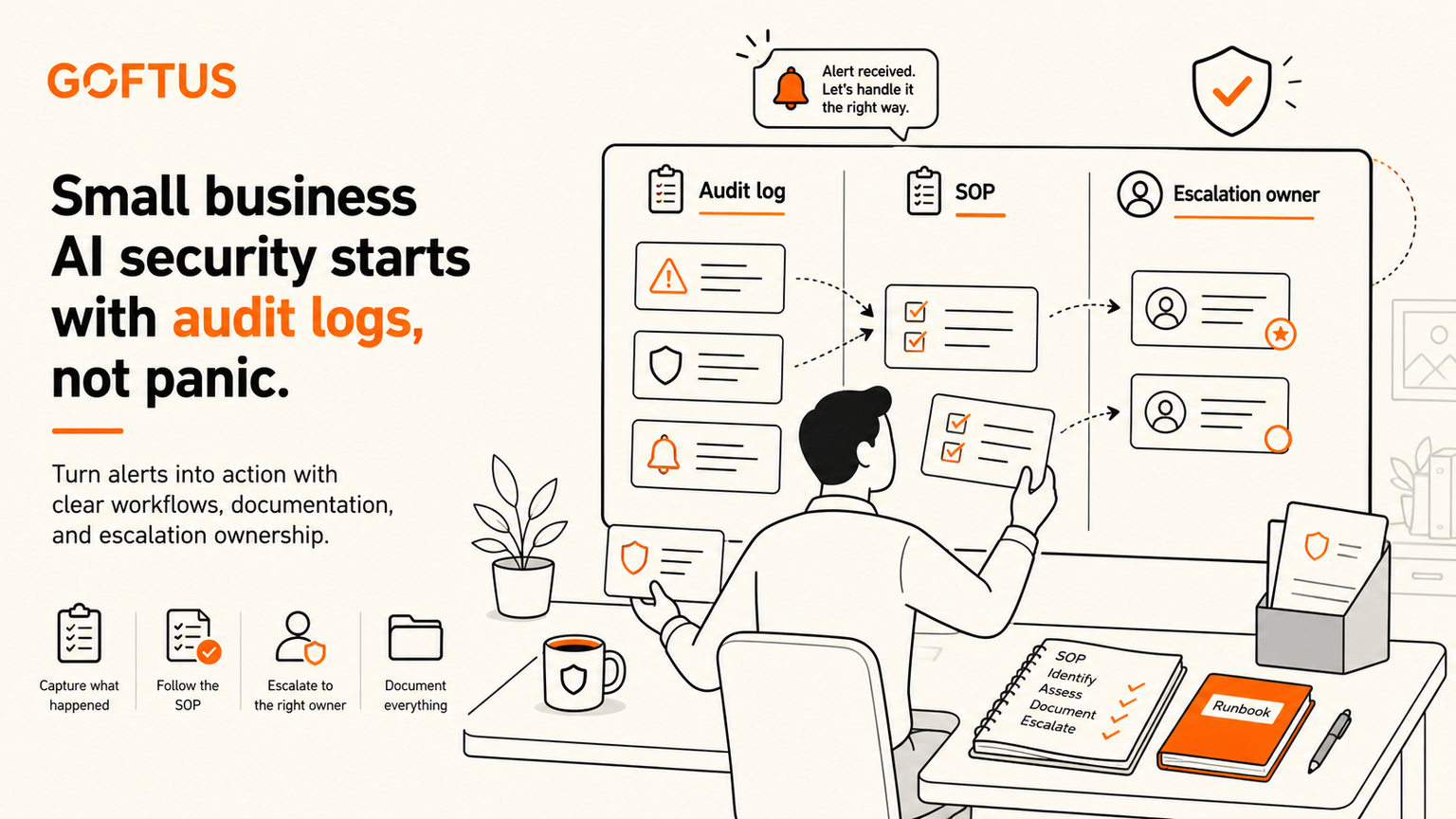
# Small business AI security starts with audit logs, not panic Meta description: Small-business AI security improves when teams turn alerts, prompts, access changes, and exceptions into logged workflows with clear owner
Small business AI security starts with audit logs, not panic
Meta description: Small-business AI security improves when teams turn alerts, prompts, access changes, and exceptions into logged workflows with clear owners.
Quick answer
The tech-ops signal today was practical and a little anxious. Reddit intelligence surfaced an r/sysadmin post asking for a crash course in AI use cases beyond asking an LLM questions, plus an r/cybersecurity post from a small regulated startup trying to build a security programme without senior support. These are social signals, not verified company facts. They show a buyer problem GOFTUS sees often: teams want AI help, but they do not yet have the workflow evidence to make it safe.
What this means for SMEs
The mapped keyword is audit logs, backed by the Reddit intelligence score of 92. For small-business AI security, audit logs are not paperwork at the end. They are the operating layer. If staff use AI to summarise tickets, draft policies, inspect alerts, update documents, or interact with admin portals, the business should know what data was used, what the AI suggested, who approved it, what changed, and what exception was raised.
A useful first workflow is alert triage. AI can group alerts, explain likely impact, draft a remediation note, or compare an event against a policy. It should not silently close incidents, change access, rotate secrets, or email customers without a gate. The workflow should route low-risk findings to the right owner, pause high-risk actions for review, and record the decision. That gives the business a simple evidence trail for training, compliance, and incident learning.
What competitors are missing
Security vendors and consultants have their place. Tools can detect signals, and consultants can create frameworks. GOFTUS focuses on the connective tissue: how the alert becomes a task, how the task gets reviewed, how the decision is logged, and how repeat problems turn into SOP updates. That is especially important for SMEs that cannot hire a full security team but still need control over AI-assisted work.
Workflow GOFTUS would implement
Measure progress by counting unresolved alerts, repeated exceptions, mean time to owner assignment, and how often staff bypass the workflow. If people keep using private AI accounts for sensitive tasks, the problem is not only policy. It is that the approved route is too slow or unclear. Build the route, log the route, then improve it.
Security workflow checklist
GOFTUS would begin by identifying the AI-assisted security tasks most likely to create hidden risk: alert summaries, policy drafts, access reviews, vendor checks, incident notes, browser portal actions, and support responses after an incident. Each task gets a lane. Low-risk summaries can be automatic if source links are preserved. Medium-risk recommendations need an owner review. High-risk remediation, access changes, and customer communications require approval and rollback notes. The log should be readable by a manager, not only a security engineer. It should say what triggered the task, what evidence was used, what the AI suggested, who accepted or changed it, and what happened next. This gives smaller teams a practical security operating system before they can hire deep specialist coverage. It also turns repeated incidents into better SOPs instead of recurring panic.
Rollout plan
A safe rollout should move in four short phases. First, observe the existing process for a week and capture the real inputs, rework, waiting time, and exceptions. Second, prepare the automation in a limited lane where AI can draft, classify, summarise, or route but cannot make irreversible changes. Third, approve the risky steps with named owners and simple review screens. Fourth, review the log and improve the workflow every month. This is deliberately less dramatic than buying a large platform and hoping staff adapt. It is also more reliable for SMEs because it respects the tools, habits, and constraints already inside the business.
The first version should be narrow enough that one manager can explain it in plain English. If staff cannot say when the workflow starts, where the output goes, who approves exceptions, and how to stop it, the automation is not ready. GOFTUS would rather ship a controlled lane that saves a few hours every week than an impressive demo nobody trusts. Once the log proves the workflow is safe, the business can widen the scope with confidence.
Summery for SMEs
The Reddit signal points to a practical operating lesson: AI security workflows for SMEs built around audit logs and escalation lanes. GOFTUS would turn that into a controlled workflow with a named owner, clear inputs, approval gates for risky actions, logs for review, and a monthly improvement loop. The internal path for this topic is /services, with supporting Q&A on /questions.
FAQ
What should an SME do first? Start with one workflow that already creates delays or risk, then define the trigger, owner, allowed AI step, review gate, and log before adding more tools.
Where does GOFTUS fit? GOFTUS designs and manages the workflow around the tool: integrations, approval screens, exception routing, audit logs, and improvement after staff use it.
Sources and signal
Reddit/social signal: r/sysadmin and r/cybersecurity signals showed operators asking for AI use cases beyond chat and a small regulated startup trying to prioritise security without senior mentorship.
News/source cross-check: Google News RSS returned headline-level context on Shadow AI risks and AI in cybersecurity. The post treats news RSS as context, not scraped article verification.
Source note: Reddit is used as operator sentiment and social heat only. Google News RSS results are cited at headline level where direct article retrieval was not available during the unattended run.