Small Business AI Agent Teams Need Workflow Ownership, Not Botsitting
AI agent teams are reaching SMEs, but the real advantage is workflow ownership, approvals, monitoring, and monthly improvement.
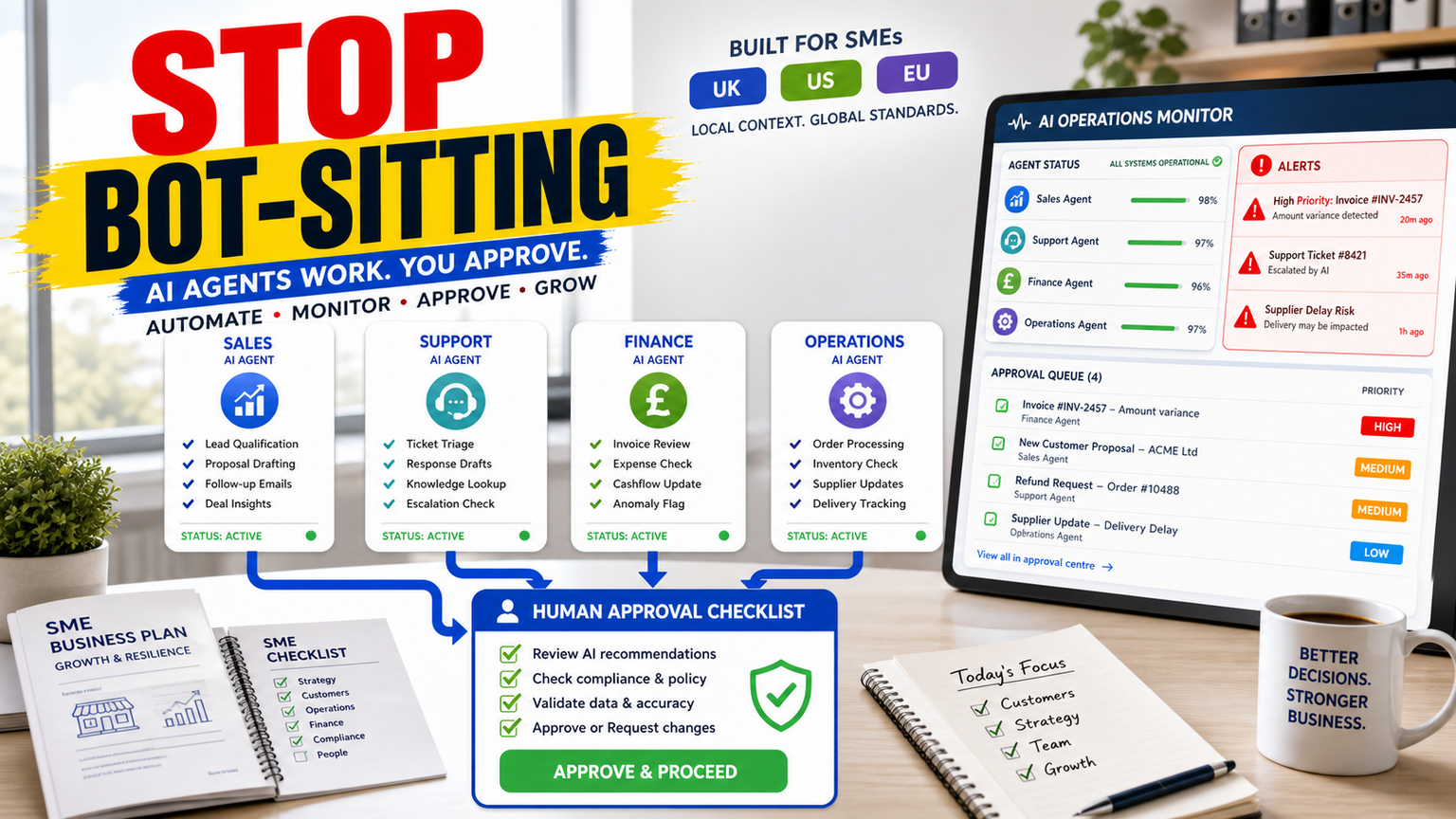
# Quick answer Hajikreena's view: this is not just another tool trend. SMEs are moving from one chatbot to many semi-independent agents, and the hard part is deciding who approves work, who checks errors, who owns data,
Quick answer
Hajikreena's view: this is not just another tool trend. SMEs are moving from one chatbot to many semi-independent agents, and the hard part is deciding who approves work, who checks errors, who owns data, and how the workflow improves every month.
What this means for SMEs
Small businesses can now connect AI agents to sales follow-up, support triage, invoice review, reporting, research, and internal knowledge work. That sounds powerful, but agent sprawl can quickly create a new management job if every bot needs constant checking.
The practical SME question is not, "Which agent is best?" It is, "Which repeatable workflow should an agent own, what can it decide, and when must a human approve?"
For UK, US, and European SMEs, the most useful agent setup usually has five parts:
1. A narrow workflow, such as quote follow-up or support routing.
2. Clean source data from CRM, inbox, docs, or finance systems.
3. Human approval rules for customer-facing, financial, legal, or sensitive decisions.
4. Monitoring for failures, cost spikes, hallucinations, duplicated messages, and missed handoffs.
5. Monthly improvement based on real exceptions, not vendor demo claims.
That is where the business value appears. One agent can draft a reply. A workflow system can check the customer record, apply policy, route edge cases, log the action, and show management what changed.
Competitor lens
Global SaaS competitors such as Zapier, n8n, Make, Lindy, Gumloop, Bardeen, Relevance AI, and Stack AI are useful because they make agent and automation building more accessible. US AI consultancies such as LeewayHertz, Markovate, SoluLab, and BairesDev often explain agentic AI through broad use cases and industry guides. European consultancies such as Netguru, STX Next, 10Clouds, and Addepto often frame the same shift around production AI, RAG, and transformation programmes.
The missing layer for many SMEs is ownership after the tool goes live. Tools automate tasks. GOFTUS automates the workflow around the task.
That means GOFTUS does not treat an AI agent as the finished product. The finished product is the operating rhythm around it: intake, permissions, prompts, CRM updates, escalation rules, human review, dashboards, audit logs, and continuous tuning. SaaS tools are useful, but SMEs need workflow design, integration, human review, monitoring, and monthly improvement if agents are going to support real sales, support, finance, and operations work.
Summery for SMEs
| SME question | Practical answer | GOFTUS workflow move |
| --- | --- | --- |
| Should we add AI agents now? | Yes, but start with one repeatable workflow. | Pick a high-volume process with clear inputs and outputs. |
| What is the main risk? | Botsitting, unclear approval, and disconnected data. | Add approval rules, logs, dashboards, and exception routing. |
| Which teams benefit first? | Sales follow-up, support triage, reporting, finance checks, and document processing. | Connect agents to CRM, inbox, files, and reporting systems. |
| What should leaders measure? | Time saved, error rate, handoff speed, customer impact, and monthly exceptions. | Review the workflow each month and improve prompts, rules, and integrations. |
FAQ
Are AI agents ready for small businesses?
AI agents are ready for narrow, well-designed SME workflows. They are not ready to be dropped into a business without permissions, monitoring, fallback paths, and human approval for sensitive decisions.
What is botsitting in an AI workflow?
Botsitting happens when a team spends so much time checking, correcting, or restarting agents that the promised productivity gain disappears. It usually means the workflow was not designed clearly enough before the agent was added.
How should an SME choose its first AI agent workflow?
Choose a repeatable process with frequent volume, visible pain, clear data sources, and low downside if a human approval step catches mistakes. Sales follow-up, support triage, document intake, reporting, and invoice checks are good starting points.
GOFTUS CTA
If your team is testing AI agents but still relying on manual checks, scattered prompts, or disconnected tools, GOFTUS can help design the workflow around the agent. We build practical CRM automation, support triage, reporting automation, document processing, internal knowledge assistants, and agentic workflow systems for UK, US, and EU SMEs.