Robot sprints and soccer are reliability signals for business automation
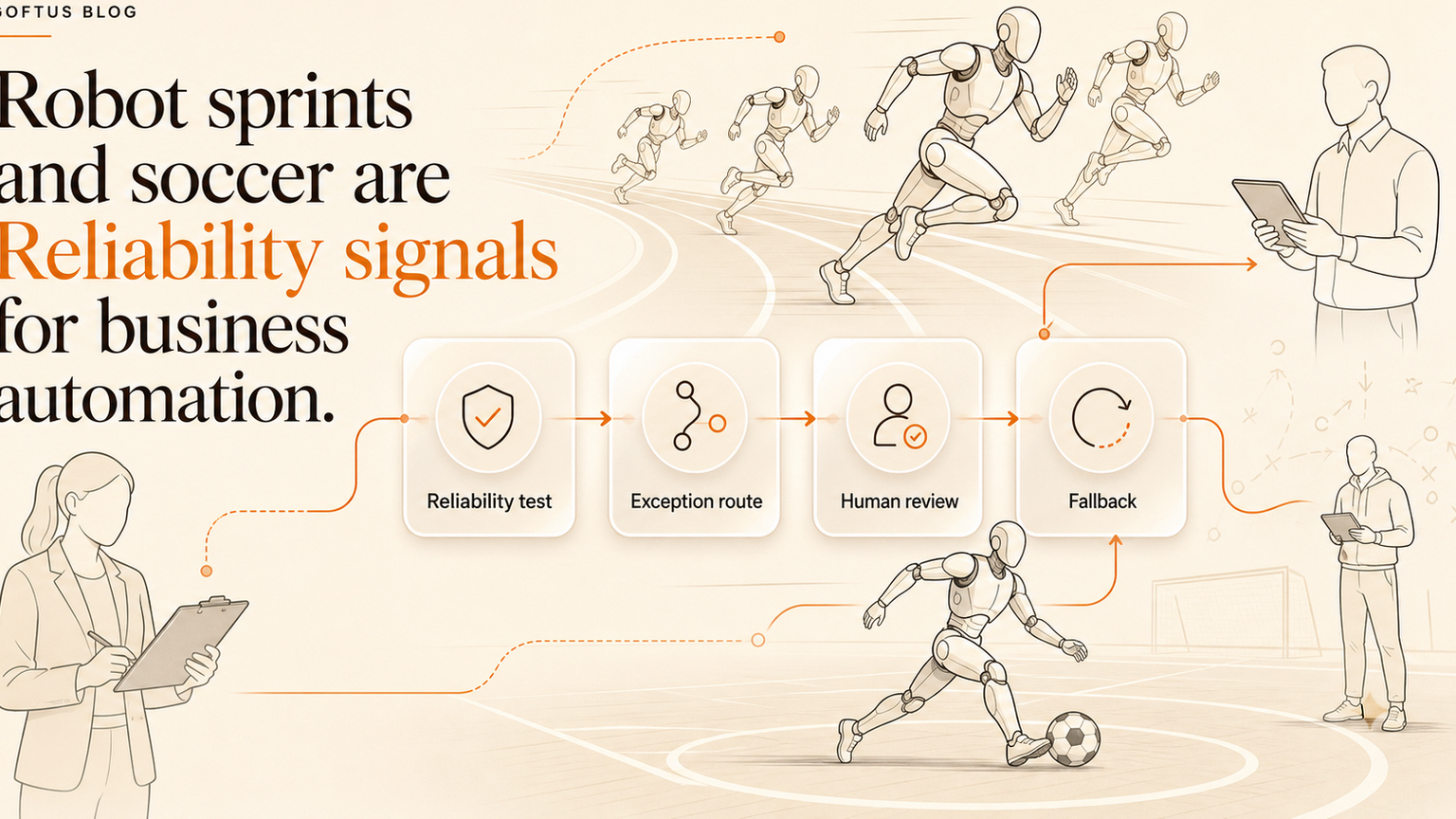
Fast robot demos grab attention, but reliability decides business value. Use visible failures to design exceptions, reviews, and fallback routes.
# Quick answer The robot sprint headlines from Beijing are attention grabbing, but the business value sits in the reliability story underneath. A robot can record a fast time and still expose the same question every auto
Quick answer
The robot sprint headlines from Beijing are attention grabbing, but the business value sits in the reliability story underneath. A robot can record a fast time and still expose the same question every automation leader faces: what happens when the system slows down, loses balance, misreads the situation, or reaches the finish with a failure the crowd can see? For SMEs, that is the useful signal. Do not buy into the idea that one impressive event equals general readiness. Use the event to rethink reliability as an operating workflow with owners, exception queues, approval gates, and fallbacks. Speed creates value only when the business can trust the process around the speed.
What this means for SMEs
The games combine events that look like simple sport but stress different parts of automation. Sprinting tests motion and control. Soccer tests perception, coordination, contact, and changing conditions. Boxing and other contest formats create clear safety and pause questions. In a business, the equivalents are delivery routes, shop-floor movement, reception handoffs, warehouse sorting, inspection rounds, and physical assistance. Each task can fail in a different way. The robot may pause, drift, block an aisle, miss an object, damage an item, or ask for help too late. That does not mean robots are useless. It means the workflow has to expect exceptions rather than hide them. A reliable automation pilot should make failures visible early, route them to a named person, capture evidence, and show whether the same issue repeats. That is more valuable than a demo video that shows only the best run.
Operations lens
GOFTUS would evaluate a robotics or embodied AI pilot with the same discipline used for AI agents and browser automations. Pick one task. Define a green lane for actions that can run without extra approval, an amber lane for actions that prepare a recommendation, and a red lane for actions that must pause and ask a person. A sprinting robot might be allowed to continue in a clear lane but pause when another object crosses the path. A warehouse robot might move sealed goods but ask for review before touching fragile stock. A service robot might answer opening hours but hand off pricing, complaints, or personal data. The system should log every run, every interruption, every override, and every manual fallback. That lets leaders compare real performance against staff time, customer impact, safety, and rework. The pilot becomes an operations instrument, not a stunt.
Competitor lens
Competitors often frame robotics as hardware capability, AI model capability, or a future labor replacement story. Those frames miss how small businesses actually adopt technology. The practical buyer does not need a general robot. The buyer needs one dependable task inside a known process. SaaS tools can monitor the device. Robotics integrators can configure the unit. Consultants can write a roadmap. But the business still needs a living control workflow that says who owns exceptions, what gets reviewed, what gets reported, and when a human takes over. GOFTUS builds around that layer. It is the difference between a fast demo and a repeatable operating process.
Summery for SMEs
The right takeaway from robot sprints and soccer is not hype or dismissal. It is reliability design. If a task can be bounded, reviewed, logged, and recovered, it can become a responsible automation candidate. If it cannot, it belongs in the lab until the workflow is clearer. SMEs can apply this immediately by reviewing existing automations too. A support bot, a reporting script, or a browser agent has the same reliability question as a robot on a track: who sees the exception, who approves the next action, and what manual path keeps work moving when the tool cannot complete the task? The question should be answered before budget is committed, not after a public failure forces the team to improvise under pressure. A quieter pilot is usually the stronger pilot.
FAQ
Is the World Humanoid Robot Games proof that humanoid robots are ready for normal workplaces?
No. The event is useful because it exposes speed, balance, coordination, handoff, and failure recovery in public. It does not prove that a robot can run a warehouse shift, handle customer property, or make unsupervised choices inside a business. SMEs should read it as a test signal, then define narrower pilots with human review, logs, pause rules, and fallback paths.
Where should an SME start if humanoid robots enter its sector?
Start with the workflow, not the robot. Map one repetitive task, the data needed, the physical boundary, the human approval point, and the exception path. GOFTUS can help convert that map into controlled automation, reporting, and review systems before a company buys hardware.
Source notes
Google News RSS was used because several direct article pages were blocked or paywalled during this unattended run. The source set included AP News, CBS News, Reuters, Al Jazeera, DW, The Economic Times, Gizmodo, The Indian Express, and regional photo syndication results surfaced by Google News RSS. The retrieved headlines described the 2026 Beijing World Humanoid Robot Games, robot sprint events, soccer, records, crashes or reliability questions, and China strategy framing. Reddit RSS search for the exact topic returned malformed XML during this run, so the article uses the news signal rather than claiming direct Reddit discussion evidence. These notes support the article as a business signal, not as proof of workplace deployment. Source ledger saved in /root/goftus/content-intel/humanoid_robot_olympics_cron_2026-08-25/source_retrieval.json.