Robot Olympics are a workflow readiness test, not deployment proof
Humanoid robot games are a signal for SMEs to design task boundaries, approval gates, exceptions, fallbacks and measurable logs before deployment.
# Quick answer The World Humanoid Robot Games are useful for SMEs, but not because a sprint, boxing match, football clip, or tennis rally proves that humanoid robots are ready for unsupervised business work. The useful s
Quick answer
The World Humanoid Robot Games are useful for SMEs, but not because a sprint, boxing match, football clip, or tennis rally proves that humanoid robots are ready for unsupervised business work. The useful signal is simpler: robots are being pushed through visible tasks where speed, recovery, stability, coordination and failure modes can be watched in public. That makes the games a workflow-readiness story.
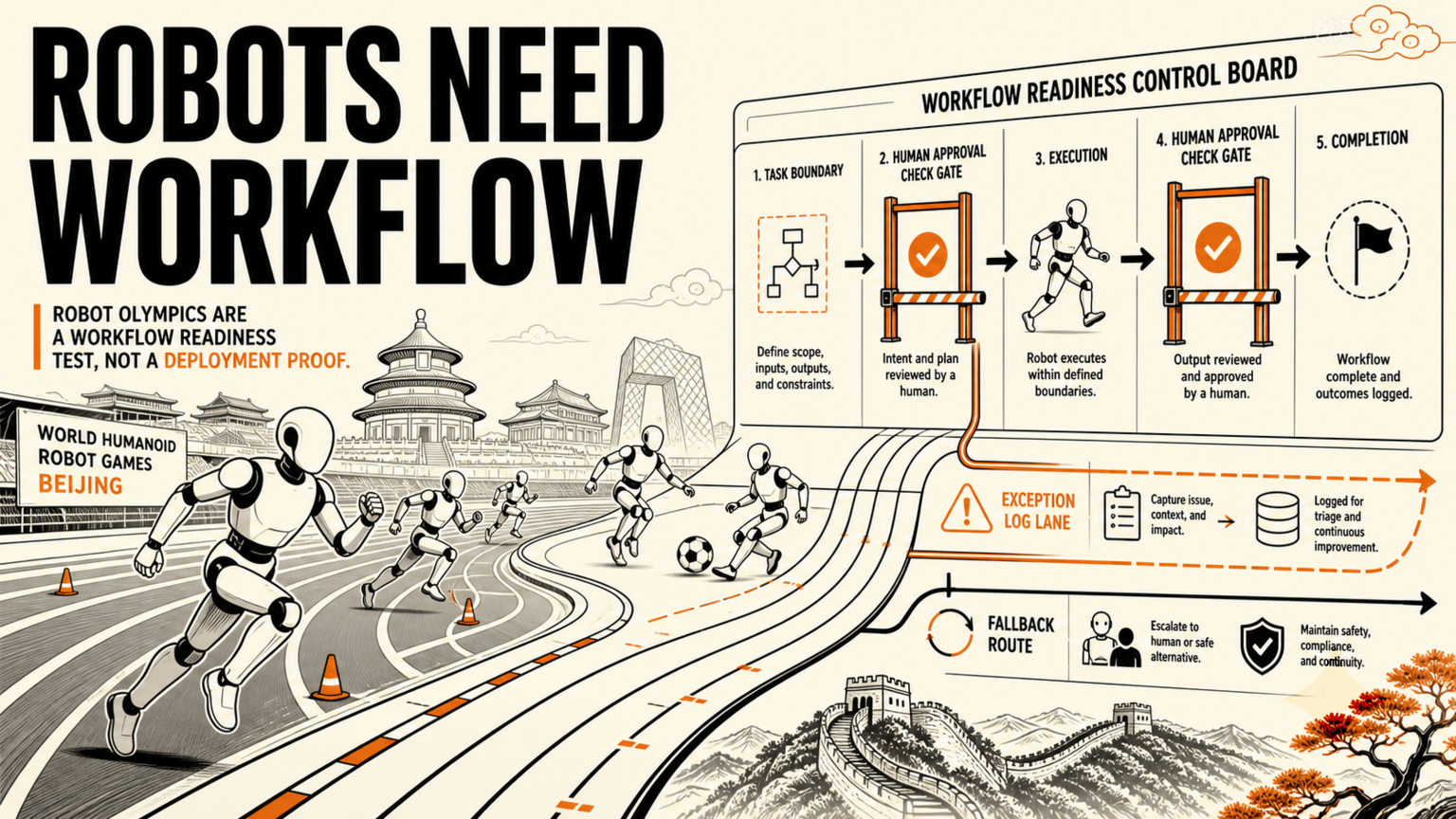
For GOFTUS, the lesson is that every exciting robot demo needs an operating wrapper. A business should know who owns the task, what the robot is allowed to do, which action needs human approval, how exceptions are caught, what fallback keeps the customer or employee safe, and what logs prove the process improved. Humanoid robotics will matter when those controls turn experiments into repeatable work.
What this means for SMEs
Many business owners will see the Beijing robot games as entertainment first. That is fair. The clips are built for attention: robots sprinting, playing football, boxing, recovering from stumbles, and testing mechanical limits. But the same clips show why workplace adoption cannot be judged by one highlight. A robot can finish a race and still be unreliable in a warehouse aisle. A robot can kick a ball and still be too risky near customers. A robot can set a record and still need a human operator, a safe stop condition, and a clear recovery procedure.
SMEs should use the moment as a checklist. First, define a narrow job. Do not start with "replace a worker." Start with "move this item from this zone to that zone," "inspect this shelf," "carry tools under supervision," or "prepare a handoff for a technician." Second, decide the boundary. The robot can observe, prepare, suggest, or act, but those lanes should not be mixed. Third, set approvals. Anything that touches people, money, customer promises, stock levels, documents, live systems, or public communication should pass through a human review gate.
The fourth control is exception handling. The most valuable operational question is not "can the robot do it once." It is "what happens when it cannot." If a robot loses balance, cannot identify an object, reaches a blocked path, sees a customer, loses connectivity, or receives conflicting instructions, the workflow should pause, alert an owner, and route the work to a fallback. That fallback may be a human task, a safer robot mode, a ticket in a support queue, or a manual checklist.
GOFTUS would connect that thinking to the same controls used for AI agents and workflow automation. The tool may be physical instead of software-only, but the operating questions are familiar: trigger, permission, review, action, log, fallback, and improvement. Businesses that learn this pattern early will evaluate robotics vendors more clearly. They will ask for logs, integration points, permission controls, escalation rules, and measurable results instead of buying a showpiece.
Competitor lens
Generic SaaS dashboards and robotics consultants can help with monitoring, device management, simulations, or procurement. They are useful pieces of the stack. The gap is that a dashboard rarely owns the workflow around the robot. A consultant may document a process, but the business still needs living controls that connect approvals, handoffs, tickets, CRM updates, support notes, document records, safety logs, and monthly improvements.
GOFTUS positions the value at that workflow layer. The robot is not the strategy by itself. The strategy is the controlled path around the robot: what it may do, what it may not do, who approves the risky steps, how exceptions route, and how the company learns from every run. That is the difference between a demo that impresses people and an operation that improves.
Summery for SMEs
The humanoid robot Olympics should make SMEs more curious and more disciplined. Public robot sports show progress in movement, coordination and endurance, but they also reveal the distance between a controlled event and a live workplace. A practical business plan starts with task boundaries, human approval gates, exception handling, fallbacks and logs. If the workflow cannot explain what happens when the robot fails, the robot is not ready for that workflow.
FAQ
Are the World Humanoid Robot Games proof that robots are ready for normal workplaces?
No. They are a strong signal of progress, but a sports event does not prove safe, repeatable deployment in customer, warehouse, office, retail, finance or support workflows.
What should a small business test first?
Test one narrow task with a named owner, an approval gate, a safe stop rule, a fallback process and a review log.
Where can GOFTUS help?
GOFTUS helps businesses design the workflow wrapper around automation, including /agents, /services, /questions and the review process that keeps risky actions controlled.
Source notes
Google News RSS for World Humanoid Robot Games surfaced The Atlantic scenes coverage, BBC coverage of robot boxing, football and sprinting, DW coverage of the robot race, and Nikkei context on robot supply chains. This run used RSS headlines and links as source discovery where direct publisher pages were blocked or inconsistent.
Google News RSS for humanoid robot Olympics surfaced New York Times, Gizmodo, Al Jazeera, Business Insider and Mashable links about sprint records, robot failures and the Beijing games. The article treats those as news signals, not proof of workplace deployment.
Google News RSS for Beijing humanoid robot games surfaced Tech Xplore, BBC, DW and South China Morning Post links about sprinting, tennis, football and records at the games.
Google News RSS for humanoid robot reliability surfaced Robot Report, MotorTrend, Devdiscourse and analyst-warning headlines about dexterity, industrial readiness and hype versus reality.
Google News RSS for China robotics strategy surfaced Reuters, Yahoo, Investing.com and diginomica links about Chinese robot makers trying to convert humanoid hype into useful work and the broader strategic showcase.