Robot Speed Is Not Operational Readiness: The Business Risk Behind the Humanoid Games
Robot sprint headlines are exciting, but companies should judge humanoid AI by exception handling, safety gates and repeatable workflows.
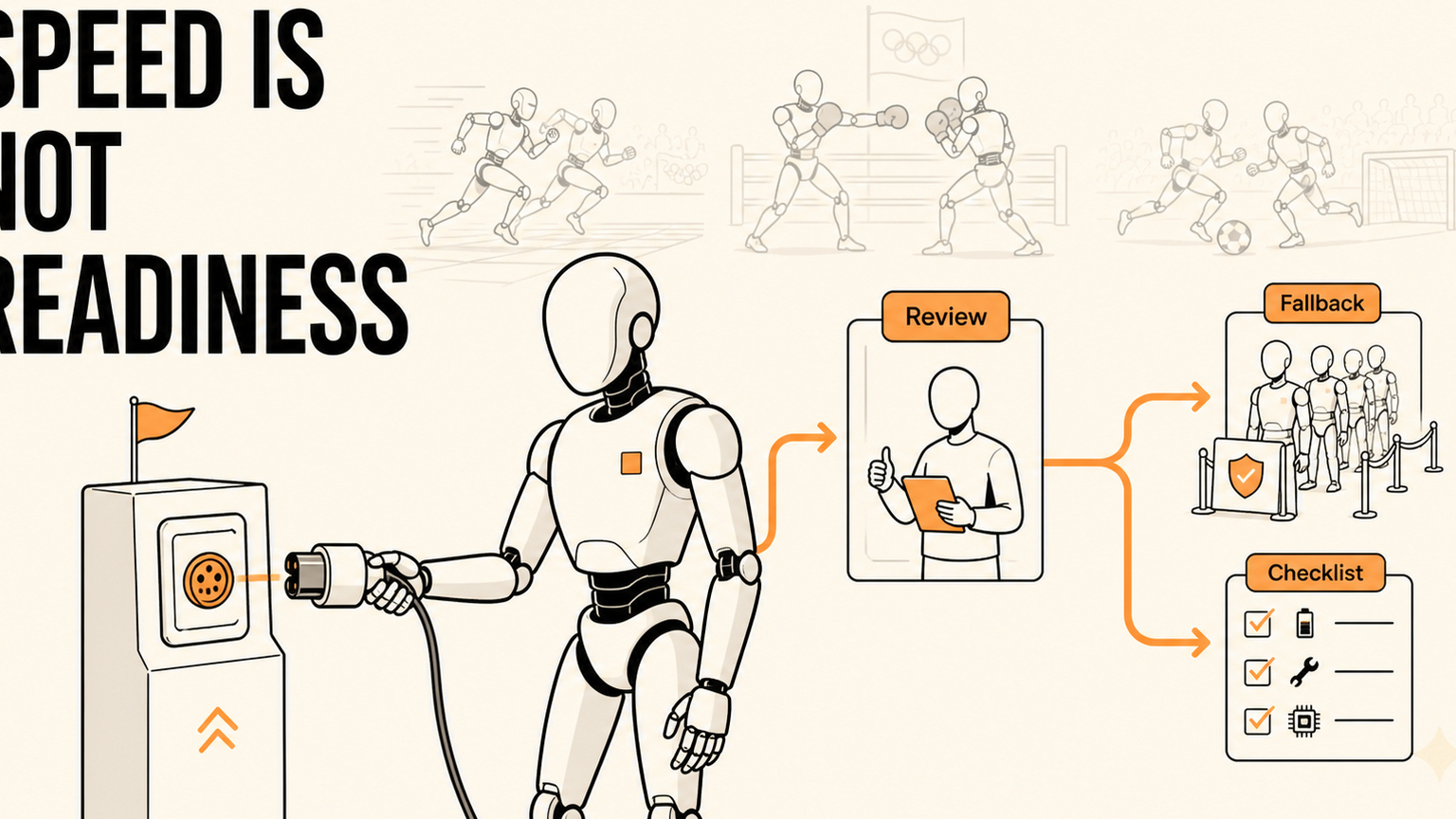
# Quick answer The most viral part of the humanoid robot Olympics was speed. Reports described robots sprinting, competing on tracks and drawing comparisons with human records. That makes a great headline, but it is not
Quick answer
The most viral part of the humanoid robot Olympics was speed. Reports described robots sprinting, competing on tracks and drawing comparisons with human records. That makes a great headline, but it is not the same thing as business readiness. In a company, speed without reliability can become expensive very quickly.
What this means for SMEs
The more interesting reporting came from the gap between spectacle and practical work. Reuters framed the issue with a simple question: robots can outrun humans, but can they plug in a cable? Business Insider described a finish line with padded walls and a stretcher. BBC covered boxing, football and sprinting. Those details matter because they show the difference between a controlled contest and a real workplace.
A robot sprint is a narrow task. It has one direction, a clear line, and a visible result. Business operations are not like that. They involve incomplete information, tired staff, customers who change their mind, stock that is not where the system says it is, doors that stick, cables that fall, forms that arrive half complete and managers who need the right alert at the right time.
The same lesson applies to non physical AI. A model can generate a good image, draft a reply or summarize a document quickly. That does not mean it is ready to run the process. The useful question is not whether the AI can produce one impressive output. The useful question is whether the workflow catches bad outputs before they reach customers, suppliers or internal systems.
For SMEs, this is the real risk of humanoid robotics and agentic AI. Buyers see a demo and assume the operational layer is included. It rarely is. The operational layer is where task boundaries, approval gates, fallback queues, alerting, logging and ownership live. Without that layer, a fast system only fails faster.
Summery for SMEs
SMEs should read the humanoid robot Olympics as an operations signal. The events show capability, but business value comes from repeatable workflows, named owners, review queues, fallbacks and logs. Before buying or trusting any robot or AI agent, map the task, define the exception path and decide what must stay under human review.
Competitor lens
Most coverage focuses on the spectacle: speed, boxing, soccer and record headlines. Many technology vendors will translate that into a simple message that robots are almost ready for work. That misses the hard part. The competitive advantage is not only the robot. It is the workflow system around the robot. Businesses that build clean task maps, approval points and operational logs will be able to adopt new AI tools with less risk.
A better framework is to judge automation on five points. First, can it identify when it is uncertain? Second, can it pause before high risk actions? Third, can it hand off to a named person or team? Fourth, can it create a clean log of what happened? Fifth, can the business measure whether the process improved after deployment?
This framework keeps excitement useful. If a humanoid robot can move boxes, the workflow should define which boxes, from where, to where, under what conditions and with what verification. If an AI agent can update CRM records, the workflow should define the fields, evidence, review thresholds and rollback path. The problem is the same, whether the tool has legs or an API key.
The robot games are therefore a helpful warning. They show that physical AI is progressing, but they also make failure visible. A robot that stumbles on camera is easier to understand than a silent software agent that makes a wrong update in the background. Both need the same discipline.
GOFTUS would not tell an SME to ignore humanoid robotics. We would tell them to prepare the operating model first. Clean processes, named owners and review queues are not boring admin. They are what turn automation from a demo into a business system.
The headline may be that humanoid robots are getting faster. The business lesson is that reliability, not speed, decides whether automation belongs in real work.
The right benchmark is not a single record. It is repeatability under ordinary pressure. A robot or agent that performs well once still needs monitoring, escalation and rollback. That is why SMEs should evaluate the surrounding process before trusting any high speed automation with customer facing or operational work.
FAQ
What should a business take from the humanoid robot games? Treat them as an early signal that embodied AI is moving toward real operations, but do not confuse demos with deployment readiness.
Should SMEs buy humanoid robots now? Most SMEs should start by fixing workflow clarity, exception handling and automation governance before considering physical robots.
What is the GOFTUS view? The workflow around AI is what makes automation reliable. Robots, browser agents, chatbots and document tools all need owners, boundaries, review paths and logs.
Source notes: Reuters reported the practical question as "Robots can outrun humans, but can they plug in a cable?" Reuters also framed China's robot games as moving from science fair to strategic showcase. BBC described robot boxing, football and sprinting at the World Humanoid Games. AP described humanoid robots sprinting, playing soccer and setting records at Beijing games. The Guardian and other outlets highlighted the 100m sprint headlines. Business Insider described padded walls and stretchers around the robot Olympics finish line. DW framed the robot race as a new frontier in technology competition.