Reporting Automation for SMEs: Catch Failed AI Workflows Before Reports Go Out
Reporting automation for SMEs should catch failed AI workflows before reports reach customers, leaders, finance teams, or sales follow-up queues.
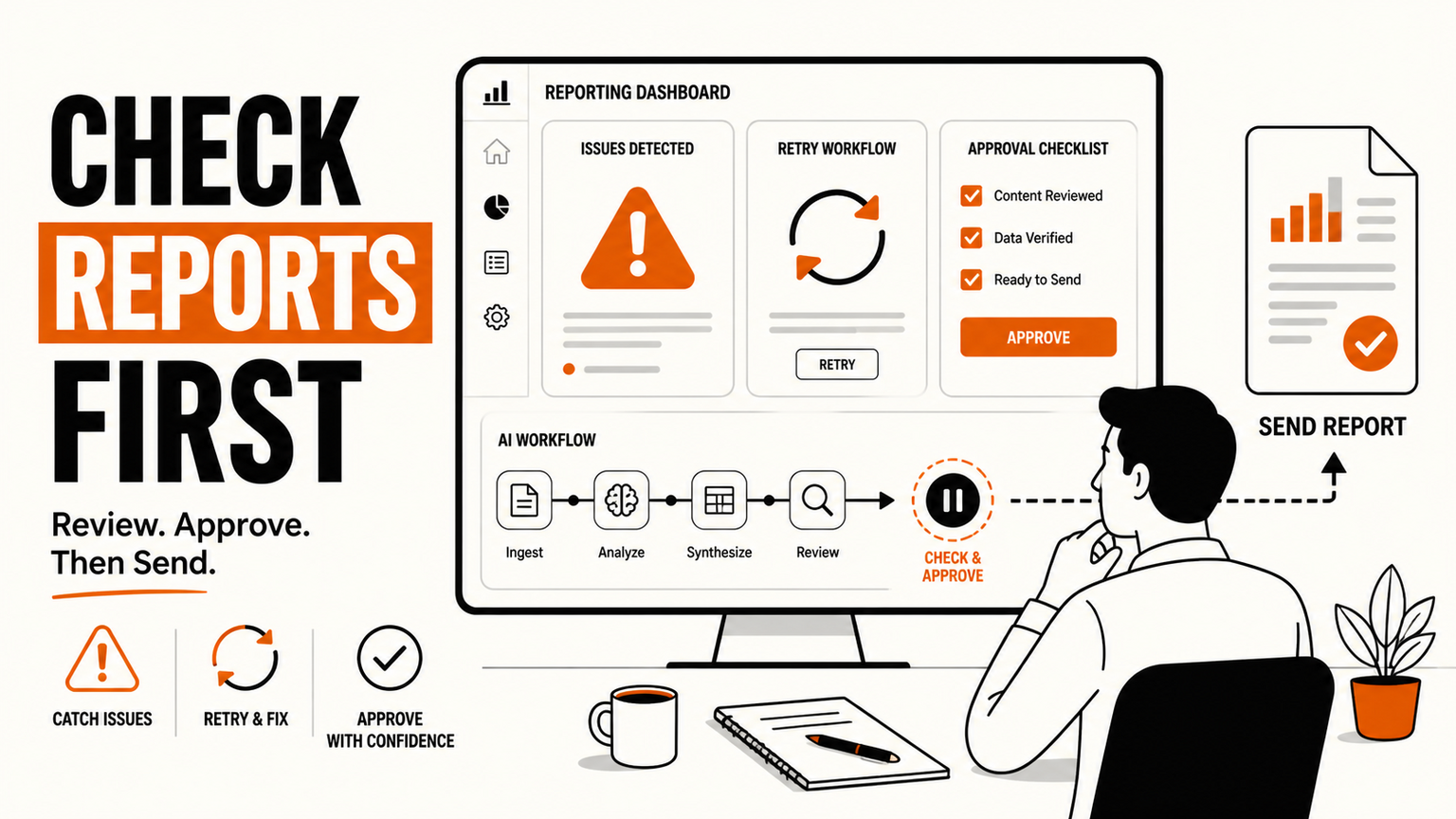
# Reporting Automation for SMEs: Catch Failed AI Workflows Before Reports Go Out # Quick answer Reporting automation is useful only when the business can trust what happens before a report is sent. The fresh operator s
Reporting Automation for SMEs: Catch Failed AI Workflows Before Reports Go Out
Quick answer
Reporting automation is useful only when the business can trust what happens before a report is sent. The fresh operator signal is simple: people building AI and automation workflows are not just asking whether a tool can connect apps. They are asking what happens when a retry fails, an AI step returns weak output, or a workflow silently skips the record that matters.
For US, UK, and EU SMEs, that turns reporting automation into a control problem. The report should not be the first place a mistake becomes visible. A practical setup needs failed-step alerts, retry limits, human approval for sensitive outputs, source links, and a clear route back into CRM, support, finance, or operations. GOFTUS designs that workflow layer around the tools, so owners see the exception before customers, managers, or sales teams act on bad information.
This post uses a Reddit operator discussion as social heat and an AI observability article as the news cross-check. It is not claiming the Reddit thread proves a market statistic.
What this means for SMEs
Most reporting automation projects start with a sensible request: send a weekly sales summary, reconcile support themes, build a management dashboard, or alert a team when numbers move. Then AI gets added to classify tickets, summarise calls, draft commentary, or decide which records deserve follow-up. That extra intelligence creates extra failure modes. A normal API failure is visible if the system logs it. An AI failure can look like success because the step returned text, even when the summary is vague or the source record is missing.
Hajikreena's view is that SMEs should treat reporting automation like an operating system for decisions, not like a pretty dashboard. The question is not just, can Zapier, n8n, Make, or a custom script move data from A to B? The question is, who checks the result when the AI step is unsure, what happens after two failed retries, and where does the exception wait until a human reviews it?
GOFTUS usually frames this as four lanes: observe the source records, prepare the report without sending it automatically, approve sensitive outputs when they affect customers or money, then act only after there is a log, an owner, and a rollback path. That is why reporting automation should connect to GOFTUS AI automation services, not just another dashboard build.
How to catch failed AI workflows before reports go out
Start with the report that already drives a decision. Good candidates include sales pipeline summaries, overdue customer follow-up lists, support volume reports, finance exception reports, delivery risk summaries, marketing campaign reviews, or weekly leadership notes.
Then mark each step as low risk, review risk, or action risk. A low-risk step might clean formatting. A review-risk step might ask an AI model to summarise open complaints. An action-risk step might update a CRM field, send a customer email, pause an advert, change a quote, or submit information in a browser portal. Reporting automation should not treat those steps equally.
Next, add retry rules that match the workflow, not just the software. Retrying a failed API call three times may be fine. Retrying an AI judgement until it produces a confident answer can be dangerous if the source data is thin. A better pattern is to retry technical failures, flag weak AI outputs, and route unclear results to a named reviewer.
The report itself should include evidence: source records used, skipped items, failed steps, human approvals, and open exceptions. If the business cannot explain why a number or recommendation appears, the workflow is not ready to act on its own. When a human corrects a summary, marks a false alert, or approves an exception, that review should improve the workflow. GOFTUS does this through practical logs and monthly tuning, not vague transformation language.
Competitor lens
The competitor market is crowded and useful. UK firms such as Faculty AI, Deeper Insights, Waracle, and Brainpool AI can support data and AI projects. US providers such as LeewayHertz, Markovate, SoluLab, and BairesDev can build custom systems. European teams such as Addepto, STX Next, Netguru, and 10Clouds can help with engineering delivery. SaaS tools such as Zapier, n8n, Relevance AI, Lindy, Gumloop, Bardeen, Make, and Stack AI can connect tasks quickly. The gap appears when a business needs the workflow around the task: who owns the report, where failures wait, which actions require approval, and what improves next month.
Tools automate tasks. GOFTUS automates the workflow around the task. For reporting automation, that means the report is not an isolated output. It becomes a controlled decision workflow with monitoring, human review, and action boundaries.
What SMEs should do next
Pick one report that already affects money, customers, staff workload, or owner attention. Choose the one where a missed failure would create real follow-up pain.
Audit the workflow in plain English. What data enters? What does AI summarise? What gets sent, updated, or escalated? What should stop the workflow? Who approves risky outputs? Where does the evidence live? If the answer is unclear, the business needs a reporting workflow, not just another automation recipe.
GOFTUS can help SMEs design this safely through practical AI automation services. The £100 Startup Kit diagnostic is a useful first step when a business wants to see which workflows should get controls before they scale.
Summery for SMEs
Reporting automation should make decisions easier, not hide failures. The current operator signal around retries and failed AI workflows is a reminder that AI reports need owners, logs, approval gates, and exception queues. If an AI workflow fails silently or sends uncertain output straight into a business process, the report becomes a risk. GOFTUS helps SMEs build the workflow control layer so useful tools can operate with human review where it matters.
FAQ
What is reporting automation for SMEs?
Reporting automation collects data, prepares summaries, and routes insights without forcing staff to rebuild the same report manually every week. For SMEs, the safest version also shows source records, failed steps, skipped items, and human approvals. GOFTUS connects reporting automation to wider workflow automation through /services, so a report can trigger CRM follow-up, support triage, document review, or owner approval without becoming an uncontrolled black box.
When should an AI-generated report require human approval?
Require approval when the report affects customers, payments, compliance, staff decisions, sales commitments, or external messages. A weekly internal trend summary may only need review for exceptions. A report that updates CRM stages, sends follow-up, changes a finance workflow, or recommends customer action should pause until the right person approves it. GOFTUS designs those approval points through /services so automation stays useful without letting AI act alone.
How do browser with AI controls relate to reporting automation?
Some reports lead to browser actions such as downloading supplier data, checking portals, updating web forms, or submitting customer information. Browser with AI controls means the AI can prepare or navigate a narrow workflow, but login boundaries, approvals, logs, and stop rules protect the business before anything is submitted. When reporting workflows touch web portals, GOFTUS can connect the report to controlled AI agents through /agents and /services.
Source notes
Social signal: r/n8n hot discussion: How are you handling retries and failures in AI/automation workflows? Evidence status: Reddit social signal from injected GOFTUS intelligence, not a verified factual claim.
News cross-check: Open Source For You article listed in Google News RSS and directly fetched: The Necessity Of Observability For AI And LLM Applications, describing observability for AI and LLM applications.
X signal: xurl was present but no apps were registered in this cron environment, so X was treated as unavailable and not used as evidence.