Perplexity AI for SMEs: Browser Agent Controls Before AI Shops or Submits
Perplexity AI news shows why SMEs need browser agent controls, approval gates, audit logs, and safe handoffs before AI shops or submits in real workflows.
## Quick answer Perplexity AI is the high-score SEO keyword behind this GOFTUS post, with a 91 Trends score in the 2026-08-18 daily SEO output. The business problem is not whether one AI browser or shopping agent wins t
Quick answer
Perplexity AI is the high-score SEO keyword behind this GOFTUS post, with a 91 Trends score in the 2026-08-18 daily SEO output. The business problem is not whether one AI browser or shopping agent wins the headlines. The practical question for UK, US, and EU SMEs is this: how do you let AI search, compare, prepare, and fill browser workflows without letting it buy, submit, change, or message customers without control?
Recent Google News RSS results point to Reuters reporting that Amazon lost a US court ban on Perplexity's AI shopping tools. GeekWire framed the same dispute as an early test of agentic commerce. TechCrunch also reported on browser work connected to Perplexity's Comet ecosystem. These are news signals, not a reason for SMEs to copy the technology blindly. The operating lesson is simple: browser agents need workflow boundaries before they touch customer, supplier, finance, or support systems.
For GOFTUS, this points to browser with AI controls, AI browser controls, and human approved browser automation. AI prepares the work. A person or rule approves the action.
What this means for SMEs
A browser agent changes the risk profile of everyday automation. It can operate inside the same websites your staff use every day: supplier portals, ecommerce checkouts, CRMs, ticketing tools, finance dashboards, travel systems, job boards, and customer support consoles.
That power is useful, but it creates a messy question. If an AI browser finds a product, compares vendors, fills a form, drafts a reply, or reaches a payment screen, when does helpful preparation become business action? The answer cannot be left to a model prompt. It needs workflow design.
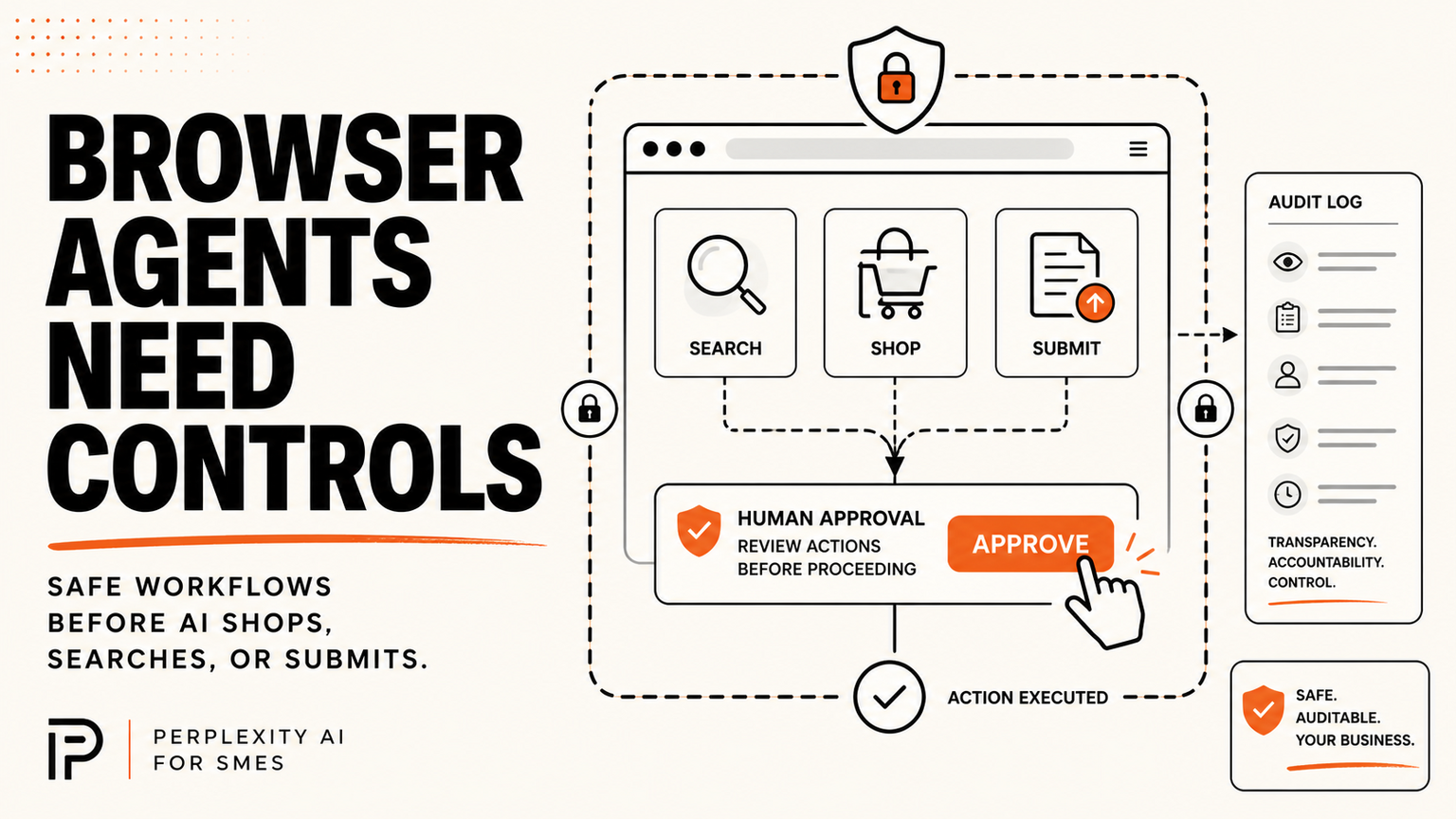
SMEs should split browser work into four lanes. First, observe: the agent can read pages, collect options, extract fields, and summarise choices. Second, prepare: it can draft a form, build a shortlist, or create a support response. Third, approve: a person checks the critical fields, supplier, amount, customer impact, policy fit, and next action. Fourth, act: the system submits, sends, books, buys, or updates only after the approval rule is satisfied.
This is where GOFTUS positions browser automation differently from a generic tool install. We help businesses define the safe lane, connect it to CRM or support records, log what happened, and improve the workflow monthly. The internal path for this topic is /agents, because browser agents need agent design, permission boundaries, and review loops, not just a clever browser extension.
Why browser agents need controls before they scale
The Perplexity AI headlines matter because they show a market moving from answer engines toward action engines. Once AI can search, decide, and act inside web pages, the business value increases. So does the need for rules.
A small team might start with supplier availability checks, lead context, software page comparisons, or draft support replies. These save attention without handing over final authority.
The risky version is different. An AI agent logs into a supplier portal, chooses a product, accepts a substitute, submits a purchase, changes a customer record, or sends a legal or financial message without a visible approval trail. Even if the action is technically correct, the business may not know why it happened, who authorised it, what source data was used, or how to undo it.
GOFTUS designs for that gap. A safe browser-agent workflow should define allowed sites, blocked sites, login handling, form fields the AI may draft, fields it may never change, spend limits, customer-impact limits, escalation rules, screenshots or structured logs, and a rollback path. That is not bureaucracy. It is what lets a business use AI more often without making every new automation feel like a risk meeting.
Competitor lens
Tools automate tasks. GOFTUS automates the workflow around the task.
Zapier, n8n, Make, Bardeen, Gumloop, Lindy, Relevance AI, and Stack AI can be useful for connecting systems or building agent-style automations. Larger consultancies such as Faculty AI, Deeper Insights, Waracle, Brainpool AI, LeewayHertz, Markovate, SoluLab, BairesDev, Addepto, STX Next, Netguru, and 10Clouds can also help with strategy, delivery, or custom engineering.
The gap for many SMEs is ownership. Who decides which browser tasks are safe? Which customer actions require review? Where does the evidence log live? How does the team know whether the agent improved response time or simply moved risk from one screen to another?
GOFTUS competes by turning browser automation into an operating system for the workflow. We map the trigger, data source, review rule, human owner, approved action, CRM or support handoff, and monthly improvement loop. The result is not just an AI browser doing clicks. It is a controlled process that staff can trust.
What SMEs should do next
Start with one browser workflow that is repetitive, measurable, and reversible. Good candidates include quote comparison, lead enrichment, supplier availability checks, public website research, support triage, and draft-only form filling.
Then decide the control level. Green actions can be prepared and logged automatically. Amber actions need human approval before submission. Red actions are blocked unless a manager approves or the workflow is redesigned. For example, reading a public web page may be green. Preparing a supplier order may be amber. Submitting a payment, changing a customer contract, or sending a formal complaint response may be red.
Next, connect the browser step to a real business system. If the agent researches a lead, the summary should attach to CRM. If it prepares a support answer, the draft should sit inside the ticket. If it checks supplier stock, the evidence should link to the operations task.
Finally, measure practical outcomes: faster response time, fewer missed leads, less copying, and easier exception review. GOFTUS can package this into an AI agent workflow diagnostic so the first automation is useful, safe, and visible.
Summery for SMEs
Perplexity AI and AI-browser headlines are a signal that browser agents are becoming normal business infrastructure. SMEs should not wait until agents are already clicking through live systems to define rules. Browser with AI controls means AI can read, prepare, and recommend, while people approve sensitive actions and the business keeps a log.
The safest first move is one narrow workflow connected to /agents, with permissions, approval gates, stop rules, and evidence capture. Once that works, the same pattern can expand into support, CRM, documents, reporting, supplier operations, and customer follow-up.
FAQ
What is the safest first browser-agent workflow for a small business?
Start with a draft-only workflow such as supplier research, lead enrichment, support triage, or public website comparison. Let AI collect information and prepare the next step, but require a person to approve submissions, purchases, contract changes, or customer messages.
How do browser with AI controls reduce risk?
They separate preparation from action. The agent can search, summarise, and fill draft fields, while approvals, logs, login boundaries, blocked actions, and stop rules control what happens next. That makes automation easier to review and safer to improve.
When should GOFTUS help with AI browser automation?
Bring in GOFTUS when the browser task touches customers, suppliers, finance, CRM, support, documents, or compliance-sensitive portals. We can map the workflow, build the agent lane, set approval rules, and connect the output to /agents or /services.
Source notes
Primary SEO input: GOFTUS daily SEO FAQ output for 2026-08-18 listed "perplexity ai" with a 91 Trends score. News cross-checks came from Google News RSS results for Reuters on Amazon and Perplexity's AI shopping tools, GeekWire coverage of agentic commerce, and accessible TechCrunch coverage of an AI browser connected to Perplexity's Comet ecosystem. X was checked through xurl, but no apps were registered in this cron environment, so X was not used. Reddit intelligence for the day showed broader operator concern around AI tools, AI cost, and agents, but this article treats Reddit only as social context, not verified fact.