OpenAI workflow automation needs a reliability layer beyond scripts
OpenAI workflow automation works best when scripts, n8n, and AI agents share retries, approval gates, exception queues, and cost controls.
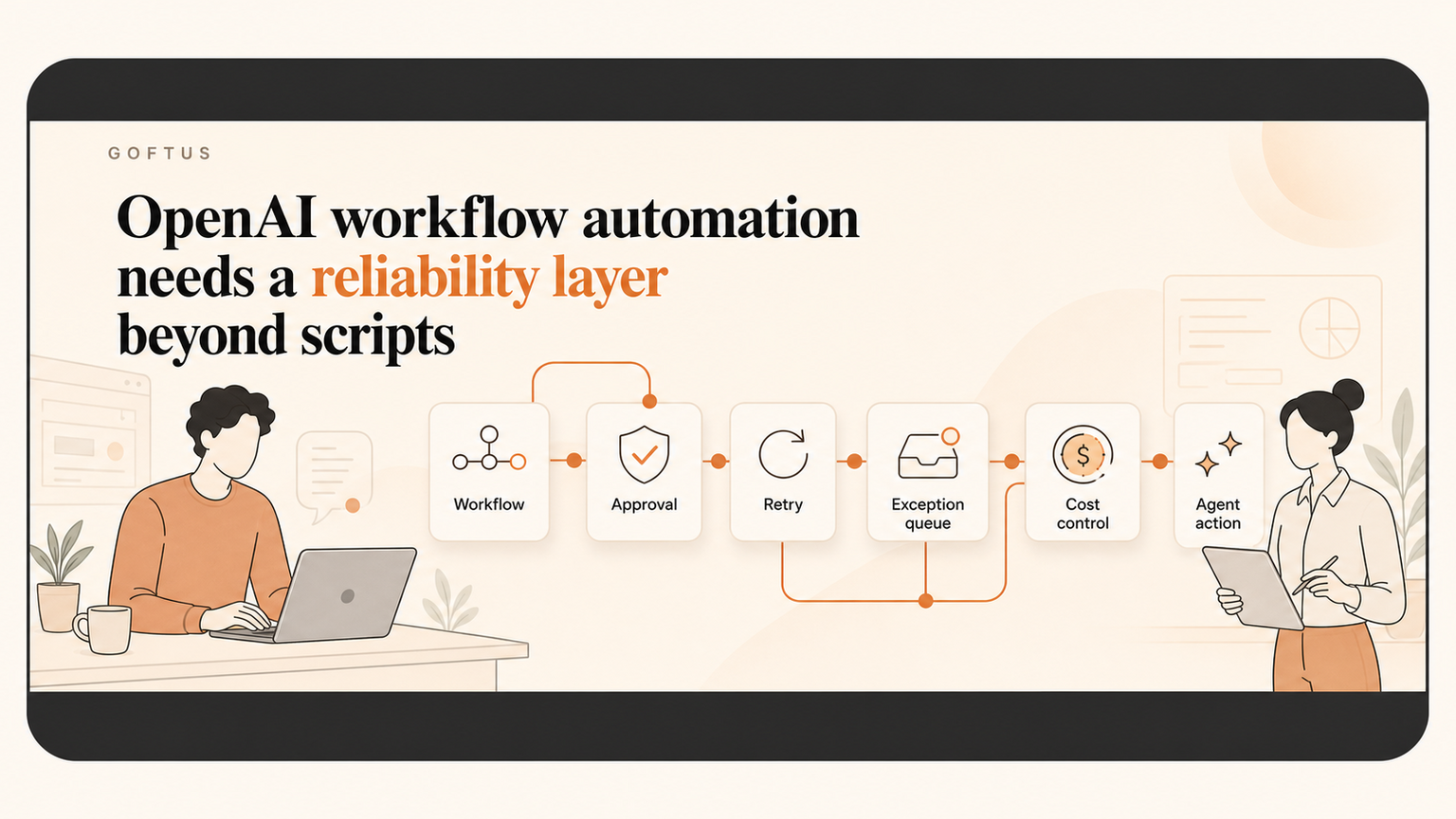
# OpenAI workflow automation needs a reliability layer beyond scripts Meta description: OpenAI workflow automation works best when scripts, n8n, and AI agents share retries, approval gates, exception queues, and cost co
OpenAI workflow automation needs a reliability layer beyond scripts
Meta description: OpenAI workflow automation works best when scripts, n8n, and AI agents share retries, approval gates, exception queues, and cost controls.
Quick answer
OpenAI workflow automation with approval and cost controls is the evergreen buyer problem behind today’s Reddit signal. The social heat came from r/n8n and r/Automation posts showed operators building contract workflows and asking which automation tools stay reliable after setup. Treat that as operator sentiment, not verified fact. The practical lesson for SMEs is simple: do not judge AI by the demo. Judge it by the workflow it is allowed to touch, the person who owns the decision, the data route it uses, and the log it leaves behind.
GOFTUS would start with one measurable workflow connected to /services: intake, prepare, review, approve, act, and report. That keeps the model useful without letting it silently change a customer record, spend money, publish content, alter documents, or trigger a browser action before a human-approved boundary is in place.
What this means for SMEs
The Reddit signal matters because it shows the gap between AI excitement and operating control. A founder may see a tool that writes quickly. An ops lead sees the missing questions: who checked the source, who approves the next step, what happens when the answer is weak, and where does the final decision get recorded? openai becomes valuable only when those questions are designed into the process.
For a small team, the first win is usually not full autonomy. It is a controlled assistant that prepares a draft, classifies a request, summarizes a record, flags a renewal, checks a knowledge base, or routes a customer issue. The human then approves the next action. This cuts manual work while preserving judgement where money, trust, policy, or customer experience is at stake.
The measurable outcome should be operational, not magical. Track fewer dropped handoffs, shorter response loops, cleaner CRM notes, faster first drafts, fewer repeated questions, and better evidence when something goes wrong. If a tool cannot show those workflow-level numbers, it is still an experiment.
A practical rollout can be split into four lanes. First, observe the current task and collect examples of good and bad outcomes. Second, let AI prepare a draft, classification, summary, or recommendation while a person still owns the decision. Third, allow approved actions only in low-risk systems with clear rollback. Fourth, review exceptions every month and decide whether to expand, narrow, or stop the workflow. This keeps adoption calm and measurable.
For GOFTUS clients, the important design choice is the boundary between preparation and action. openai may read a brief, summarize a ticket, draft a reply, compare a document, or suggest a routing decision. It should not quietly spend budget, publish external content, overwrite records, send sensitive data, or submit web forms without an approval rule. That boundary is what turns an AI tool into a business process.
The same logic applies whether the team prefers SaaS, n8n, custom scripts, browser agents, or a frontier model interface. The tool is only one component. The workflow also needs source control, role permissions, exception handling, cost review, customer visibility, and a plain-language SOP so non-technical staff can operate it after launch.
Summery for SMEs
Use the Reddit signal as an early warning: operators are already feeling the risk, cost, trust, or reliability gap. The answer is not to ban AI tools or chase every new release. The answer is to build a narrow workflow with a named owner, input rules, approval gates, fallback paths, and a review rhythm. GOFTUS can implement that operating layer so the SME gets useful automation without losing control.
Competitor lens
SaaS tools, no-code builders, consultants, and internal scripts can all be useful. The weak point is usually between them. A tool may generate content, another may update CRM, another may run a workflow, and another may store documents. GOFTUS focuses on the connective tissue: workflow design, integrations, monitoring, human review, action boundaries, and monthly improvement. That is where ROI becomes repeatable.
FAQ
What should an SME automate first with openai? Start with a frequent workflow that already has a clear owner, such as support triage, content review, lead routing, document intake, or reporting preparation. Avoid high-risk actions until the approval and rollback path is proven.
Should AI agents act without approval? Not at first. Let the system observe and prepare. Then require human approval before finance, CRM, customer messaging, document changes, browser submissions, or security actions.
How does GOFTUS make the workflow safer? GOFTUS maps the trigger, data source, tool access, approval step, exception queue, log, and review cadence before connecting AI to live systems.
Source notes
Reddit/social signal: r/n8n and r/Automation posts showed operators building contract workflows and asking which automation tools stay reliable after setup. Reddit is treated as social heat only, not verified fact.
News and article cross-check: Google News RSS listed AIMultiple, Hostinger, Cybernews, and other 2026 AI-agent and n8n workflow tool comparisons. Direct pages may be blocked or surfaced through Google News RSS, so this is cited as headline-level context where applicable.
SEO keyword used: openai with Google Trends US past 1 month relative score 96. Mapped GOFTUS angle: OpenAI workflow automation with approval and cost controls.