OpenAI and Anthropic Rivalry Shows Why SMEs Need AI Vendor Control Workflows
OpenAI and Anthropic rivalry shows why SMEs need vendor-control workflows, approval gates, audit logs, fallback routes, and portable AI automation systems.
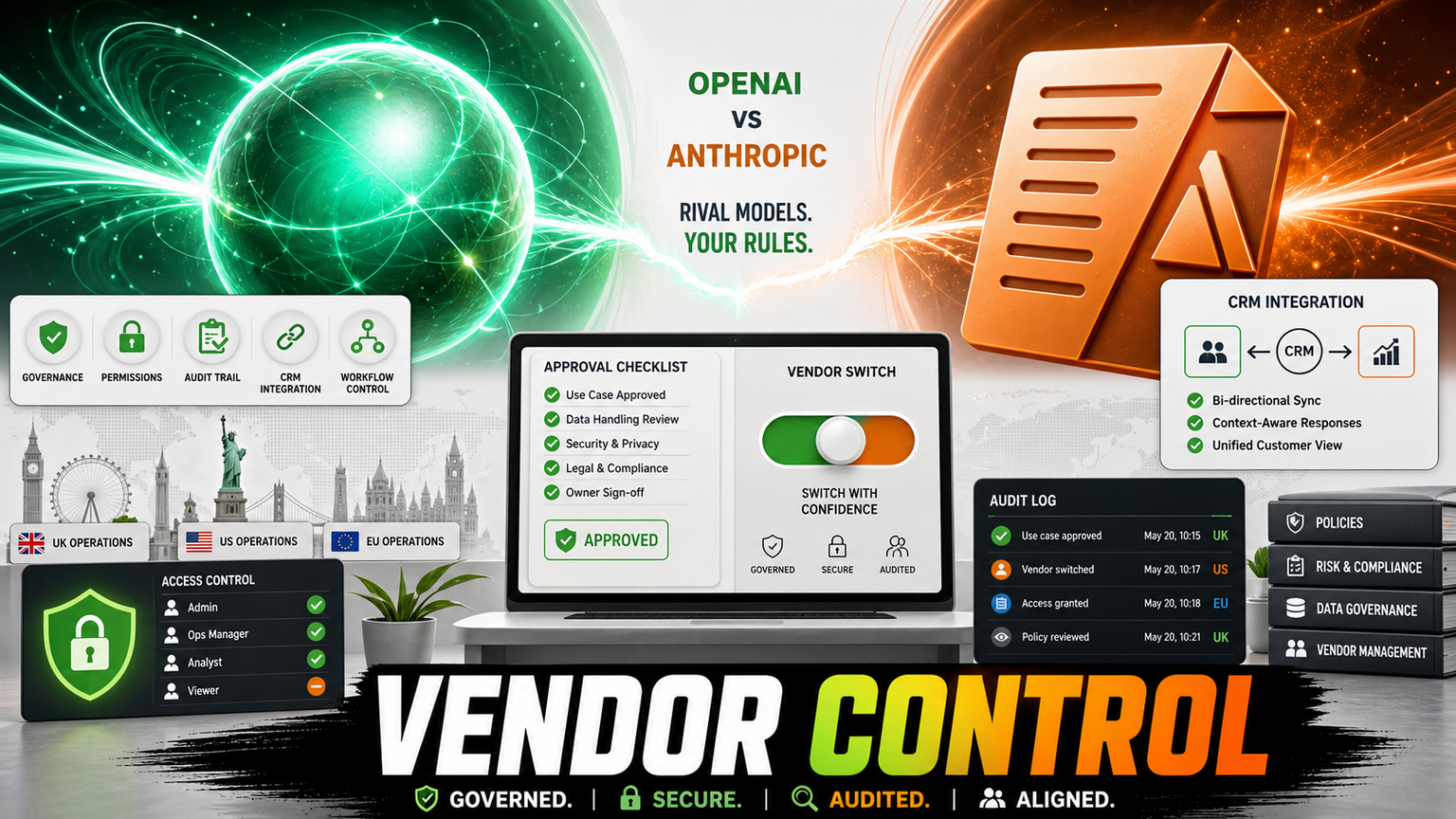
# OpenAI and Anthropic Rivalry Shows Why SMEs Need AI Vendor Control Workflows Meta description: OpenAI and Anthropic rivalry shows why SMEs need vendor-control workflows, approval gates, audit logs, fallback routes, an
OpenAI and Anthropic Rivalry Shows Why SMEs Need AI Vendor Control Workflows
Meta description: OpenAI and Anthropic rivalry shows why SMEs need vendor-control workflows, approval gates, audit logs, fallback routes, and portable AI automation systems.
It points to a bigger pattern that matters for UK, US, and EU SMEs: the AI market is becoming a rivalry between powerful vendors, fast-moving model releases, public arguments, government standards, and selective access to the newest systems.
Google News cross-checks show related coverage from Business Insider, CNBC, Fortune, AP News, Reuters, and others around OpenAI, Anthropic, AI standards, enterprise access, and model competition. The practical lesson is simple. SMEs should not build critical operations around one model, one chat interface, or one vendor promise. They need AI vendor-control workflows: clear use cases, approval gates, fallback routes, logs, data boundaries, and a way to switch providers without rebuilding the whole process.
Reddit JSON access was blocked during this cron run, so the post is treated as a headline-level community discussion rather than direct comment analysis. The useful part is not the drama between named AI leaders. It is the operator question underneath it: what happens when the AI provider you depend on changes policy, pricing, access, model behaviour, or public positioning?
Some direct article pages were not fully retrieved from this cron environment, so this article uses them as headline-level cross-checks rather than claiming full text extraction.
Bharatvaj's view is that AI vendor rivalry is no longer background industry gossip. It is now an operational design issue. If a small business lets one AI tool handle quotes, support triage, lead follow-up, document review, or CRM updates, the business has quietly created a dependency. That dependency may be acceptable, but it should be visible.
The wrong response is to avoid OpenAI, Anthropic, Google, Microsoft, Mistral, Meta, or any other provider. The right response is to separate the business workflow from the model used inside it. The workflow should define the trigger, data source, permitted action, approval owner, audit trail, escalation path, and measurement loop. The model is then one component inside a controlled system, not the whole system.
That is where GOFTUS spends its time with SMEs. We do not only connect a prompt to a form. We design the operating rails around the automation so the business knows what the AI is allowed to do, what must stay human-approved, what gets logged, and how the workflow can be improved or moved later.
What this means for SMEs
For SMEs, model competition creates opportunity and risk at the same time. Better models can draft better replies, classify tickets faster, search documents more accurately, and support more advanced agents. But fast competition also means interfaces change, limits change, policies change, and features appear before teams have governance in place.
A practical vendor-control workflow starts with a map of business tasks that touch customers, money, private data, or legal commitments. Customer support, sales follow-up, operations reporting, supplier emails, onboarding, and internal knowledge search are common starting points. Each workflow should have three layers: the automation layer, the human-review layer, and the evidence layer.
The automation layer handles repeatable work: summarising a request, drafting a reply, tagging a lead, extracting document fields, or preparing a CRM update. The human-review layer decides which actions can happen automatically and which need sign-off. The evidence layer records the source, suggested action, final decision, timestamp, and owner. That structure helps the business benefit from AI without becoming dependent on a black box.
If your team is still using AI as scattered browser tabs, start by moving one repeated task into a managed automation. GOFTUS can help through practical workflow automation at /services and agentic systems at /agents.
Faculty AI, Deeper Insights, Waracle, and Brainpool AI in the UK can support serious AI programmes. LeewayHertz, Markovate, SoluLab, and BairesDev in the US often package AI development for broader delivery. Addepto, STX Next, Netguru, and 10Clouds across Europe can help with data and software implementation. SaaS tools such as Zapier, n8n, Relevance AI, Lindy, Gumloop, Bardeen, Make, and Stack AI are also useful for moving fast.
The gap for many SMEs is not whether these tools can automate a task. It is whether the business has a workflow owner, fallback plan, review path, and improvement loop. Tools automate tasks. GOFTUS automates the workflow around the task.
That counter-positioning matters when vendors are competing loudly. A tool-first setup can become a patchwork of prompts and dashboards. A workflow-first setup can use the best model today, replace it tomorrow, and still preserve the customer journey, data rules, and reporting logic.
What SMEs should do next
First, list the AI-enabled workflows that would hurt if the provider changed behaviour next week. Include anything touching customer promises, finance, sensitive documents, CRM records, or support decisions.
Second, define allowed actions. For example, an AI agent may draft a support reply, classify urgency, and suggest a CRM update. It may not promise a refund, change a contract field, or send a sensitive message without approval.
Third, add a fallback route. If the preferred model is unavailable, too expensive, blocked by policy, or unsuitable for a particular request, the workflow should degrade gracefully. That may mean switching provider, routing to a human, using a smaller model, or pausing the action.
Fourth, measure outcomes monthly. Track time saved, unanswered requests, manual overrides, errors caught by human review, and follow-ups completed. This is where GOFTUS can help with a Startup Kit style diagnostic and a practical build plan through /contact.
The OpenAI and Anthropic rivalry signal is not just industry theatre. It is a reminder that AI vendors will keep competing, changing access, and reshaping the market. SMEs should capture the upside without tying critical work to one uncontrolled tool. Build the workflow first, then choose the model inside it.
Should SMEs avoid depending on OpenAI or Anthropic?
No. SMEs should avoid depending on any single AI vendor without controls. OpenAI, Anthropic, Google, Microsoft, and others can all be valuable. The safer pattern is to design the workflow so the business can review important actions, log decisions, and swap model providers if needed.
What is an AI vendor-control workflow?
It is a workflow that separates business rules from the AI provider. It defines the trigger, data used, allowed actions, approval owner, audit log, fallback route, and success measure. That lets an SME use AI while keeping the operating process under business control.
How can GOFTUS help with vendor-control workflows?
GOFTUS maps the repeated workflow, connects the right tools, adds approval and escalation steps, and builds reporting around the automation. The goal is not a flashy demo. It is a dependable AI-enabled process that fits the way the business actually works.