OpenAI Says Agents Are Moving From Chat to Delegated Work
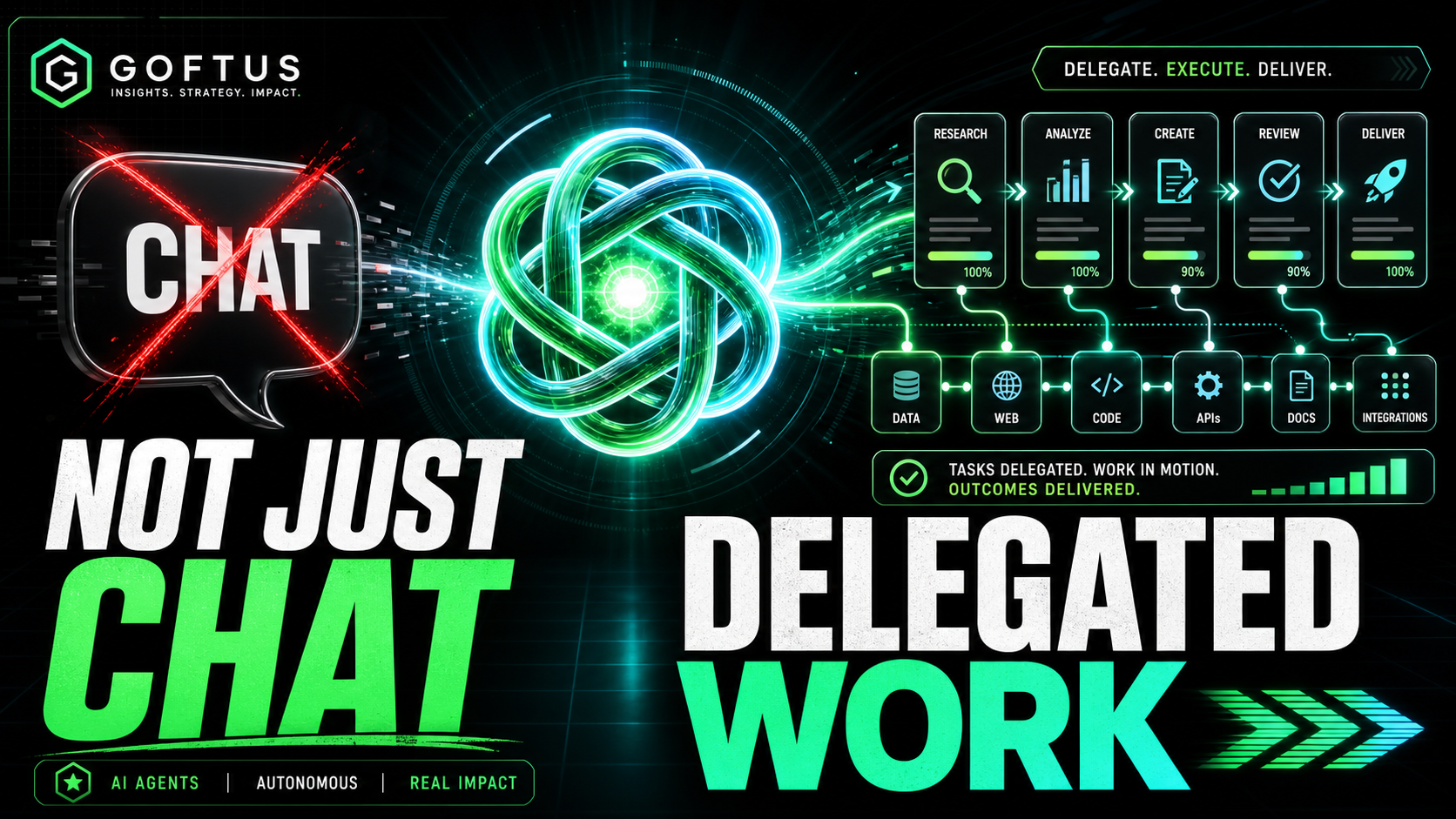
OpenAI's latest Codex data shows a clear shift from chatbots to long-running agents, with work delegation now becoming the default AI pattern.
# OpenAI Says Agents Are Moving From Chat to Delegated Work **Meta description (149 chars):** OpenAI says Codex is becoming a primary work tool across teams, showing how agentic AI is shifting from chat to long-running
OpenAI Says Agents Are Moving From Chat to Delegated Work
Meta description (149 chars): OpenAI says Codex is becoming a primary work tool across teams, showing how agentic AI is shifting from chat to long-running delegated work.
OpenAI’s latest write-up on how agents are transforming work is more than a product story. It is a signal that the center of gravity in AI is moving from one-off prompts to delegated execution.
That distinction matters for every business leader trying to turn AI from a demo into an operating capability.
For the last two years, many teams have treated AI like an exceptionally fast assistant: ask a question, get a draft, move on. Useful, yes. Transformational, not yet. But agentic systems change the unit of work. Instead of a single answer, you can hand off a task, let the system call tools, revisit context, and keep going until the job is done or a human needs to step in.
OpenAI says that shift is already happening internally. In its June 25 post, the company says Codex moved from being a niche developer tool to the primary AI tool for work across the organization, including Legal, Finance, and Recruiting. OpenAI also says usage has shifted toward longer-horizon work: by May 2026, 80.6% of sampled individual users had made at least one Codex request estimated to exceed 30 minutes of human work, 70.2% had made one over an hour, and 25.6% had made one over eight hours.
Those are not vanity metrics. They point to a new pattern of adoption: people are trusting AI with work that resembles a project, not a prompt.
Why this matters for founders and operators
If you lead operations, RevOps, CX, or a founder-led business, the takeaway is straightforward: the AI opportunity is moving away from “assist my team” and toward “run this workflow with supervision.”
That changes how you should evaluate use cases.
Instead of asking, “Can this model answer questions?” ask:
Can it complete a workflow with clear inputs and outputs?
Can it use your systems safely and consistently?
Can it recover from errors or escalate when uncertain?
Can you measure the cost, latency, and quality of each step?
Those are production questions. They are also the difference between a helpful pilot and durable automation.
OpenAI’s article shows that the highest-value agentic work is not necessarily the most glamorous. It is often the most operational:
structured analysis
automation and data transformation
debugging and tooling
legal and finance workflows
recruiting and internal coordination
That aligns with what many GOFTUS clients already see in practice. The first real wins from AI rarely come from replacing a whole department. They come from taking repetitive, high-friction tasks out of human hands and giving people a control layer instead of another inbox.
The real business change: longer tasks need better control
Once an agent is doing long-running work, the conversation shifts from “How smart is the model?” to “How do we govern the workflow?”
That means your AI stack needs more than model access. It needs an operating layer:
1) Routing
Not every task deserves the strongest model. Some requests should be handled by a smaller model, some by a specialist workflow, and some by a human.
2) Observability
You need logs, traces, and decision records. If an agent takes a wrong turn, you should know where it happened, why it happened, and what data it touched.
3) Guardrails
Long-running agents should not freewheel. Define what they may do, what they must not do, and when they must stop and ask for approval.
4) Escalation
The best agentic systems do not pretend to know everything. They hand off cleanly when the task is ambiguous, high-risk, or customer-facing.
5) Business metrics
Measure cycle time, exception rate, cost per task, and human review load. If you cannot tie the agent to operational outcomes, you do not yet have a business system.
This is why the OpenAI update is important. It reflects a market-wide shift toward long-horizon work. That shift will reward companies that build the control plane around AI, not just the prompt layer.
What leaders should do next
If you are deciding where to invest, do not start with a broad “AI transformation” program. Start with one workflow that is repetitive, structured, and expensive enough to matter.
Good candidates usually have these traits:
frequent handoffs
obvious inputs and outputs
clear rules or playbooks
measurable SLA pressure
a human reviewer already involved
Examples include lead routing, support triage, internal knowledge retrieval, invoice processing, compliance checks, and account research. These are the kinds of workflows where an agent can create leverage quickly without needing to touch the most sensitive parts of the business first.
From there, build a simple operating model:
1. Map the workflow end to end.
2. Identify the decisions that can be delegated.
3. Define the approval points.
4. Add logging and exception handling.
5. Run a small pilot with real users.
6. Expand only after quality and cost are proven.
That approach is boring on purpose. It is also how AI becomes reliable.
Bottom line
OpenAI’s latest data makes the direction clear: agents are no longer just a better chat interface. They are becoming a practical way to delegate multi-step work.
For business leaders, that means the next advantage will not come from asking whether AI can answer a question. It will come from asking whether AI can take ownership of a workflow, work through it safely, and hand back a result that your team can trust.
If you want help identifying the first 2–3 workflows in your business that are ready for agentic automation, GOFTUS can help you map the use case, design the operating layer, and ship a production-ready pilot. Book a GOFTUS consultation and we’ll turn the opportunity into a concrete automation plan.