Microsoft AI Agents Need Workflow Guardrails Before They Act for SMEs
Microsoft’s AI agent security signal shows why SMEs need permissions, approvals, audit logs, and human review before agents act.
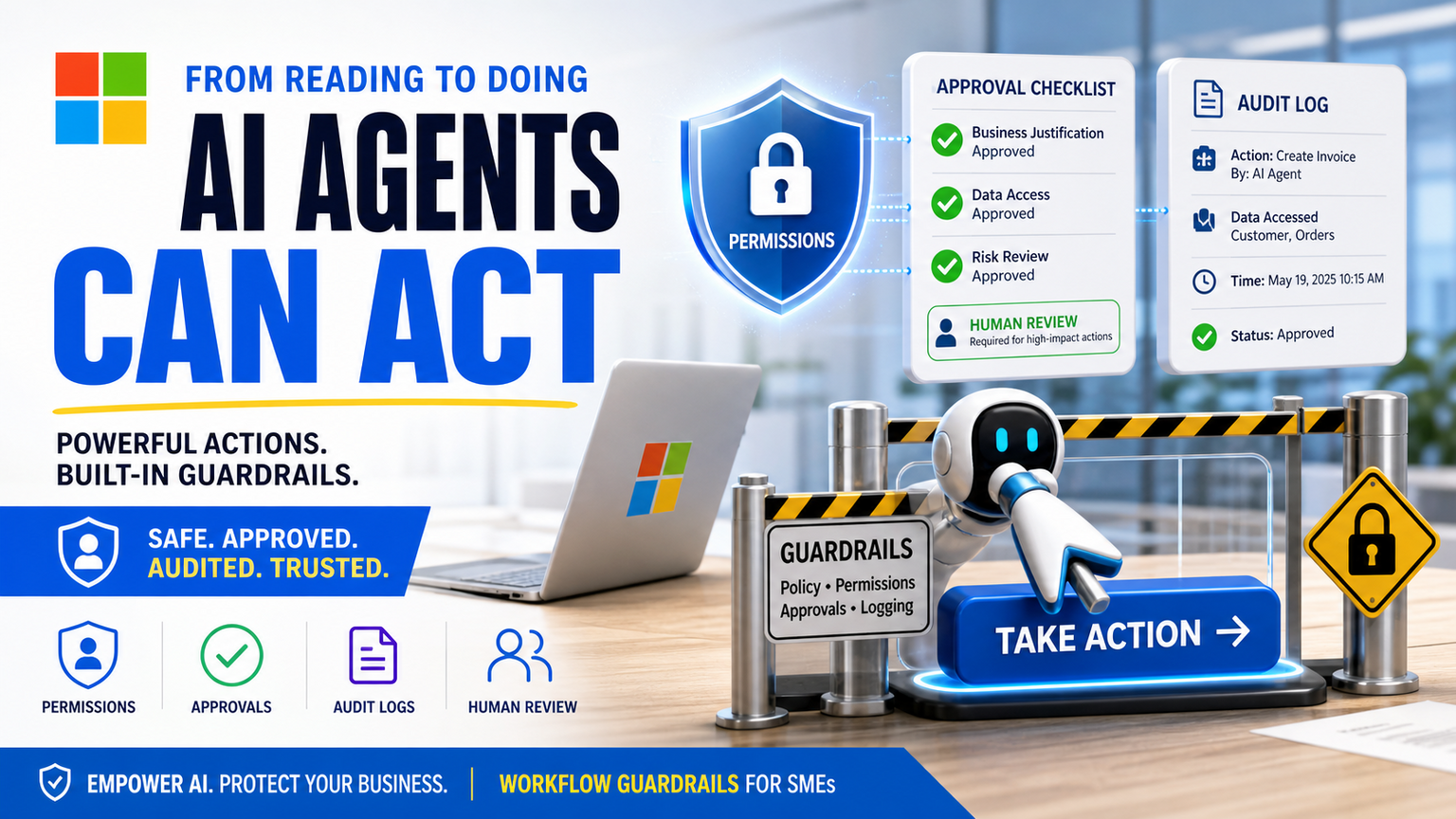
# Quick answer Microsoft’s latest AI security signal is simple: AI agents are moving from reading information to taking actions. Thirumurugan's view is that this is not only a cybersecurity issue. It is an operations de
Quick answer
Microsoft’s latest AI security signal is simple: AI agents are moving from reading information to taking actions. Thirumurugan's view is that this is not only a cybersecurity issue. It is an operations design issue for every SME that wants AI to touch invoices, CRM records, support refunds, documents, reports, procurement, or internal approvals.
When an AI system can only summarise a page, the risk is mostly wrong advice. When it can press buttons, update records, send messages, trigger refunds, create invoices, or route tickets, the risk moves into the workflow. That means permissions, business rules, human review, logs, rollback paths, and monitoring must be designed before the agent is allowed to act.
What this means for SMEs
Direct access to the Microsoft page returned a 403 during this unattended run, so this post treats the public RSS listing as the confirmed signal rather than claiming full article extraction.
For SMEs, the practical lesson is clear. AI agents are no longer just assistants that draft replies or summarise notes. They are becoming workflow participants. If a business connects an agent to a CRM, helpdesk, inbox, accounting system, data warehouse, or document store, the agent needs the same operating controls that a trusted employee would have.
A safe SME rollout should define what the agent can read, what it can recommend, what it can change, and what needs approval. Low-risk tasks can be automated end to end, such as tagging leads or drafting internal summaries. Higher-risk tasks should stop for review, such as refund approvals, contract edits, payroll changes, vendor payments, legal replies, or deletion of customer data.
This is especially relevant for UK and EU firms because data protection, auditability, and role-based access matter when AI touches customer information. It is also relevant for US businesses where AI agents are being pushed quickly into sales, support, finance, and cybersecurity workflows.
Competitor lens
Global SaaS competitors such as Zapier, n8n, Make, Lindy, Relevance AI, Gumloop, Bardeen, and Stack AI make it easier to connect apps and build agent workflows. US and European AI consulting firms often explain agentic AI, RAG, security, and production AI. Those tools and advisors are useful. The gap for SMEs appears when a workflow crosses systems, teams, approvals, exceptions, and monthly operational improvement.
Tools automate tasks. GOFTUS automates the workflow around the task.
That distinction matters for AI agents that can act. A task automation might say, "when a support email arrives, draft a refund reply." A workflow automation asks more operational questions: Is the customer eligible? Which order system is authoritative? What is the refund limit? Who approves exceptions? Where is the audit log? What happens if the agent is uncertain? How are bad outcomes reviewed next month?
GOFTUS counter-positioning is practical, not anti-tool. SMEs can still use SaaS automation builders and AI agent platforms. But they need workflow design, integration, human review, monitoring, and monthly improvement so the agent does not become an ungoverned button-presser inside the business.
Summery for SMEs
| SME question | Practical answer | GOFTUS workflow layer |
|---|---|---|
| Should AI agents be allowed to act? | Yes, but only after permissions and limits are defined. | Role-based access, action tiers, and approval gates. |
| Which tasks can be automated first? | Start with low-risk internal work. | Lead tagging, ticket triage, report drafts, knowledge search, and data cleanup. |
| What needs human review? | Any action with money, legal risk, customer harm, data deletion, or reputation risk. | Review queues, exception routing, and escalation rules. |
| How do we know what happened? | Every agent action should leave evidence. | Audit logs, summaries, source links, timestamps, and owner records. |
| How does the system improve? | Review failed, delayed, or overridden actions each month. | Monitoring dashboards and monthly workflow tuning. |
FAQ
Why does agent security matter for small businesses?
Small businesses often have fewer layers of control than enterprises. If an AI agent is connected to inboxes, CRMs, payment tools, or customer systems without clear limits, one mistake can create customer, financial, or compliance problems quickly.
What is the first safe AI agent workflow to build?
Start with a workflow where the agent reads and prepares work but does not make final high-impact decisions. Good examples include support triage, CRM note cleanup, sales follow-up drafts, document classification, internal knowledge search, and weekly reporting.
How can GOFTUS help with AI agents that take action?
GOFTUS designs the workflow around the agent. We map the process, connect the right systems, set approval rules, define review points, monitor outcomes, and improve the automation monthly so SMEs get measurable work done without losing control.
If your business is ready to move from AI experiments to safe AI agents, GOFTUS can help design a workflow with permissions, approvals, integrations, human review, and monitoring from day one.
Most feeds returned rate limits during this run, and one Reddit search feed returned no usable current discussion items.
xurl was not available in the runtime, so X was not used as a source.