Microsoft's AI Agent Security Warning Shows Why SMEs Need Workflow Guardrails
Microsoft's AI agent security warning shows why SMEs need approvals, access controls, audit logs, and workflow guardrails before agents act.
# Microsoft's AI Agent Security Warning Shows Why SMEs Need Workflow Guardrails Meta description: Microsoft's AI agent security warning shows why SMEs need approvals, access controls, audit logs, and workflow guardrails
Microsoft's AI Agent Security Warning Shows Why SMEs Need Workflow Guardrails
Meta description: Microsoft's AI agent security warning shows why SMEs need approvals, access controls, audit logs, and workflow guardrails before agents act.
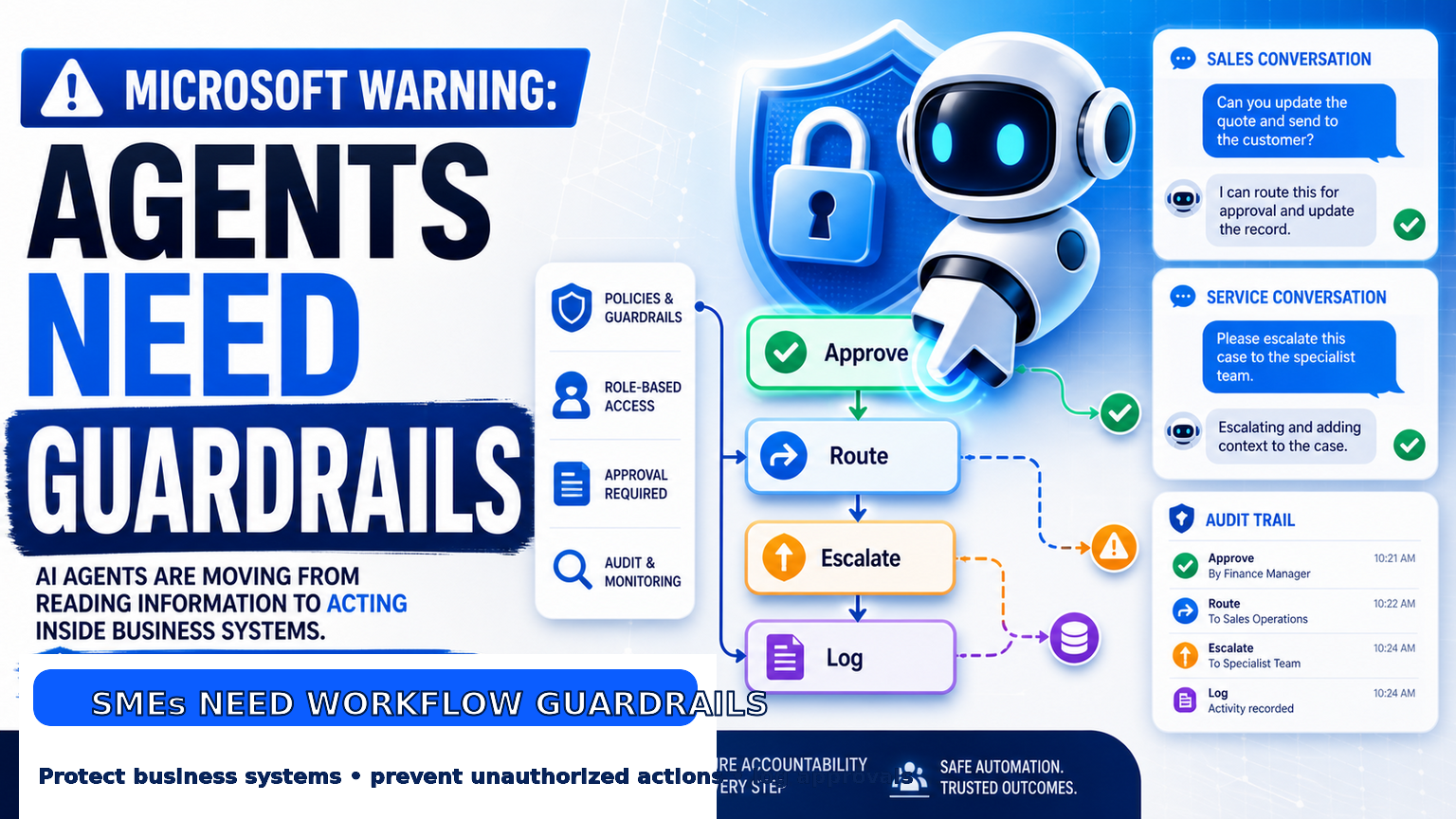
Microsoft has been warning that AI agents are moving from reading information to acting inside business systems. For UK, US, and EU SMEs, that is the practical turning point. A chatbot that drafts an answer is one risk profile. An agent that updates a CRM record, sends a quote, changes a support ticket, or triggers a finance task is another. The opportunity is real, but the workflow around the agent needs to be designed before the agent is given permission to act.
The useful lesson is not to avoid agents. It is to launch them with narrow scope, role-based access, human approval gates, logging, exception routes, and clear ownership. That is where GOFTUS focuses its work: building automation systems that can save time without turning every action into an untracked experiment.
The source signal for this post is Microsoft's public security framing around AI agents, indexed in Google News under the headline "Securing AI agents: When AI tools move from reading to acting." Direct retrieval of the Microsoft page returned a 403 during this cron run, so this article treats the Microsoft item as a headline-level official-source signal rather than claiming full article extraction.
A Google News cross-check also surfaced adjacent July coverage about Microsoft putting agentic AI into sales and service conversations. That matters because customer-facing workflows are exactly where SMEs are most tempted to let agents act quickly: replying to prospects, updating opportunities, escalating cases, and summarising customer history. The operator signal is the broader market pressure: teams want agents to do useful work, not just sit in a chat window.
Thirumurugan's view
Thirumurugan's view is that the AI agent conversation has moved from "which model is best?" to "who approved this action, where did it write, and can we reverse it?" That is a healthy shift for smaller businesses. Most SMEs do not need an experimental swarm of autonomous bots. They need one dependable workflow at a time: qualify leads, chase missing information, triage support, prepare reports, or move documents through review.
The risk appears when a tool is connected to live systems before the operating rules are clear. A sales agent should not discount a proposal without approval. A service agent should not promise a refund without policy checks. A finance agent should not alter billing records without an audit trail. A recruitment agent should not email candidates from an unreviewed template. These are not reasons to slow down forever; they are reasons to build the rails before increasing speed.
That is why GOFTUS treats agents as workflow components, not standalone magic. A good agent project defines the trigger, data sources, allowed actions, blocked actions, approval steps, fallback owner, reporting view, and monthly improvement loop.
What this means for SMEs
For SMEs, the first question is not whether Microsoft, OpenAI, Anthropic, Google, or another vendor will keep improving agents. They will. The question is whether your business process is ready for software that can take action.
Start with one workflow where the value is visible and the boundaries are clear. Customer support triage is a common candidate: the agent can classify the request, suggest an answer, check a policy, update a ticket, and route edge cases to a human. Sales follow-up is another: the agent can draft a response, enrich CRM fields, remind the owner, and prepare a next-step note. Document automation is useful when the agent extracts information but still sends exceptions to a reviewer.
GOFTUS can help businesses map these steps through practical AI automation services at /services and agentic workflow builds at /agents. The important point is that the workflow is designed before the tool is connected to sensitive systems.
The guardrails that matter
A safe SME agent workflow usually needs seven controls. First, scope: the agent should have a short job description and a list of actions it cannot take. Second, access: it should only reach the data and tools required for that job. Third, approvals: sensitive actions should pause for a named human. Fourth, logs: every recommendation, edit, and action should be visible after the fact. Fifth, exception routing: low-confidence or unusual cases should go to a person, not into a silent failure queue. Sixth, monitoring: leaders need a simple weekly view of handled tasks, unresolved cases, and manual overrides. Seventh, improvement: unanswered questions and failed automations should become the backlog for the next iteration.
This is also where FAQ automation can become a low-risk entry point. Repeated customer questions can be answered automatically while unanswered or sensitive requests move to a human. That gives the business measurable value and a training ground for wider automation. See the GOFTUS FAQ automation service at /services#faq-automation if customer answers are the natural first workflow.
The market has plenty of options. UK consultancies such as Faculty AI, Deeper Insights, Waracle, and Brainpool AI can support larger AI programmes. US firms such as LeewayHertz, Markovate, SoluLab, and BairesDev can build custom systems. European teams such as Addepto, STX Next, Netguru, and 10Clouds bring strong engineering capability. SaaS tools such as Zapier, n8n, Relevance AI, Lindy, Gumloop, Bardeen, Make, and Stack AI can be useful for fast automation prototypes.
The gap for many SMEs is not access to a tool. It is ownership of the full workflow. Tools automate tasks. GOFTUS automates the workflow around the task. That means designing the handoff, approval, CRM update, audit log, reporting view, and improvement cycle together instead of leaving each team to stitch it together later.
What SMEs should do next
Before giving an AI agent write access to a business system, write down the exact actions it may take. Then mark each action as automatic, approval-required, or blocked. Connect the agent to one process, not every process. Give one person ownership of exceptions. Review the first month of logs before expanding the scope.
If you already use Microsoft 365, Dynamics, HubSpot, Salesforce, Zendesk, Notion, Google Workspace, Airtable, or n8n, the question is not whether automation is possible. It is which workflow should be made reliable first. GOFTUS can run a focused diagnostic through /contact and turn that into a practical build plan for /services or /agents.
The businesses that benefit most from agents will not be the ones that connect everything fastest. They will be the ones that decide where agents are allowed to act, where humans stay in control, and how every outcome is measured.