Meta's Instagram AI Backlash Shows Why SMEs Need Content Approval Workflows
Meta's Instagram AI backlash shows why SMEs need content approval workflows before AI touches public accounts or customer content.
# Meta's Instagram AI Backlash Shows Why SMEs Need Content Approval Workflows Meta description: Meta's Instagram AI backlash shows why SMEs need content approval workflows before AI touches public accounts, images, or c
Meta's Instagram AI Backlash Shows Why SMEs Need Content Approval Workflows
Meta description: Meta's Instagram AI backlash shows why SMEs need content approval workflows before AI touches public accounts, images, or customer content.
Quick answer
Fox Business reported on 11 July 2026 that Meta shut down an Instagram AI image feature that allowed users to generate images by mentioning public Instagram accounts. News & World Report and the Los Angeles Times, so this post treats the story as a current news signal about AI content governance, not as a claim that every detail of Meta's internal process is public.
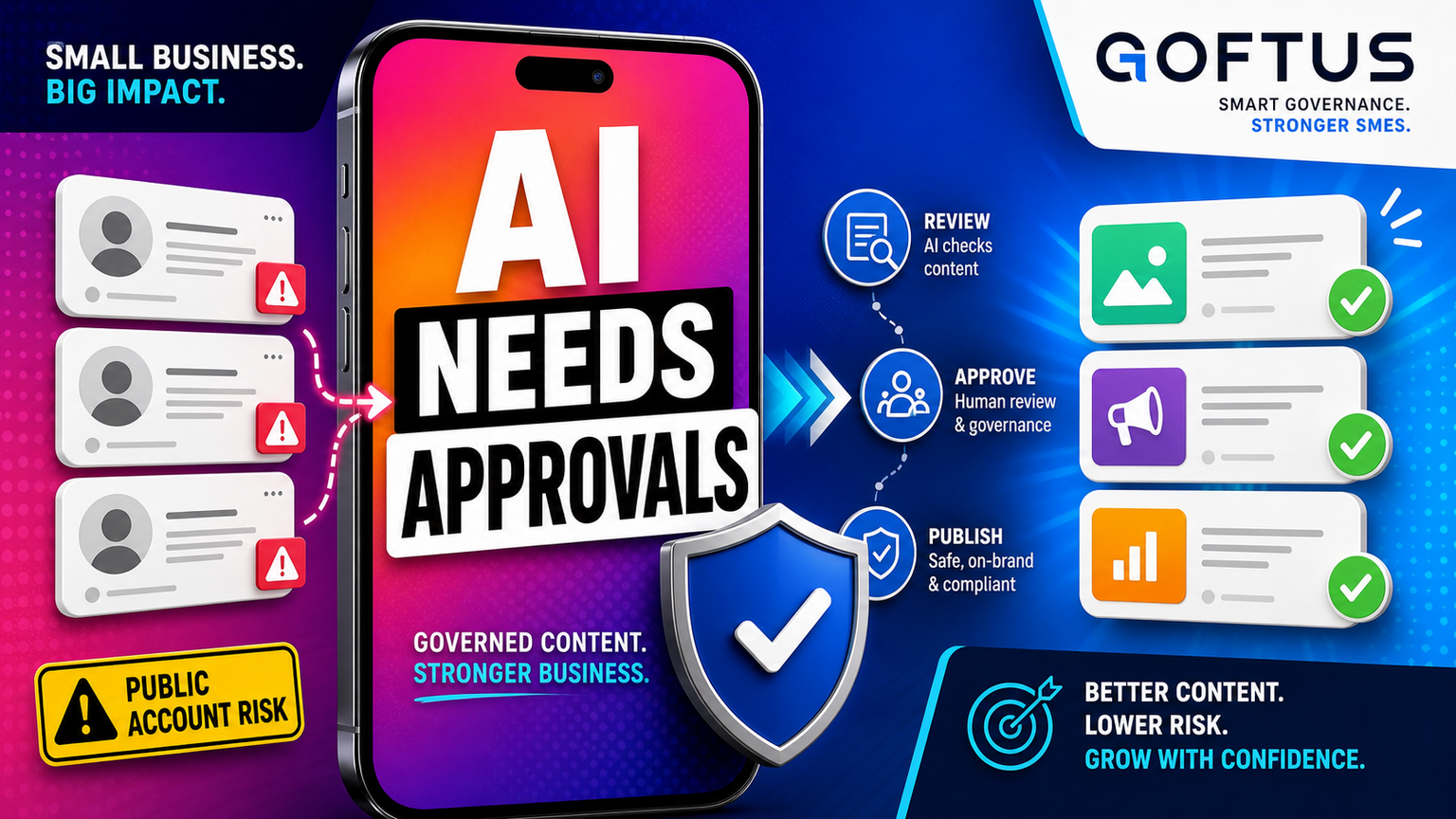
For UK, US and EU SMEs, the lesson is simple. AI content tools should not be allowed to touch public profiles, brand assets, customer images, support conversations, proposals or campaign copy without a clear approval workflow. A prompt can be fast, but a business still needs permission checks, brand rules, legal review triggers, audit history and a human sign-off path.
That is where GOFTUS positions AI differently. The point is not to add another content generator. The point is to build the workflow around content generation so the team knows what AI can use, who approves outputs, where records are saved, and when a risky item is blocked.
What happened
The reported Meta feature matters because it sits at the boundary between public data, identity, creative output and automated publishing. Could a staff member generate content from a public customer profile? Could a junior marketer publish an AI-edited asset without consent? Could a contractor reuse a founder's image in a campaign? Could a support team paste sensitive content into a tool without a record?
Most SMEs do not need a big AI ethics department. They need practical controls inside the way work already happens. A simple approval workflow can define safe inputs, restricted inputs, review stages, owner roles and escalation paths.
What this means for SMEs
Small teams often adopt AI tools faster than they update their process. A founder tests image generation, a marketer tries a social post tool, and a support agent pastes a customer issue into a chatbot. None of this is automatically wrong. The risk appears when no one can say what data was used, whether permission existed, who reviewed the output, and where the final version was saved.
AI can make content creation feel frictionless, but public-facing work still needs controls in the right places. SMEs should decide which content needs approval, which assets are off-limits, which claims need evidence, and which outputs need legal or leadership review.
GOFTUS translates those rules into workflow automation. An AI content workflow can draft a response, check brand tone, flag risky terms, route high-risk outputs, save approved versions, and record the decision. For support and FAQ teams, the same governance can connect to AI FAQ automation, so repeated answers stay helpful and controlled.
Hajikreena's view
Hajikreena's view is that SMEs should stop treating AI approval as a final manual check at the end of the process. Approval should be designed into the workflow from the first input. If a tool can create a public image, customer answer, sales email or social post, the workflow should already know which data sources are allowed, which staff roles can approve, and which outputs need to be blocked.
This is also a cost issue. When approval is informal, managers become bottlenecks and teams either wait too long or bypass review. When approval is automated around the task, the system can handle low-risk work quickly and only escalate exceptions. That is the difference between AI that creates more supervision work and AI that improves operations.
Competitor lens
The market is crowded. UK firms such as Faculty AI, Deeper Insights, Waracle and Brainpool AI, US providers such as LeewayHertz, Markovate, SoluLab and BairesDev, and European consultancies such as Addepto, STX Next, Netguru and 10Clouds can all help with AI delivery. SaaS tools such as Zapier, n8n, Relevance AI, Lindy, Gumloop, Bardeen, Make and Stack AI can automate useful pieces of the process.
Those options can be valuable, but many SMEs do not need another isolated automation or generic AI strategy deck. They need their real content, support, sales and operations workflow mapped end to end. Tools automate tasks. GOFTUS automates the workflow around the task.
That means GOFTUS starts with the operational question. What should happen before AI sees a prompt? What should happen after it produces an answer? Who approves the output? Which CRM, helpdesk, file store or reporting dashboard needs to update? How will the business learn from blocked items and unanswered questions each month?
What SMEs should do next
Start with one public-facing workflow. It could be social content, customer support replies, FAQ answers, proposal drafts, lead follow-ups or product update emails. Write down the inputs the team uses, the claims they make, the systems they update, and the approvals they currently rely on. Then separate the workflow into three lanes.
First, define safe automation. These are routine drafts, standard answers, CRM updates and internal summaries that AI can prepare with low risk. Second, define review-required work. These are customer-facing messages, legal-sensitive claims, use of images, pricing promises, data handling and regulated-sector content. Third, define blocked actions. These include unapproved public profile use, sensitive customer details, unsupported performance claims, and anything the business would not want in an audit trail.
From there, use automation to route work instead of relying on memory. GOFTUS can help connect AI assistants, approval steps, CRM updates, support triage, internal knowledge bases and reporting into one working system. If your business is testing content AI, start with the GOFTUS services page or ask for a practical workflow diagnostic through contact.
Summery for SMEs
Meta's reported Instagram AI reversal is not only a Big Tech story. It is a reminder that AI content work needs permission, approval and auditability. SMEs can still move fast, but they should not let AI tools operate as disconnected side projects. The safer path is to automate drafting, checking, routing and recording together. That is how AI becomes a workflow asset instead of a brand or compliance surprise.
FAQ
Should small businesses stop using AI content tools?
No. The practical answer is to use AI content tools inside a workflow that defines approved inputs, human review points and publication rules. AI can still save time on drafts, summaries, FAQs and follow-ups when the business controls what happens before and after the output.
What is the first approval workflow an SME should automate?
Start with the workflow that creates the most repeated public content, such as customer support replies, FAQ answers, sales emails or social posts. Map the current review steps, then automate the routing, reminders, CRM updates and audit notes around them.
How can GOFTUS help with AI content governance?
GOFTUS designs practical AI automation around the task, including approval gates, CRM or helpdesk updates, FAQ automation, reporting and human review. The aim is not just faster content. The aim is safer content that fits the way your team already works.
Source notes
News & World Report and the Los Angeles Times.