Meta and Google AI Dependency Risk: Why SMEs Need Workflow Fallbacks
A Reddit and TechSpot signal on Meta and Google AI shows why SMEs need fallback plans for AI workflows, not just faster agents.
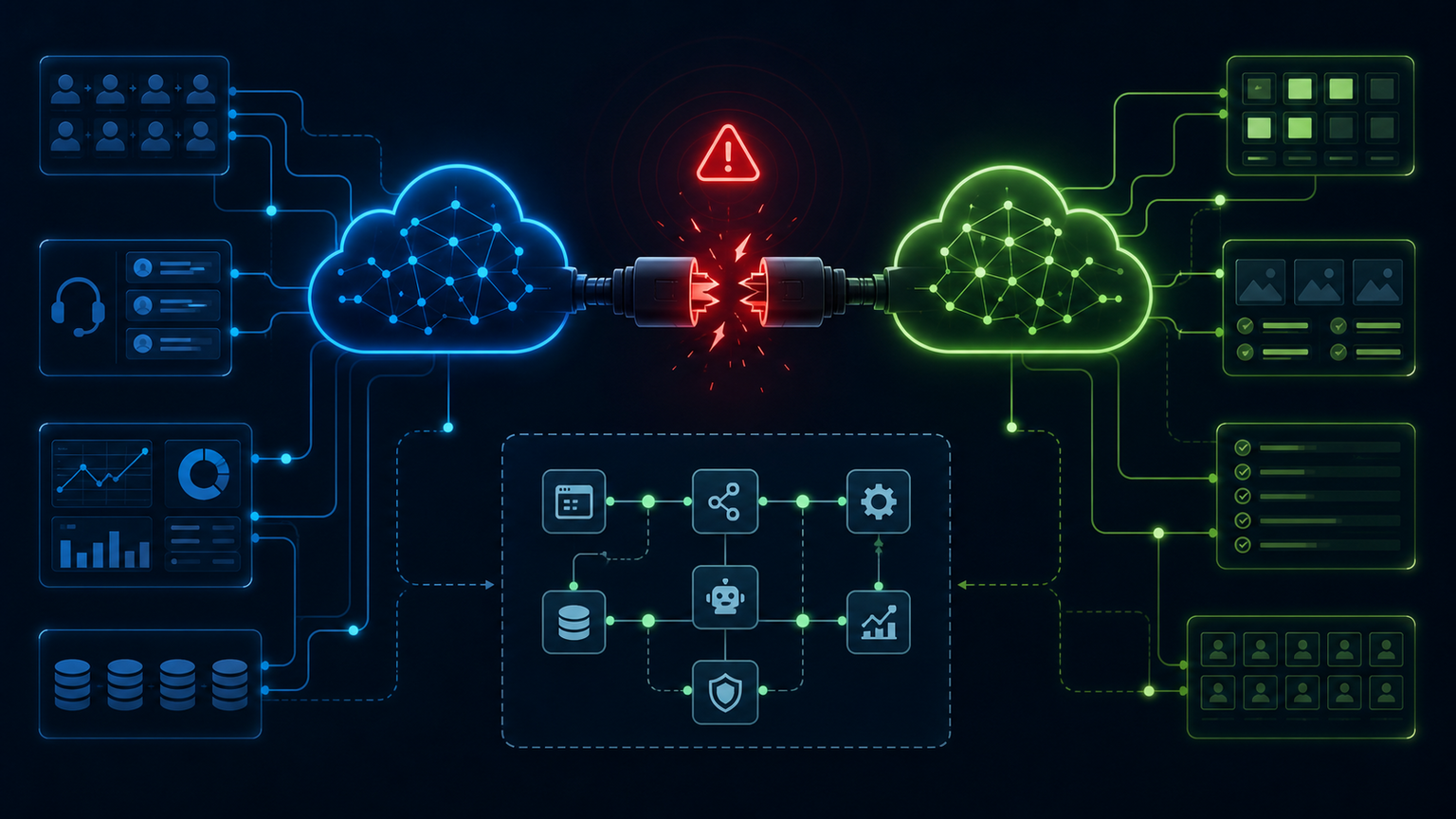
# Quick answer A hot r/technology thread is debating a report that Meta relied on Google's AI for customer service, ad tools and content moderation before access was cut off. Treat the story as a workflow risk signal, n
Quick answer
A hot r/technology thread is debating a report that Meta relied on Google's AI for customer service, ad tools and content moderation before access was cut off. Treat the story as a workflow risk signal, not just Big Tech gossip: when one AI layer sits inside multiple operations, dependency mapping, fallbacks and human review become commercial controls.
For SMEs, the lesson is simple. Do not buy or build an AI workflow that only works when one model, one SaaS connector or one vendor policy stays unchanged.
What happened
The Reddit signal came from r/technology, where users discussed a TechSpot report headlined that Meta had been secretly relying on Google's AI for customer service, ad tools and content moderation before being cut off.
Because the available cross-check is an article report rather than direct company filings reviewed here, this piece frames the topic as Hajikreena's view on a Reddit signal with article support.
That distinction matters. The verified business lesson is not whether every detail of the reported Meta and Google arrangement is final. The lesson is that AI dependencies can spread quietly across several workflows until a vendor change exposes the fragility.
Hajikreena's view
The uncomfortable part is not that a company used another company's AI. That is normal. The uncomfortable part is when AI dependency becomes invisible to the people responsible for service quality, escalation, reporting, compliance and customer trust.
In an SME, the same pattern appears in smaller ways:
A support inbox depends on one AI classifier.
A sales follow-up workflow depends on one enrichment tool.
A reporting assistant depends on one data connector.
A document processing flow depends on one OCR or LLM provider.
A marketing workflow depends on one browser automation or scraping tool.
None of those choices are wrong by themselves. The risk appears when the workflow has no fallback path, no monitoring and no human review point for exceptions.
What this means for SMEs
SMEs should read this as an operations design warning. AI agents and automations are no longer isolated experiments. They are starting to sit inside service, sales, finance, HR, compliance and management reporting.
Before connecting another agent to live work, ask five practical questions:
1. What breaks if the AI vendor, model, API, browser tool or connector changes tomorrow?
2. Which customer or employee experience becomes worse first?
3. Who receives the exception alert?
4. Can a human complete the task manually while the automation is degraded?
5. Are outputs logged well enough to audit later?
For UK businesses, this is especially relevant where customer communications, data protection duties and service complaints can become regulatory or reputational issues. For US and European SMEs, the same logic applies to vendor concentration, data processing records, resilience and customer trust.
Competitor lens
Global SaaS competitors such as Zapier, n8n, Make, Lindy, Relevance AI, Gumloop, Bardeen and Stack AI make it easier to connect tools, route LLM calls and build agents quickly. That is useful. US and European AI consulting competitors often publish strong guidance around AI agents, RAG, production AI, AI security and vertical transformation.
What this Reddit signal highlights is the gap between task automation and workflow ownership.
Tools automate tasks. GOFTUS automates the workflow around the task.
That means the practical work is not only connecting an inbox to an AI model. It is mapping the customer journey, adding human review, defining fallback states, logging decisions, monitoring failures and improving the workflow every month. SaaS tools are useful building blocks, but SMEs usually need workflow design, integration, human review, monitoring and monthly improvement to make the automation dependable.
What competitors are missing
Many AI agent pages still sell the upside: faster replies, cheaper operations and always-on digital workers. Those benefits are real, but the Meta and Google discussion points to the less marketable layer: dependency governance.
A useful SME automation plan should include:
A vendor dependency map for every workflow.
A model fallback plan for high-volume or customer-facing tasks.
Human approval thresholds for sensitive outputs.
Alerting when confidence, latency or failure rates shift.
Monthly workflow review to remove brittle steps.
That is where AI automation becomes an operating system for the business rather than another tool subscription.
Summery for SMEs
| Question | Short answer |
|---|---|
| What is the business issue? | AI dependencies can spread across customer service, ads, moderation and operations without clear fallback ownership. |
| Why should SMEs care? | A vendor cutoff, model change or connector failure can break customer-facing workflows. |
| What should leaders do first? | Map where AI touches live work and identify the highest-risk dependency. |
| What is the GOFTUS approach? | Design the full workflow around the AI task, including review, fallback, monitoring and improvement. |
| Best first automation candidate? | A repeatable support, CRM follow-up, reporting or document workflow with clear exceptions and measurable outcomes. |
FAQ
Should SMEs avoid AI tools because of vendor dependency?
No. SMEs should use AI tools, but they should avoid making one tool an invisible single point of failure. The safer approach is to design the workflow with fallback paths, audit logs and human review for edge cases.
Is this only a Big Tech problem?
No. Big Tech examples are larger, but the same issue appears when an SME connects one AI assistant to support tickets, sales follow-ups, invoice handling or management reports without monitoring what happens when the tool fails.
What should a business automate first?
Start with a workflow that is repetitive, measurable and painful, such as support triage, CRM follow-up, document processing, reporting automation or an internal knowledge assistant. Then design the checks around it before scaling.
Practical GOFTUS CTA
If your business already has AI tools in support, sales, reporting or document workflows, GOFTUS can review where the hidden dependency risks are and redesign the process around measurable outcomes. Book a practical AI workflow audit and we will map the task, the surrounding workflow, the fallback plan and the monthly improvement loop.
Sources and source notes
Direct TechSpot page was not accessible from this environment due to a 403 challenge, so the article is cited as a Google News cross-check rather than independently scraped article text.