Meta's Slower AI Agents: The SME Workflow Lesson
Meta's slower AI agent progress is a reminder: SMEs need workflow design, monitoring, and human review before scaling automation.
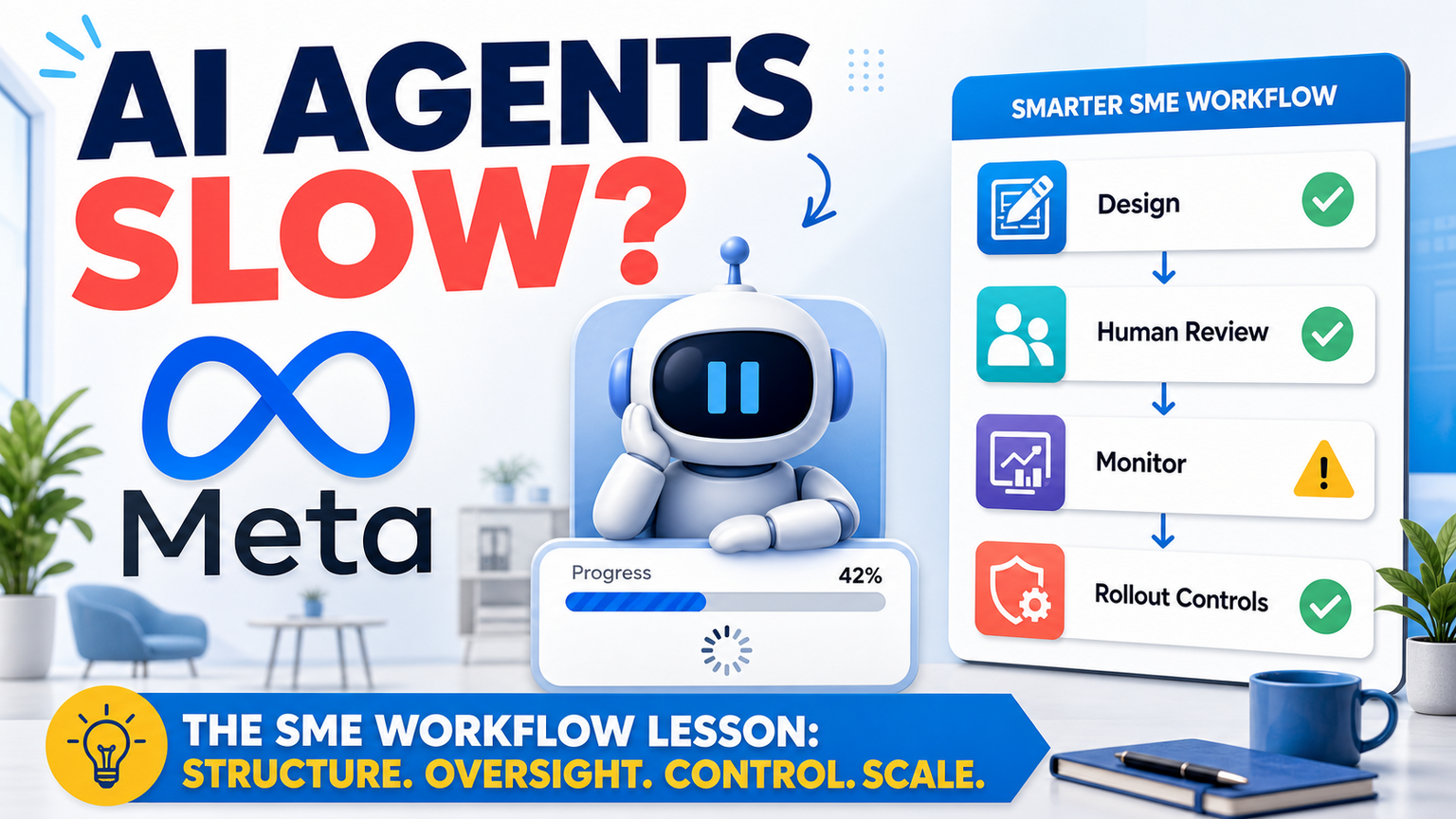
# Quick answer A hot r/technology discussion picked up reports that Mark Zuckerberg told Meta staff AI agents have not advanced as quickly as he hoped. Bharatvaj's view: this is not a reason for SMEs to pause AI automa
Quick answer
A hot r/technology discussion picked up reports that Mark Zuckerberg told Meta staff AI agents have not advanced as quickly as he hoped.
Bharatvaj's view: this is not a reason for SMEs to pause AI automation. It is a reason to stop buying agent demos as if they are finished operating models. The winning move is to build narrower, measurable workflows where the agent has context, permissions, review rules, fallback paths, and monitoring from day one.
What this means for SMEs
The Reddit signal is useful because it reflects a bigger buyer problem. Many businesses are being sold broad promises: autonomous sales agents, support agents, finance agents, research agents, and AI staff. The practical gap is not whether a model can perform a task once. The gap is whether the full workflow works reliably every Monday morning.
For an SME, that means asking different questions before adopting AI agents:
What system of record does the agent read from and write back to?
Which actions need human approval before sending, updating, refunding, deleting, or escalating?
What happens when the model is uncertain, the API fails, or the customer gives incomplete information?
Who reviews agent output weekly, and what gets improved every month?
Which metric proves the workflow is better, such as faster response time, fewer missed follow-ups, cleaner CRM records, or lower manual reporting hours?
The Meta signal matters because it comes from a company with enormous AI resources. If even frontier teams are finding agent progress slower than hoped, SMEs should not copy the most ambitious public demos. They should implement scoped workflows that compound over time.
Good SME examples include support triage that drafts replies but routes edge cases to humans, CRM follow-up that creates tasks and reminders before sending messages, document processing that extracts fields then flags exceptions, and reporting automation that prepares dashboards with audit notes.
Competitor lens
Global SaaS tools such as Zapier, n8n, Relevance AI, Lindy, Gumloop, Bardeen, Make, and Stack AI are making AI agents easier to build. That is useful. US and European AI consultancies are also publishing more about agentic AI, RAG, production AI, industry use cases, and cost control. UK competitors often frame the discussion around responsible AI, public-sector adoption, and decision intelligence.
What competitors are often missing is the operational middle layer for SMEs. A workflow is not just a trigger, a prompt, and an API call. It also needs process mapping, permissions, CRM and helpdesk integration, exception handling, human review, monitoring, and monthly improvement.
Tools automate tasks. GOFTUS automates the workflow around the task.
For UK, US, and European SMEs, the regional relevance is simple: AI agent adoption will be judged by reliability, accountability, and measurable business outcomes, not by how futuristic the demo looks.
Summery for SMEs
| Signal | SME risk | Practical response |
|---|---|---|
| Meta reportedly says agent progress is slower than hoped | Buying broad agent promises too early | Start with one narrow workflow and a measurable metric |
| Reddit discussion shows strong interest and scepticism | Staff may distrust black-box automation | Add review checkpoints and explain where AI is used |
| Agent tools are improving quickly | Tool sprawl and disconnected automations | Design the workflow before selecting the tool |
| News cross-check shows this is not only a Reddit rumour | Leaders may overreact and delay useful automation | Build low-risk agentic workflows with monitoring |
FAQ
Are AI agents ready for SMEs?
Yes, when they are scoped to clear workflows. They are risky when positioned as fully autonomous replacements for teams, processes, or management oversight.
Should SMEs wait until Meta or OpenAI solves agents?
No. SMEs can get value now from practical agentic workflows in support triage, CRM follow-up, document processing, reporting, and internal knowledge support. The key is to keep humans in the loop for sensitive actions.
What should an SME automate first?
Start with a repetitive workflow that already has rules, data, and a clear owner. Good first candidates are inbound support categorisation, overdue CRM follow-ups, invoice or document extraction, meeting note routing, and weekly KPI reporting.
GOFTUS CTA
If your team wants AI agents without betting the business on a demo, GOFTUS can map one high-value workflow, connect the tools around it, add review and monitoring, and improve it monthly. Start with one measurable workflow, then scale what works.
This article treats the Reddit thread as a discussion signal and the news RSS results as headline-level cross-checks, not as independently scraped full article text.