Insurance AI Agents Need Human Approved Browser Controls
Insurance browser agents show why SMEs need approval gates, audit logs and safe workflow handoffs before critical submissions.
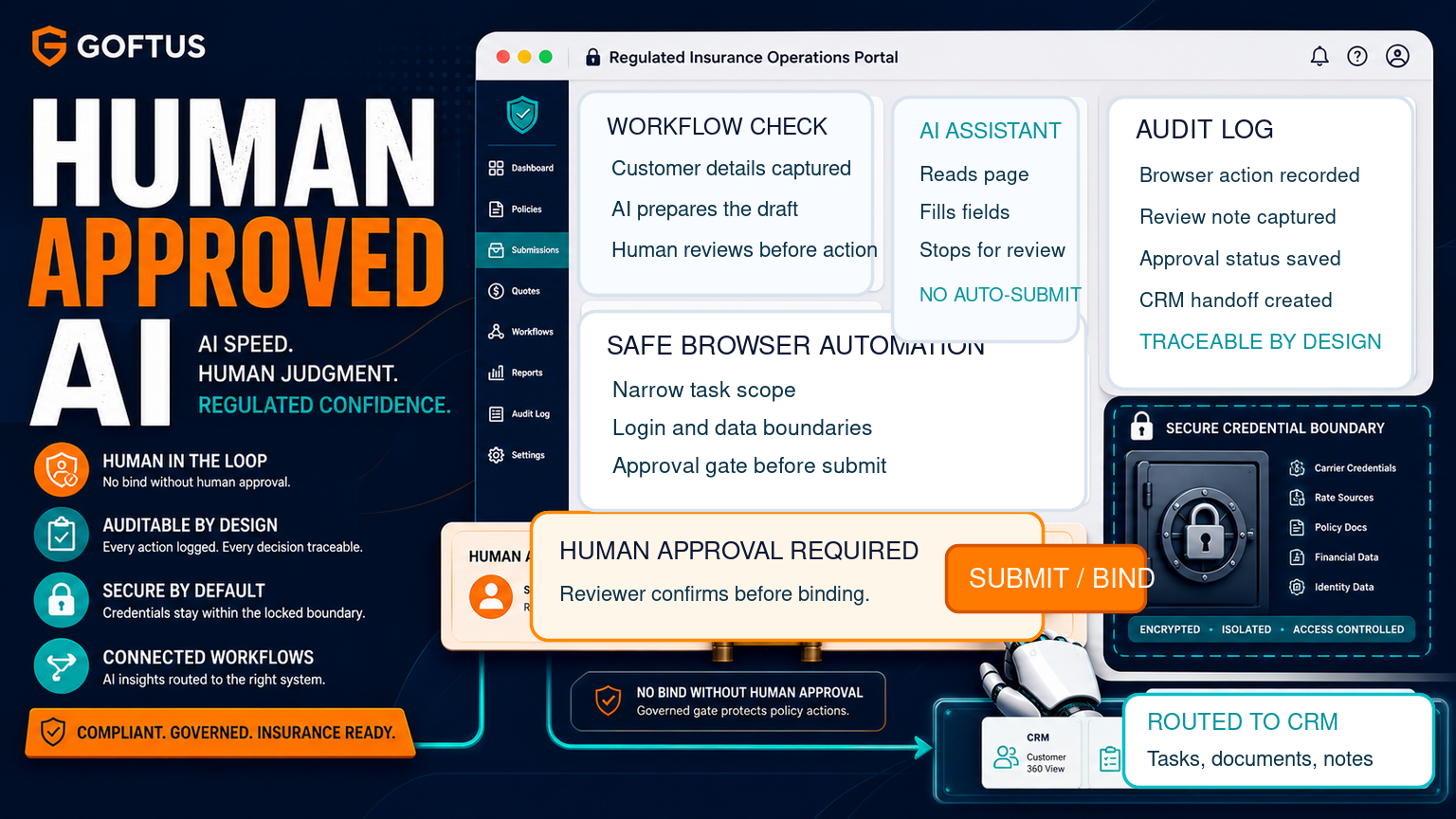
# Insurance AI Agents Need Human Approved Browser Controls Meta description: Insurance browser agents show why SMEs need human approved AI controls, audit logs and safe workflow handoffs before critical business submiss
Insurance AI Agents Need Human Approved Browser Controls
Meta description: Insurance browser agents show why SMEs need human approved AI controls, audit logs and safe workflow handoffs before critical business submissions.
That matters beyond insurance. UK, US and EU SMEs are about to see more browser AI agents that can log into portals, fill forms, collect documents and move work through websites where APIs are missing. The useful part is not the agent clicking faster. The useful part is the control system around the click: allowed sites, credential boundaries, field checks, human approval, audit logs and follow-up into CRM or support tools.
Thirumurugan's view is simple. Browser automation becomes business automation only when the company owns the workflow. GOFTUS helps SMEs design that layer through /agents and /services, so an AI browser helper can prepare work without silently taking risky actions.
Why this insurance signal matters for operators
Insurance is a good test case because it mixes repeated admin, regulated decisions and costly mistakes. Back-office teams often move between carrier portals, quote forms, document systems, email, CRM and spreadsheets. Some steps are repetitive enough for automation. Other steps, such as final submission, binding, policy changes or customer communication, need human judgement.
The Reliance signal points to the pattern SMEs should copy, not the specific insurance product. Let the AI collect context, navigate the browser and prepare the next step. Then require a human to review and approve the business action. A browser AI agent should not be treated like a magic employee with unlimited permission. It should be treated like a fast assistant inside a narrow lane.
This is especially relevant for businesses that still rely on portals instead of clean APIs. Recruitment platforms, supplier dashboards, courier portals, procurement sites, accounting tools, claim forms and public-sector portals often force humans to copy and paste data across screens. A browser agent can reduce that manual load. Without controls, it can also submit the wrong form, expose login data or act on stale customer information.
What this means for SMEs
For SMEs, the first question is not whether a browser agent can technically click a button. The first question is which browser task is safe enough to automate. Good candidates include checking order status, downloading invoices, pre-filling application forms, collecting screenshots, comparing portal records with CRM and routing exceptions to a reviewer.
Riskier tasks need stronger gates. Submitting a quote, accepting a contract change, sending a refund, updating a customer record or confirming a regulated action should require approval. The business should see what the agent read, what it changed, what evidence it used and who approved the final action.
GOFTUS designs browser-based workflow automation around those controls. A practical build can start with one process, one login boundary and one clear approval rule. From there, the workflow can connect to CRM follow-up, support triage, document automation or reporting dashboards through /services. If the browser work belongs to a broader AI agent, GOFTUS can connect it to /agents with narrow permissions and stop rules.
The control checklist before a browser agent touches live work
Before an SME deploys a browser with AI controls, the workflow should answer six questions.
First, which websites and pages are allowed? Second, which credentials can it use? Third, which fields can it edit? Fourth, which actions need approval? Submit, bind, refund, delete and send actions often need a person in the loop. Fifth, where is the log stored? Screenshots, page URLs, extracted fields and approval notes should be traceable. Sixth, what happens when confidence is low? The agent should stop and route the case, not improvise.
This is where the GOFTUS approach differs from simply buying another automation tool. The browser action is only one part of the system. The surrounding workflow decides whether the automation is safe, measurable and useful.
Faculty AI, Deeper Insights, Waracle and Brainpool AI can be strong partners for larger AI programmes in the UK. LeewayHertz, Markovate, SoluLab and BairesDev often frame agent builds for US buyers. Addepto, STX Next, Netguru and 10Clouds bring European software delivery experience. SaaS platforms such as Zapier, n8n, Relevance AI, Lindy, Gumloop, Bardeen, Make and Stack AI can automate useful tasks.
The gap for many SMEs is ownership of the whole operating path. Tools automate tasks. GOFTUS automates the workflow around the task. That means defining the trigger, checking the data, controlling the browser action, adding human approval, recording evidence, updating CRM or support systems and reviewing failures each month.
What SMEs should do next
Pick one browser-heavy process that wastes time every week. Map the current steps, including the login, data source, portal action, reviewer, follow-up system and failure cases. Then separate low-risk preparation from high-risk submission.
A good first GOFTUS diagnostic looks for repeated browser work, a clear business owner and a measurable outcome such as faster response time or cleaner CRM records. If the process also includes customer questions, the same control logic can connect to /services#faq-automation so automated customer answers feed the right workflow.
The safest browser agent is not the one that acts alone. It is the one that prepares work clearly, asks for approval at the right moment and leaves the team with an audit trail. If that sounds like the kind of workflow your business needs, GOFTUS can help scope the first controlled automation through /contact.
Browser AI agents are moving from demos into regulated back-office work. The useful lesson is not that every SME should let AI click through business portals. The lesson is that browser automation needs limits: narrow tasks, protected credentials, approval gates, logs, stop rules and handoff into CRM, support or reporting systems. GOFTUS helps SMEs turn those controls into practical AI agent workflows.
What is a browser with AI controls?
A browser with AI controls is a browser automation setup where an AI agent can help read pages, fill forms or prepare actions, but the business defines where it can operate, what it can change and when a human must approve the next step.
Should SMEs let AI agents submit forms automatically?
Usually not at first. SMEs should start by letting the agent prepare forms, collect evidence and flag exceptions. Final actions such as submit, bind, refund, delete or send should stay behind human approval until the workflow has enough evidence and monitoring.
How can GOFTUS help with safe browser agents?
GOFTUS can map the workflow, define login boundaries, add approval steps, connect browser activity to CRM or support tools, and create audit logs. The goal is controlled automation through /agents and /services, not uncontrolled clicking.
Direct Stock Titan access returned HTTP 403 here, so this is treated as headline-level source evidence.
Adjacent developer/social context came from Hacker News Algolia results discussing AI browser agent visibility, logs and action blocking. This is social context, not confirmation of the Reliance launch.