Humanoid Robot Olympics: What Businesses Should Learn Before Robots Enter Real Workflows
Humanoid robot games are a useful signal, but business readiness depends on ownership, fallbacks, review queues and logged exceptions.
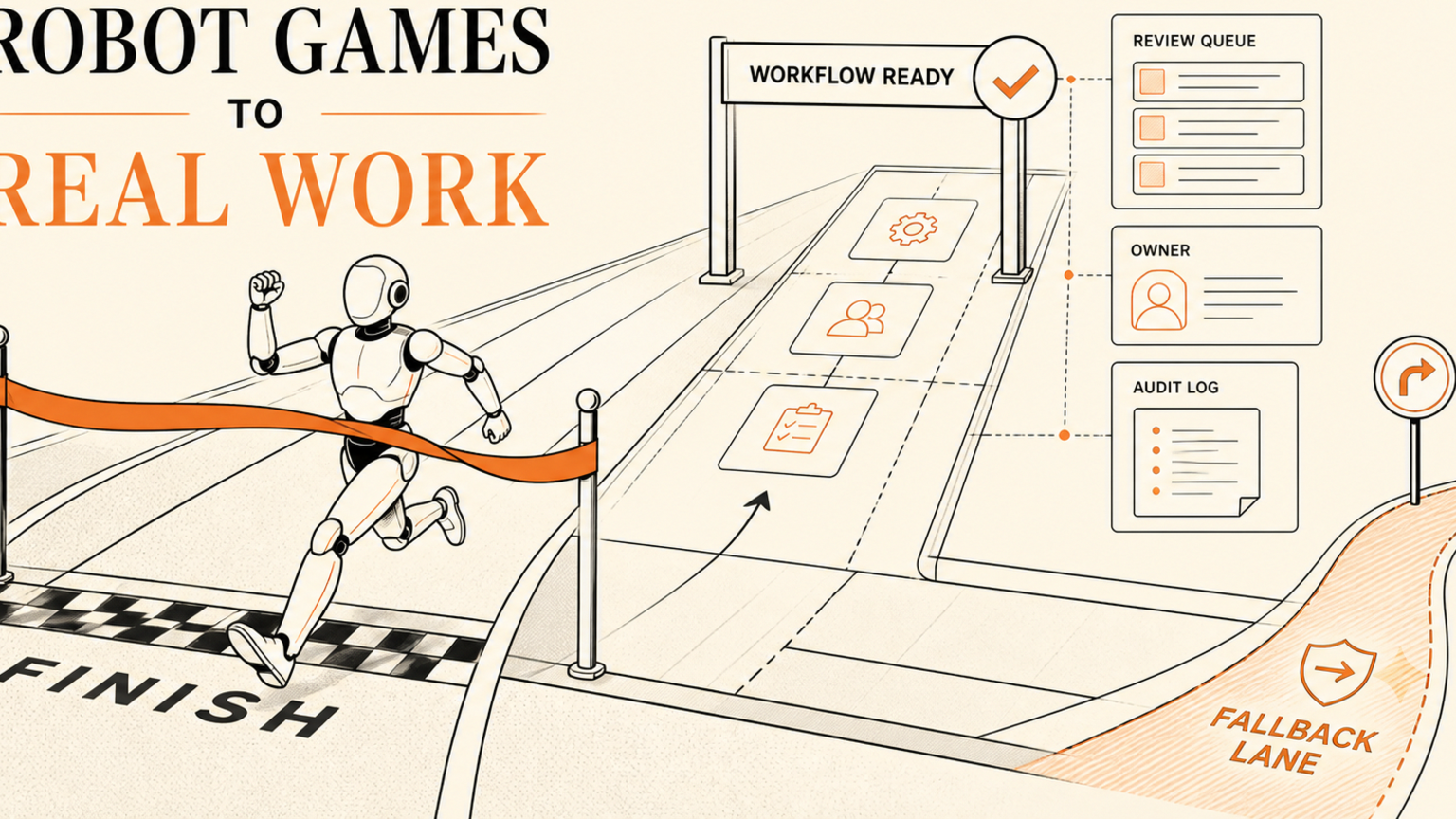
# Quick answer The World Humanoid Robot Games made robotics feel unusually close to everyday business. News coverage showed humanoid robots sprinting, playing soccer, boxing, and competing in staged events in Beijing. S
Quick answer
The World Humanoid Robot Games made robotics feel unusually close to everyday business. News coverage showed humanoid robots sprinting, playing soccer, boxing, and competing in staged events in Beijing. Some headlines focused on track records and speed. Others focused on the awkward moments, including padded walls, crashes and practical questions about whether a robot that can run can also complete simple physical handoffs reliably.
What this means for SMEs
That contrast is exactly why the event matters for small and mid sized businesses. The robot Olympics are not only entertainment. They are a public stress test for a bigger question: when machines leave the demo floor, who owns the workflow around them? A sprint can be measured in seconds. A warehouse handoff, reception desk task, facility check, customer support action or office process has more failure points than a finish line.
The most useful lesson is not that every company needs a humanoid robot. It is that embodied AI exposes the same problem businesses already have with software AI. The tool can look impressive in a controlled moment, but operations depend on boundaries, roles, fallback paths and records. A robot that fails to plug in a cable is the physical version of an AI agent that drafts a wrong email, updates the wrong CRM field, or misses a support escalation.
For business leaders, the smart response is to separate capability from readiness. Capability asks whether the system can perform a task once. Readiness asks whether it can perform the task repeatedly, inside a messy workplace, with exceptions, people, approvals and accountability. The second question is where most automation projects succeed or fail.
GOFTUS looks at these events as workflow signals. When robots become more capable, the winners will not be the teams that buy the newest machine first. The winners will be the teams that define what the machine is allowed to do, what it must never do alone, who gets alerted when it is uncertain, and how every exception is recorded.
Summery for SMEs
SMEs should read the humanoid robot Olympics as an operations signal. The events show capability, but business value comes from repeatable workflows, named owners, review queues, fallbacks and logs. Before buying or trusting any robot or AI agent, map the task, define the exception path and decide what must stay under human review.
Competitor lens
Most coverage focuses on the spectacle: speed, boxing, soccer and record headlines. Many technology vendors will translate that into a simple message that robots are almost ready for work. That misses the hard part. The competitive advantage is not only the robot. It is the workflow system around the robot. Businesses that build clean task maps, approval points and operational logs will be able to adopt new AI tools with less risk.
A practical humanoid robot deployment should start with a task map, not a product demo. List the actions, inputs, outputs, risks and handoffs. Then decide which steps are autonomous, which require review, and which need a human owner. If the robot handles reception, who takes over when a visitor is upset? If it moves inventory, who verifies the item and destination? If it monitors a facility, where do alerts land and how are false alarms handled?
This is also why the robot Olympics are useful even for companies that will not buy robots soon. The same operating model applies to chatbots, AI image tools, browser agents, document intake and CRM automation. A flashy demo gets attention. A reliable workflow protects the business.
The source pattern is clear. Reuters asked whether robots that can outrun humans can plug in a cable. BBC covered boxing, football and sprinting. AP described sprinting, soccer and records at the Beijing games. Business Insider highlighted the safety theatre around padded walls and stretchers. Together, the story is not simply robot progress. It is progress meeting practical operations.
Businesses should watch this space, but not with a shopping list. Watch it with an operations checklist. If humanoid robots enter your market, ask whether your processes are clear enough for any automation to follow. If they are not, the robot will only make the gaps more visible.
The business question after the humanoid robot Olympics is simple: what happens after the impressive demo ends? The answer is the workflow.
A useful test is to ask what the system should do on its worst normal day, not its best demo day. For a business, that means busy staff, incomplete inputs, customers waiting, stock mismatches and a manager who needs evidence quickly. If the automation plan only describes success, it is not ready.
FAQ
What should a business take from the humanoid robot games? Treat them as an early signal that embodied AI is moving toward real operations, but do not confuse demos with deployment readiness.
Should SMEs buy humanoid robots now? Most SMEs should start by fixing workflow clarity, exception handling and automation governance before considering physical robots.
What is the GOFTUS view? The workflow around AI is what makes automation reliable. Robots, browser agents, chatbots and document tools all need owners, boundaries, review paths and logs.
Source notes: Reuters reported the practical question as "Robots can outrun humans, but can they plug in a cable?" Reuters also framed China's robot games as moving from science fair to strategic showcase. BBC described robot boxing, football and sprinting at the World Humanoid Games. AP described humanoid robots sprinting, playing soccer and setting records at Beijing games. The Guardian and other outlets highlighted the 100m sprint headlines. Business Insider described padded walls and stretchers around the robot Olympics finish line. DW framed the robot race as a new frontier in technology competition.