Humanoid robot games show why workflow boundaries matter before robots enter work
Robot games are a useful signal, not a workplace guarantee. SMEs need task boundaries, approvals, logs, and fallback routes before robot pilots.
# Quick answer The World Humanoid Robot Games in Beijing is a useful business signal because it turns humanoid robotics into visible tasks: sprinting, soccer, boxing, balance, recovery, and coordination. The lesson for S
Quick answer
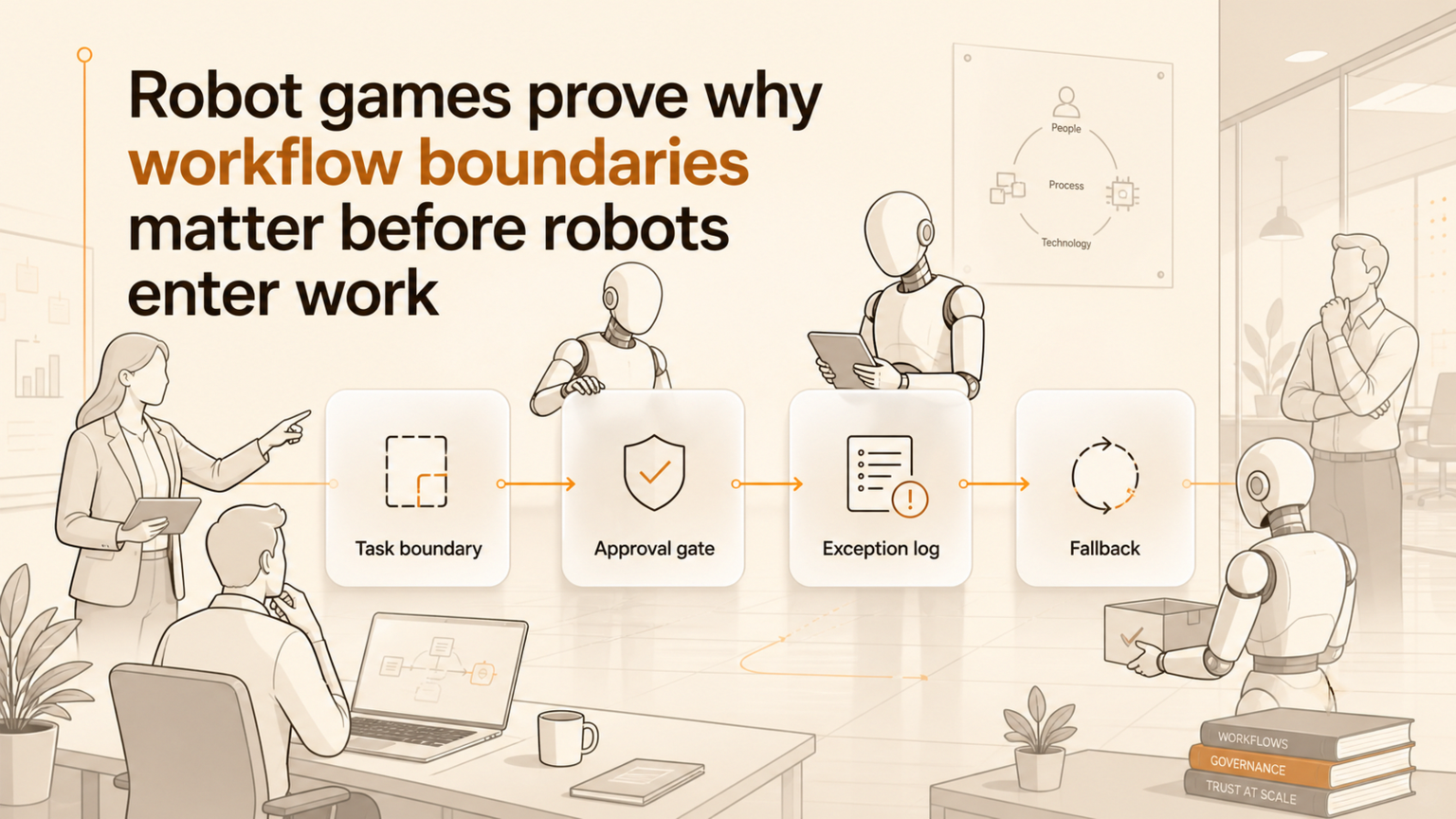
The World Humanoid Robot Games in Beijing is a useful business signal because it turns humanoid robotics into visible tasks: sprinting, soccer, boxing, balance, recovery, and coordination. The lesson for SMEs is not that robots are ready to take over normal operations. The lesson is that every visible action needs a boundary. A robot can be impressive in a lane, on a field, or inside a controlled demo and still be risky in a warehouse, showroom, clinic, school, hotel, or back office without a workflow owner. GOFTUS would treat a humanoid robot pilot like any other automation project: define the task, define who approves the next step, define what the machine is not allowed to do, and keep a log that a manager can review.
What this means for SMEs
For business leaders, the games make robotics easier to understand because the tasks are concrete. A sprint has a start line, a finish line, and a time. Soccer has a field boundary, a ball, a rule set, and a referee. Boxing has a ring and a pause condition. Those same ideas apply to business automation. A robot that moves boxes needs a route boundary, a weight limit, a near-miss rule, and a handoff to a person when the aisle is blocked. A robot that greets visitors needs a privacy rule, a handoff to reception, and a clear pause point before it handles sensitive information. A robot that assists maintenance needs evidence capture, supervisor approval, and a rollback path. Without those rules, the hardware becomes a novelty rather than an operating asset. The games should push SMEs to ask better pilot questions: what is the safe lane, what is the review gate, what happens when the robot falls behind, and how does the team measure whether the task is actually better than before?
Operations lens
A practical pilot starts before procurement. First, write the job in business language, for example inspect the front aisle every hour, move sealed cartons from shelf A to staging zone B, or guide visitors from reception to meeting rooms. Second, list the allowed actions and the forbidden actions. Third, choose the human who owns exceptions. Fourth, create a visible log with task start, task outcome, interruption, human override, and follow-up. Fifth, keep a manual fallback, so staff can keep serving customers when the robot cannot act. This is where robotics and software automation meet. The robot may be the body, but the workflow is the control system. GOFTUS builds that control layer around approvals, status updates, CRM or support handoffs, document evidence, and reporting. The goal is not to make humans watch every movement forever. The goal is to let people approve the moments that matter while ordinary, low-risk steps become measurable and repeatable.
Competitor lens
Robotics vendors, SaaS dashboards, and consultants can all be useful in a pilot. A vendor may provide the robot and the device software. A dashboard may show battery, route, uptime, or event status. A consultant may help compare options. The missing layer is often workflow ownership. Somebody still has to decide which task is ready, where the robot can act, who reviews exceptions, how the customer experience is protected, and when the pilot should pause. GOFTUS positions the robotics conversation around that operating layer. A company does not need to wait for perfect humanoids to build it. The same approval gates, logs, and fallback paths can improve AI agents, browser automation, CRM follow-up, document handling, and reporting today. When robots improve, the business already has the discipline to absorb them.
Summery for SMEs
Treat the humanoid robot Olympics as a readiness mirror. It shows how much progress is happening, but also why work needs lanes, review gates, pause rules, and measurement. The winning SME move is to design the operating workflow before the hardware arrives. That discipline turns a public robotics spectacle into a practical checklist for safer automation investment.
FAQ
Is the World Humanoid Robot Games proof that humanoid robots are ready for normal workplaces?
No. The event is useful because it exposes speed, balance, coordination, handoff, and failure recovery in public. It does not prove that a robot can run a warehouse shift, handle customer property, or make unsupervised choices inside a business. SMEs should read it as a test signal, then define narrower pilots with human review, logs, pause rules, and fallback paths.
Where should an SME start if humanoid robots enter its sector?
Start with the workflow, not the robot. Map one repetitive task, the data needed, the physical boundary, the human approval point, and the exception path. GOFTUS can help convert that map into controlled automation, reporting, and review systems before a company buys hardware.
Source notes
Google News RSS was used because several direct article pages were blocked or paywalled during this unattended run. The source set included AP News, CBS News, Reuters, Al Jazeera, DW, The Economic Times, Gizmodo, The Indian Express, and regional photo syndication results surfaced by Google News RSS. The retrieved headlines described the 2026 Beijing World Humanoid Robot Games, robot sprint events, soccer, records, crashes or reliability questions, and China strategy framing. Reddit RSS search for the exact topic returned malformed XML during this run, so the article uses the news signal rather than claiming direct Reddit discussion evidence. These notes support the article as a business signal, not as proof of workplace deployment. Source ledger saved in /root/goftus/content-intel/humanoid_robot_olympics_cron_2026-08-25/source_retrieval.json.