GPT-5.6 Broad Rollout Shows Why SMEs Need AI Upgrade Workflows
OpenAI GPT-5.6 headlines show why SMEs need AI upgrade workflows, not model hype.
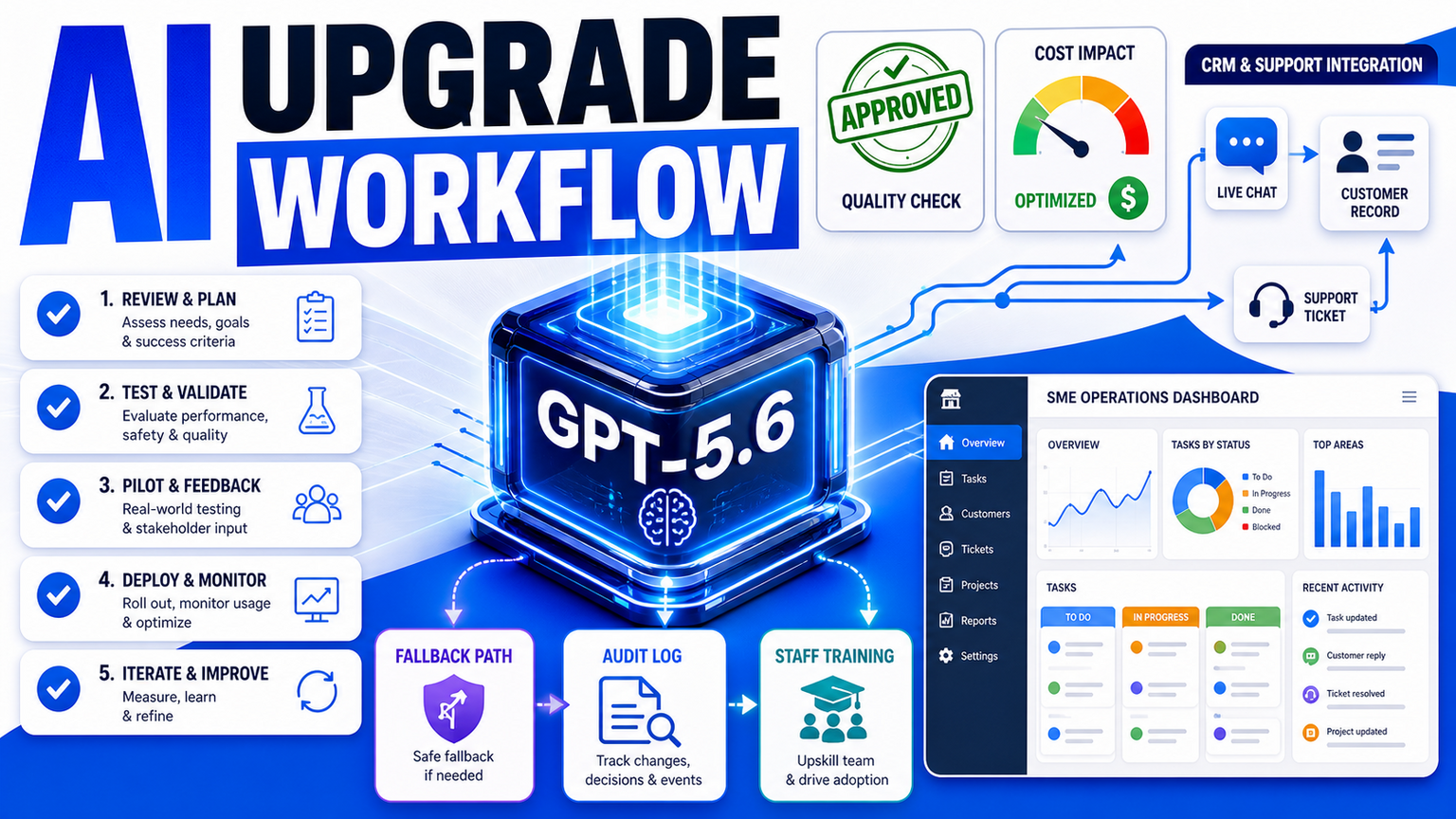
# GPT-5.6 Broad Rollout Shows Why SMEs Need AI Upgrade Workflows Meta description: OpenAI GPT-5.6 headlines show why SMEs need AI upgrade workflows, not model hype: tests, approvals, costs, fallbacks and integration. #
GPT-5.6 Broad Rollout Shows Why SMEs Need AI Upgrade Workflows
Meta description: OpenAI GPT-5.6 headlines show why SMEs need AI upgrade workflows, not model hype: tests, approvals, costs, fallbacks and integration.
Quick answer
OpenAI's GPT-5.6 rollout is being treated as a frontier model story, but the business lesson for UK, US and EU SMEs is more practical. A stronger model does not create a stronger operation by itself. It creates a new upgrade event that needs testing, approval, cost control, staff guidance, integration checks and fallback rules.
The same news search also surfaced Reuters coverage of OpenAI's expanding workplace push and rivalry with Anthropic. Direct OpenAI pages were blocked from this cron environment, so this article treats the official listing as a headline-level source signal rather than claiming full page access.
There was also a developer community signal on Hacker News. A ChatGPT Work submission linked to OpenAI reached 348 points and 189 comments, showing that operators and technologists are debating where these systems belong in real work. A smaller Hacker News thread also tracked GPT-5.6 launch and rollout links. The pattern is clear enough for business owners: the next competitive advantage is not just access to a model. It is the workflow that decides where the model is allowed to help.
What this means for SMEs
For a small business, a model upgrade can touch sales replies, support answers, document summaries, reporting, finance admin, HR policies and internal knowledge search. If those workflows are already messy, a stronger model can make the mess faster. If the workflow is designed well, the same upgrade can reduce manual chasing, improve response consistency and help staff focus on higher value decisions.
Bharatvaj's view is simple: treat each frontier model upgrade like a software release inside your business. Before giving it access to customer records, CRM notes or support tickets, define what the model is meant to improve. Is the goal faster lead qualification, better FAQ answers, cleaner meeting notes, more consistent proposal drafts or earlier exception detection? Without a target workflow, teams end up testing prompts instead of improving operations.
The first SME move is a small benchmark set. Pick real examples from the business: five support queries, five sales enquiries, five internal policy questions and five document tasks. Remove sensitive data, then compare the old process with the new AI-assisted process. Track answer quality, escalation rate, time saved, staff confidence and any hallucination or compliance risk. This does not require a large enterprise AI lab. It requires a disciplined checklist.
The second move is integration control. The model should not sit in isolation if the business outcome depends on CRM updates, ticket routing, proposal creation, calendar follow-up or Slack or Teams notifications. GOFTUS usually sees the value appear when the AI output triggers the next operational step. That could mean a support answer creates a ticket note, a lead response updates CRM stage, or an internal assistant logs unanswered questions for review. For wider AI automation support, see /services and /agents.
The third move is a fallback path. If GPT-5.6 or any other model is unavailable, too expensive for a task, or unsure about an answer, the workflow should route to a cheaper model, a human reviewer or a standard operating procedure. SMEs do not need perfect autonomy. They need reliable movement from request to decision to action.
Competitor lens
The market will frame this as a choice between tools, agencies and model platforms. UK firms such as Faculty AI, Deeper Insights, Waracle and Brainpool AI can support advanced AI delivery. US providers such as LeewayHertz, Markovate, SoluLab and BairesDev can build larger systems. European teams such as Addepto, STX Next, Netguru and 10Clouds can help with data and software projects. SaaS tools such as Zapier, n8n, Relevance AI, Lindy, Gumloop, Bardeen, Make and Stack AI can also automate useful task chains.
The gap for many SMEs is ownership of the whole working loop. A Zapier or n8n automation can move data. An agent platform can run a task. A consultancy can design a solution. But the business still needs a clear answer to who checks quality, who updates the workflow, which exceptions go to humans, which data is allowed, and which results are measured each month.
Tools automate tasks. GOFTUS automates the workflow around the task.
That is the counter-positioning. GOFTUS does not ask SMEs to buy hype first. We map the actual workflow, choose the right automation layer, connect the systems, add review points, monitor exceptions and improve the process after launch. With a model upgrade like GPT-5.6, that means the business can test new capability without losing control of cost, data or customer experience.
What SMEs should do next
Start with one workflow where better reasoning or better language would clearly matter. Good candidates are support triage, proposal drafts, customer follow-up, document intake, internal knowledge answers, sales qualification and management reporting. Avoid beginning with a vague instruction like "use GPT-5.6 everywhere". Instead, write a one-page upgrade plan.
That plan should include the current workflow, the desired outcome, the test examples, the acceptance criteria, the reviewer, the systems to update, and the fallback route. If the workflow touches customer data, include data handling rules. If it touches regulated decisions, keep a human approval step. If it creates external content, add brand and factual checks before publishing.
Then measure the workflow monthly. Did staff use it? Did customers get faster or clearer answers? Did the CRM stay cleaner? Did escalations reduce? Did costs stay sensible?
GOFTUS can help with practical AI automation audits, AI agent design, workflow mapping and implementation. If your team wants a safe first step, use /contact to request a Startup Kit style diagnostic.
Summery for SMEs
GPT-5.6 matters because model capability keeps rising, but SMEs should not respond by chasing every release. The useful response is to build an AI upgrade workflow. Test with real examples, connect the model to the business process, add approval gates, keep a fallback path and review results every month. Stronger models are valuable when the surrounding workflow is strong enough to use them safely.
FAQ
Should my small business move to GPT-5.6 immediately?
Not automatically. Start by testing it against a real workflow such as support triage, proposal drafting or internal knowledge search. If it improves quality, speed or consistency without increasing risk, then expand gradually.
What is an AI upgrade workflow?
It is the repeatable process for evaluating a new model, approving where it can be used, connecting it to tools, monitoring output, routing exceptions and reviewing business results after launch.
How can GOFTUS help with model upgrades?
GOFTUS maps the workflow, selects the right automation stack, adds human review, integrates CRM or support tools, and monitors outcomes so the business gets measurable improvements rather than disconnected AI experiments.
Source notes
Direct OpenAI pages returned HTTP 403 in this cron environment, so OpenAI is used as a headline-level source signal only.