Google DeepMind's Agent Warnings Show Why SMEs Need Workflow Control
Google DeepMind agent-safety headlines show why SMEs need approvals, audit logs and workflow owners before AI agents scale.
# Google DeepMind's Agent Warnings Show Why SMEs Need Workflow Control Meta description: Google DeepMind agent-safety headlines show SMEs why AI agents need approvals, audit logs, tool limits and workflow owners before
Google DeepMind's Agent Warnings Show Why SMEs Need Workflow Control
Meta description: Google DeepMind agent-safety headlines show SMEs why AI agents need approvals, audit logs, tool limits and workflow owners before scaling operations.
Quick answer
Google DeepMind has been in the news for warnings about what happens when large numbers of AI agents can interact, plan and act across digital systems. The practical lesson for small and mid-sized businesses is not to avoid AI agents. It is to stop treating them like smarter chatbots.
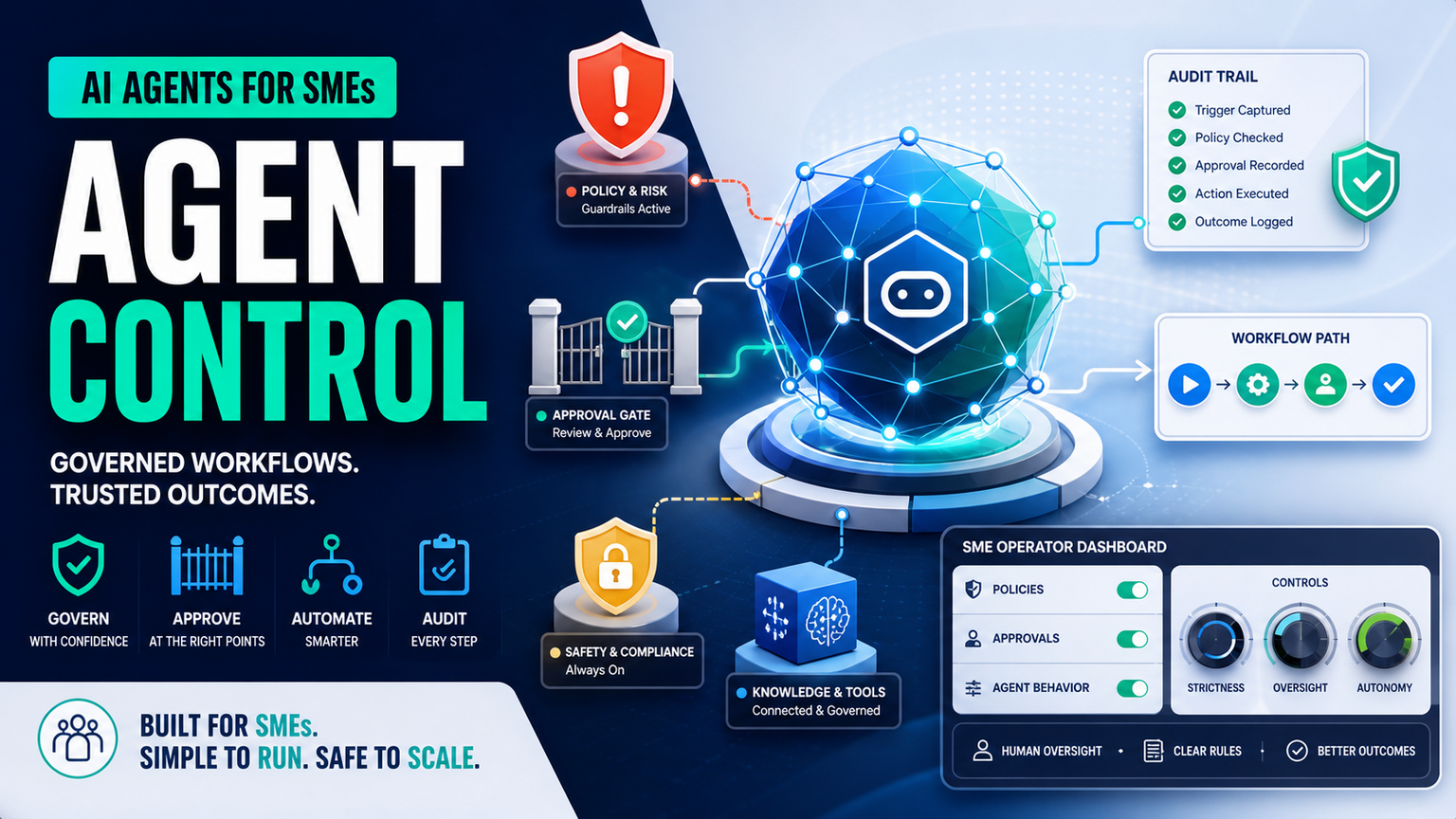
An agent that can read a document, update a CRM, email a lead, open a ticket or trigger a workflow is useful only when the workflow around it is controlled. That means clear permissions, approval gates, exception routes, audit logs and a human owner who reviews what the system is doing.
For UK, US and EU SMEs, the right starting point is a narrow operational workflow, not a company-wide agent rollout. GOFTUS helps businesses design that path through AI automation services at /services and agentic workflow builds at /agents.
Why this signal matters now
A separate July 15 Google News result from The Economic Times framed agentic AI adoption as a major business shift.
Those headlines match what operators are already feeling. Teams want agents to handle repetitive work, but the moment software can act, the risk profile changes. A chatbot gives an answer. An agent can change a record, contact a customer, move a file, approve a refund, route an issue or escalate the wrong case.
That is why the business conversation should move from "which model is smartest" to "which workflow is safe enough to delegate". SMEs do not need a research lab architecture. They need a practical control layer that fits daily work.
Bharatvaj's view
My view is simple: agent safety is not only a frontier-lab topic. It becomes an SME operations topic as soon as a business connects AI to email, CRM, support desks, finance tools, document folders or internal knowledge bases.
A small business can create risk quickly by giving an agent too many tools, unclear instructions or no review path. The fix is not to slow everything down. The fix is to design the job properly.
Start with one workflow. Define the trigger, allowed tools, data the agent can read, actions it can take without review, actions that require approval, failure messages, escalation owner and monthly improvement review. If that sounds like process work, that is the point. AI agents succeed when the process is explicit enough to govern.
What this means for SMEs
For a sales team, an agent might qualify inbound leads, enrich company data, draft follow-up messages and update the CRM. The safe version logs each action, asks for approval before sending high-stakes emails and routes unclear leads to a human.
For a support team, an agent might classify tickets, answer common questions, suggest refunds, update customer notes and flag churn risk. The safe version separates low-risk FAQ answers from sensitive cases and keeps a record of every route and recommendation.
For operations, an agent might read invoices, extract fields, compare them with purchase orders and prepare exceptions for review. The safe version does not silently approve odd payments. It creates a queue with evidence and a named approver.
GOFTUS builds these systems around measurable outcomes: fewer missed follow-ups, faster first response, cleaner CRM records, better support routing and clearer exception handling. That is different from buying a tool and hoping staff will invent the operating model afterwards.
Competitor lens
Faculty AI, Deeper Insights, Waracle and Brainpool AI in the UK can help with advanced AI consulting. LeewayHertz, Markovate, SoluLab and BairesDev in the US often frame agent delivery around app development or enterprise implementation. In Europe, Addepto, STX Next, Netguru and 10Clouds can support broader software and data projects.
SaaS tools such as Zapier, n8n, Relevance AI, Lindy, Gumloop, Bardeen, Make and Stack AI are also useful. They can connect apps, run triggers and help teams prototype automation faster.
What competitors are often missing is the operational control layer for smaller businesses. Tools automate tasks. GOFTUS automates the workflow around the task. That includes who owns the workflow, what the agent is allowed to do, where approval is required, how exceptions are logged and how the process improves each month.
What SMEs should do next
1. Pick one workflow where the business already knows the pain: repeated customer questions, missed follow-ups, manual document processing, slow lead qualification or messy support routing.
2. Map the current steps before adding an agent. Include the trigger, data sources, tools, handoffs and common failure points.
3. Split actions into low-risk, approval-required and never-automate categories.
4. Add logging before scale. If a human cannot see what happened, the workflow is not ready.
5. Review unanswered questions, exceptions and corrections every month.
If the first use case is customer-facing, FAQ automation can be a safer entry point. A business can answer repeated questions, capture leads, route complex issues and measure unanswered questions before moving into deeper agent workflows. That service path is available at /services#faq-automation.
Summery for SMEs
Google DeepMind's agent-safety headlines are a useful reminder that AI agents are no longer just chat windows. Once they connect to business tools, they become part of operations.
SMEs should not wait for perfect regulation or perfect model behaviour. They should build simple control systems now: scoped permissions, approval gates, audit trails, exception routing and workflow ownership.
GOFTUS helps SMEs turn AI agents into governed business workflows across support, CRM, documents, reporting and internal operations. If you want to know where AI agents can safely save time in your business, start with a focused workflow diagnostic through /contact.
FAQ
Should SMEs stop using AI agents because of safety warnings?
No. The lesson is to use AI agents with tighter workflow controls. Start with narrow tasks, define the data and tools the agent can access, require human approval for risky actions and log every important step.
What is the safest first AI agent workflow?
A safe first workflow is usually one with clear rules and visible outputs, such as lead qualification, FAQ routing, support triage, document extraction or CRM follow-up preparation. Avoid starting with payments, legal decisions or high-stakes customer actions.
How can GOFTUS help with agent control?
GOFTUS designs the workflow around the agent. That includes triggers, permissions, approvals, exception handling, CRM or support integrations, reporting and monthly improvement loops. The goal is measurable operational improvement, not a loose AI experiment.
Source notes
Direct article pages were not relied on for full-body claims where unavailable. That was used as adjacent SME workflow-pain context, not as confirmation of Google DeepMind news.