What the Egypt vs Argentina FIFA Dispute Teaches About AI, VAR and Trustworthy Sports Software
Egypt’s complaint after its World Cup loss to Argentina shows that technology alone does not create trust. AI and software can reduce future disputes only when evidence, protocols and communication are designed together.
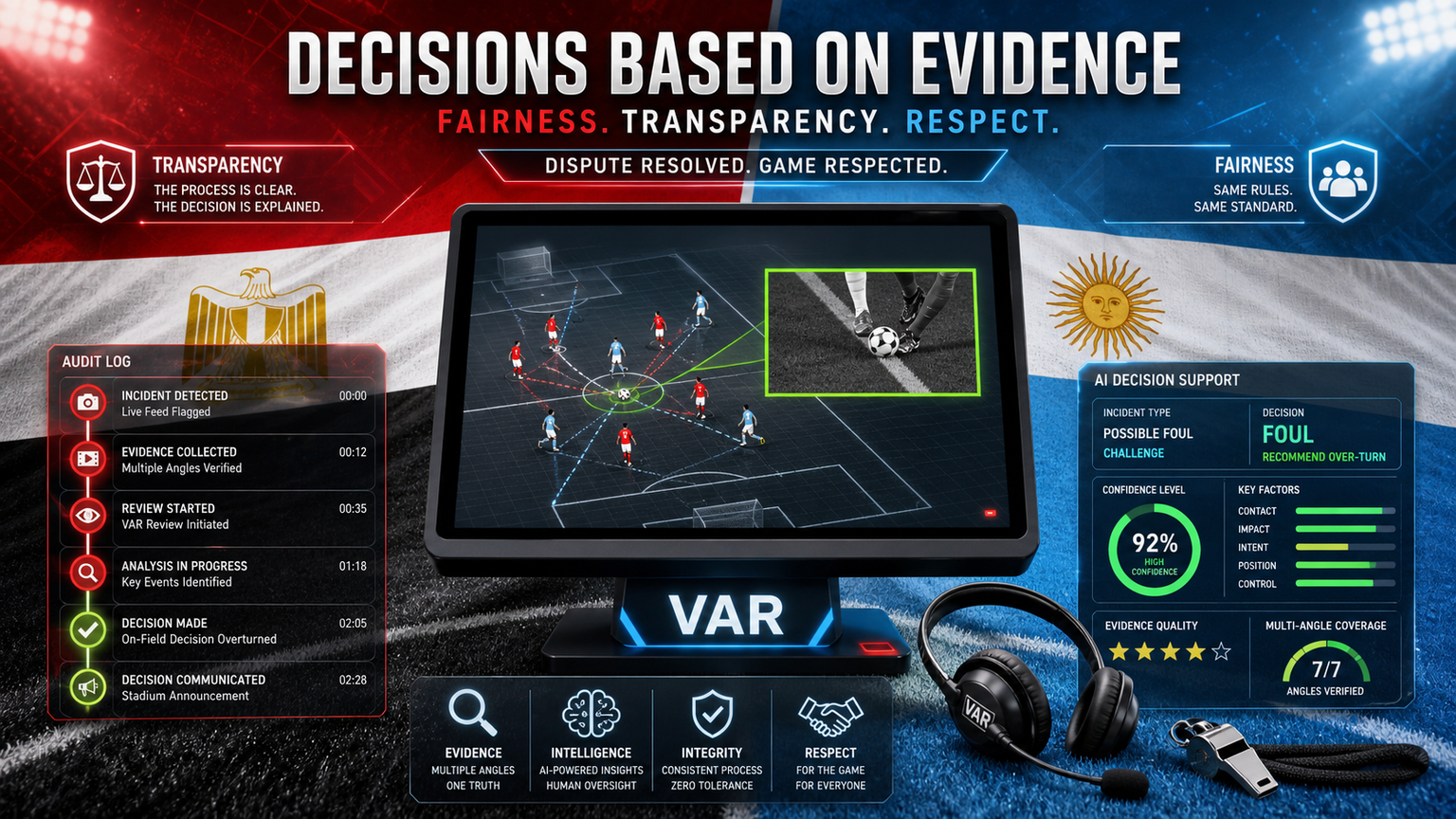
# What the Egypt vs Argentina FIFA Dispute Teaches About AI, VAR and Trustworthy Sports Software A football dispute is rarely just about one whistle. It is usually about timing, context, communication, and whether suppo
What the Egypt vs Argentina FIFA Dispute Teaches About AI, VAR and Trustworthy Sports Software
A football dispute is rarely just about one whistle. It is usually about timing, context, communication, and whether supporters believe the decision process was fair.
That is why the controversy around Egypt’s World Cup loss to Argentina matters beyond sport. Multiple news listings reported that Egypt complained to FIFA about officiating and VAR decisions after Argentina’s win. Other coverage framed the incident around allegations of bias, social media claims that the match was “rigged,” questions about referee assignments, and FIFA’s defence of the officiating process.
The important business lesson is simple: adding software to a high-stakes process does not automatically create trust. If people cannot see how the system reached a decision, who reviewed it, what evidence was used, and how appeals are handled, technology can become part of the dispute instead of the solution.
What appears to have happened
The public reporting around the Egypt vs Argentina controversy points to four connected issues:
1. Egypt’s federation objected to the officiating after the match.
2. VAR decisions became the focus of criticism.
3. Fans and commentators amplified claims of unfairness online.
4. FIFA faced pressure to explain the process, not only the final score.
Whether every complaint is valid or not, the situation shows a governance gap. Football has cameras, VAR rooms, communication channels, and match officials. But supporters still often receive the final decision without a clear evidence trail they can understand.
That is exactly the type of trust gap AI and workflow software are designed to reduce.
The real problem is not “AI replacing referees”
The wrong solution would be to say AI should make every decision automatically. Football is too contextual for that. A foul, offside, handball or penalty incident often depends on timing, intent, angle, body movement, and the referee’s interpretation of the laws.
The better solution is AI-assisted decision governance.
That means software should help officials collect evidence, enforce protocols, explain decisions, and create a reviewable record. Humans still make the call. The system makes the process cleaner, faster, and more transparent.
1. AI can create a decision evidence timeline
Every disputed moment should have a structured timeline:
match time and event type
referee’s original call
VAR check start and end time
camera angles reviewed
rule category involved
final decision
referee explanation
escalation status if a complaint is filed
AI can automatically assemble this timeline from match feeds, referee audio markers, VAR timestamps, broadcast angles, and official event data.
This does not decide the match. It creates a clean record so the federation, FIFA and the public are not arguing from scattered clips and social posts.
2. Computer vision can flag incidents for review, not decide them alone
Modern computer vision can detect patterns such as player position, ball contact, offside lines, possible handball proximity, and collision timing. But the output should be treated as a confidence signal, not a verdict.
A safer model would be:
AI detects a possible review incident.
The system ranks available camera angles.
VAR officials review the most relevant clips.
The referee receives structured evidence.
The final human decision is logged with the rule reference.
This gives officials better tools without pretending that sport can be reduced to a simple algorithm.
3. Protocol-checking software can prevent inconsistent VAR usage
Many disputes become bigger because fans do not know whether VAR was used consistently. Did similar incidents receive the same review time? Was the correct protocol followed? Was the referee advised to visit the monitor? Was the check completed before play restarted?
Software can monitor the protocol in real time:
required checks completed
minimum evidence reviewed
referee communication logged
review delay measured
rule category recorded
final explanation generated for the match report
If a step is missed, the system can alert the fourth official or match supervisor before the controversy grows.
4. AI can produce public-facing decision cards
One major reason sports disputes go viral is silence. A fan sees a decision, feels confused, then the internet fills the gap with theories.
FIFA, leagues and federations could publish simple decision cards after major VAR incidents:
incident: penalty review, offside check, red-card check
original call: goal, no penalty, foul, no foul
review result: confirmed, overturned, no clear error
evidence used: camera angles, semi-automated offside line, referee monitor review
rule reference: short plain-English explanation
AI can draft these cards instantly from structured match data, while a human communications lead approves the final wording.
This is not only a sports idea. Any business that uses AI in customer support, finance, operations or HR needs the same thing: explainable decision records.
5. Referee assignment software can reduce perceived conflicts
Some disputes are about decisions. Others are about trust in the people making decisions.
Sports bodies could use assignment software to track:
previous matches involving the same teams
referee nationality and federation links
historic complaint patterns
travel fatigue and scheduling load
language coverage for communication
prior high-pressure match history
The goal is not to accuse officials. The goal is to prevent avoidable perception risks before kickoff. When trust is fragile, governance should be proactive.
6. A formal dispute workflow should replace ad hoc complaints
When a federation complains, the process should not feel like a black box. A dispute workflow can give every party a structured path:
1. Federation submits incident references.
2. FIFA uploads the official evidence package.
3. Independent reviewers classify each incident.
4. AI checks for similar historical decisions.
5. A final report is issued with rule references and evidence notes.
6. Lessons are fed back into referee training.
This turns a public argument into an auditable process.
7. Misinformation monitoring matters after the match
The Egypt vs Argentina story also shows how quickly a refereeing controversy can become a wider online narrative. Claims of bias, rigging and political meaning can spread faster than official clarification.
AI can help governing bodies monitor the narrative without censoring fans:
detect viral misinformation themes
identify which decision is causing confusion
publish clarifying evidence cards
route serious abuse or threats to safety teams
measure whether official explanations are reaching supporters
For brands and institutions, this is reputation operations. For sports bodies, it is match integrity communication.
A practical software architecture for future tournaments
A robust sports decision system would include:
Match event data layer for all official incidents.
Video evidence layer with camera angle indexing.
VAR workflow layer with timestamps and protocol status.
AI assistance layer for detection, summarisation and similarity search.
Human approval layer for referee decisions and public communication.
Dispute resolution layer for federations and governing bodies.
Public transparency layer for decision cards and post-match reports.
The key is integration. If these systems are disconnected, people will still argue from screenshots, TV angles and social posts.
What businesses can learn from FIFA’s problem
The same lesson applies outside football.
A customer support chatbot can create disputes if it gives an unexplained refund decision. A sales automation system can damage trust if it contacts the wrong person. A finance AI agent can create risk if invoice approvals are not logged. A HR workflow can become sensitive if candidates cannot understand why an automated screening step happened.
AI is useful only when the workflow around it is trustworthy.
That means every AI system needs:
clear human ownership
approval gates for sensitive decisions
evidence logs
exception queues
simple explanations
audit trails
post-incident improvement loops
How GOFTUS would approach this kind of system
For a sports body, governing organisation or enterprise team, GOFTUS would not begin by “adding AI.” We would begin by mapping the dispute points:
Where does confusion start?
Which decisions need a human in the loop?
What evidence must be captured?
What needs to be explained publicly?
What should be reviewed after the incident?
Then we would design the workflow, build the integrations, add AI where it improves speed or clarity, and keep humans responsible for the decisions that require judgement.
That is the difference between using AI as a gimmick and using AI as operational infrastructure.
Final takeaway
The Egypt vs Argentina dispute is not just a football story. It is a reminder that high-stakes systems need more than technology. They need visible process, clear evidence, consistent protocols, and fast communication.
AI and software can help prevent future controversies, but only if they are designed to support fairness, not hide behind automation.
Source notes
This article was drafted from headline-level and RSS-accessible reporting found through Google News for the Egypt vs Argentina FIFA controversy, including listings from NPR, Reuters, USA Today, France 24, Al Jazeera, Yahoo Sports and other outlets. Direct access to some original article pages was blocked or unavailable during collection, so disputed factual claims are framed cautiously around the public reporting theme: Egypt objected to officiating and VAR decisions after Argentina’s win, FIFA faced questions about transparency, and online claims amplified the controversy.