FAQ automation for SMEs: turn website questions into sales and support follow-up
FAQ automation helps SMEs answer repeated website questions, capture leads, route support issues, and trigger sales follow-up before interest goes cold.
# FAQ automation for SMEs: turn website questions into sales and support follow-up Meta description: FAQ automation helps SMEs answer repeated website questions, capture leads, route support issues, and trigger sales fo
FAQ automation for SMEs: turn website questions into sales and support follow-up
Meta description: FAQ automation helps SMEs answer repeated website questions, capture leads, route support issues, and trigger sales follow-up before interest goes cold.
Quick answer
FAQ automation is not just a better help page. For a small or mid-sized business, FAQ automation should answer repeated website questions, capture buyer intent, route complex issues, and create a clear follow-up task for sales or support. The daily SEO signal for GOFTUS shows the exact query "faq automation" needs one focused article today, and the wider source context points the same way: customer-service automation tools are being compared heavily, while operators still worry about trust, handoffs, and what happens after the first answer.
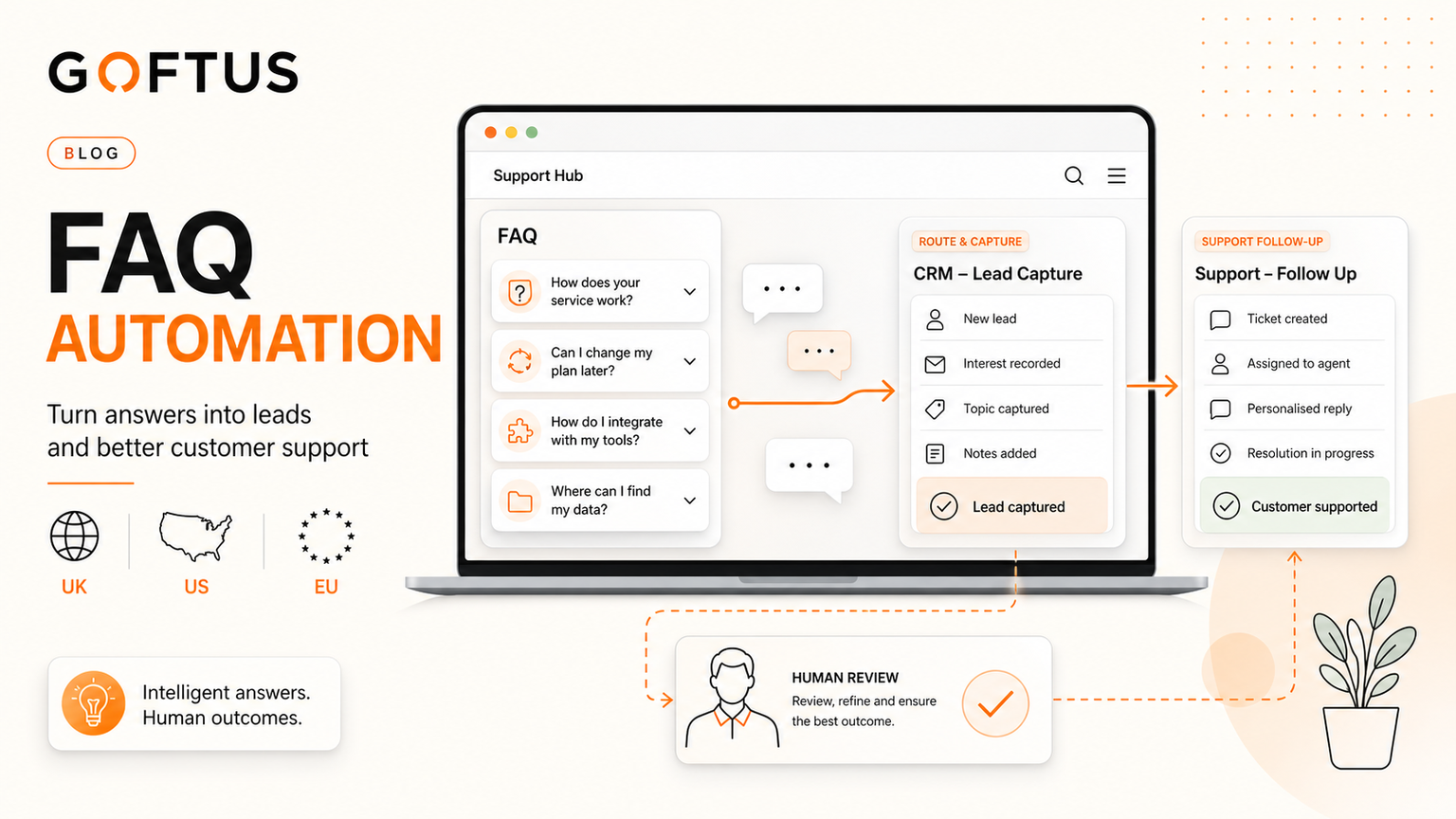
The practical answer is simple: use AI FAQ automation as the first customer-answer layer, then connect it to CRM, support, and human review. GOFTUS builds this as an FAQ automation service so repeated questions become workflow inputs, not forgotten chat bubbles.
What this means for SMEs
Most SMEs do not lose customers because they cannot write an FAQ page. They lose customers because website questions arrive in messy ways. A prospect asks about pricing fit, implementation time, integrations, onboarding, warranty, support, or delivery. The answer might exist somewhere, but it is split between a website page, a sales deck, a staff member's memory, an inbox, and a CRM note that never gets updated.
That is where FAQ automation becomes a workflow problem rather than a content problem. The goal is not to publish a giant list of answers and hope people read it. The goal is to detect the question, answer safely from approved knowledge, capture the reason the person asked, and decide what should happen next.
For a service business, that next step may be a qualified consultation request. For an ecommerce or logistics business, it may be a support ticket with the right category. For a B2B SaaS team, it may be a CRM task, a trial follow-up, or an implementation note. For a regulated or high-trust business, it may be a human review before anything sensitive is sent.
Bharatvaj's view: the best FAQ automation project starts with the boring questions that staff answer every week. Those questions are not low-value. They reveal buying intent, onboarding friction, support risk, and missing product clarity. If you only answer them on the page, you reduce a little friction. If you route them into the right workflow, you improve follow-up, reporting, and customer trust.
Build the first customer-answer layer
A useful FAQ automation system has four lanes.
First, it needs an approved answer base. That can include service pages, product snapshots, onboarding notes, policy documents, support scripts, and sales qualification rules. The important point is that the AI should not improvise beyond what the business has approved.
Second, it needs intent capture. If someone asks "Can you integrate with our CRM?" the useful record is not only the answer. The useful record is that a CRM integration question appeared, from a specific page or form, with a possible buying signal attached.
Third, it needs routing. Simple answers can stay on the website. Unanswered questions, high-intent questions, complaints, and integration requests should route to the right owner. That might be sales, support, operations, or a named manager.
Fourth, it needs review and reporting. Teams should know which questions are answered, which ones are unclear, which answers need improvement, and which question categories lead to demos or support load. This is where FAQ automation becomes a measurable system instead of a chatbot experiment.
GOFTUS usually recommends starting with a narrow workflow: ten repeated questions, one service path, one CRM or support handoff, and one weekly improvement loop. That prevents the business from buying another tool that nobody owns after launch.
Competitor lens
There are useful options in the market. SaaS tools such as Zapier, n8n, Make, Lindy, Gumloop, Bardeen, Stack AI, and Relevance AI can connect apps and trigger automations. Larger consultancies and agencies in the UK, US, and Europe, including Faculty AI, Deeper Insights, Waracle, Brainpool AI, LeewayHertz, Markovate, SoluLab, BairesDev, Addepto, STX Next, Netguru, and 10Clouds, can support wider AI delivery.
The gap for SMEs is ownership of the workflow around the answer. A tool can show a response. A connector can move data from one app to another. A consultant can design a wider AI roadmap. But the business still needs answer approval, routing rules, CRM fields, support categories, escalation boundaries, logs, and a review rhythm.
Tools automate tasks. GOFTUS automates the workflow around the task. That is the difference between an FAQ chatbot that answers a few questions and an FAQ automation system that creates better follow-up.
What SMEs should do next
Start by collecting the questions your team already answers manually. Pull them from email, website forms, chat history, sales calls, support tickets, and staff notes. Group them into buying questions, support questions, operational questions, and risky questions that need human review.
Then decide what each group should do. A buying question should answer clearly and invite a next step. A support question should either solve the issue or create a support ticket. A complex question should be routed to a human with context. An unanswered question should become a content-improvement item, not a dead end.
Next, connect the system to the place your team already works. That may be HubSpot, Airtable, a spreadsheet, a support tool, Slack, Teams, Notion, Google Workspace, or a custom admin panel. The right stack matters less than the handoff. If the answer is good but nobody owns the follow-up, the automation is incomplete.
Finally, measure the right things. Do not only count chats answered. Track unanswered questions, lead questions, repeated objections, support categories, follow-up speed, and which questions turn into consultations or tickets. These are the signals that help an SME improve offers, pages, onboarding, and operations.
GOFTUS can help scope this through the FAQ automation service or the £100 Startup Kit diagnostic when a team wants a quick workflow map before building.
Summery for SMEs
FAQ automation should not be treated as a decorative chatbot. It is the first customer-answer layer for the business. Done well, it answers repeated questions, captures intent, routes complex issues, updates CRM or support tools, and shows owners what needs improvement.
The safest version is narrow and measurable. Start with approved answers, define routing rules, keep humans in the loop for sensitive cases, and review unanswered questions every week. That turns a website FAQ into a sales and support workflow.
FAQ
Is FAQ automation the same as a chatbot?
No. A chatbot is an interface. FAQ automation is the workflow behind it: approved answers, intent capture, routing, CRM or support handoff, reporting, and human review where needed.
What should an SME automate first?
Start with repeated buying and support questions that staff already answer manually. Prioritise questions that affect demos, quotes, onboarding, delivery, integrations, and customer trust.
Where should this link inside GOFTUS?
The most relevant internal path is GOFTUS FAQ automation, because the service is designed around automated customer answers, lead capture, routing, and follow-up.
Source notes
Primary SEO input: GOFTUS daily SEO FAQ run for 2026-08-20 listed "faq automation" as the required daily cluster and also surfaced high-score Trends topics such as ai tools and ChatGPT.
News cross-check: Google News RSS for "faq automation customer support" and "AI FAQ automation small business" listed customer-service automation and AI tools resources from Salesforce, G2, Sprout Social, Coursera, Hostinger, and related publications. These are used as market context, not as scraped article claims.
Social signal: the latest GOFTUS Reddit intelligence included r/SaaS trust discussions and r/n8n automation-tool evaluation as operator sentiment. Reddit is treated as social heat only, not verified fact.